The G20 Presidency Presents an Opportunity for the United States. Will Trump Take It?

The Trump administration’s national security strategy calls for US dominance. But in embracing a G20 agenda of multilateralism, the United States could affirm its role as a world leader—and elevate its ability to set the terms.
Today, the United States released its long-awaited national security strategy. The 33-page document downplays threats from China and Russia, calls for deterrence in the Indo-Pacific, and suggests the most important goal for the United States is to confirm American dominance in the Western Hemisphere. The Trump administration’s attack on Europe and specifically the European Union is severe. It calls for "cultivating resistance" in Europe, which it says faces "civilizational erasure."
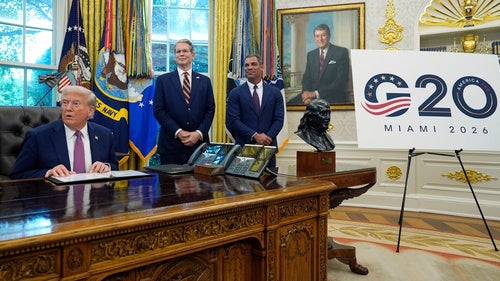
The strategy, which US President Donald Trump refers to in an introductory note as “a roadmap to ensure that America remains the greatest and most successful nation,” comes on the eve of what could prove to be an extraordinary year for US leadership. The United States took the helm of the Group of Twenty (G20) earlier this week and will celebrate its 250th anniversary in July. While the strategy presented is rooted in Trump’s “America First” doctrine, it is not too late for the United States to pivot away from an approach grounded on a logic of sphere of influence—one that is bound to fail—and pivot to using the year ahead to lead with ambition, shaping an agenda favorable to US interests while bringing others along.
After four years of ambitious agendas and relative cohesiveness, experts expect to see a marked narrowing both of the G20 agenda and of the range of stakeholders that are engaged throughout the year under Trump’s leadership. The handoff of the presidency by South Africa to the United States was overshadowed by Trump’s announcement that he would not invite South Africa, which hosted the Leaders’ Summit in Johannesburg at the end of November, to the US gathering. In a statement titled “America Welcomes a New G20,” US Secretary of State Marco Rubio shared the United States would instead welcome European ally Poland “to assume its rightful place in the G20.”
The United States has also apparently decided not to host a Think 20 (T20), a parallel group of policy analysts that contribute to the G20 agenda throughout the year. Instead, the United States will exclusively host the G20 and the Business 20 (B20), which convenes business leaders from the G20 countries to engage in dialogue. This leaves US civil society to fill the gap. Already at least one Washington-based think tank is considering taking up the slack and convening an informal T20 in the year ahead.
Representing roughly 85 percent of global GDP, the G20’s claims are more than the economic heft of the G7 and the BRICS combined. The economic weight of the G20 means it is ideally positioned, in theory, to tackle the greatest challenges for the global economy. Even more important is the fact this plurilateral framework involves both China and the United States —the world's two great economic superpowers—and major and emerging powers from the Global West, the Global South, and the Global East, a terminology for the global architecture set out by leading international relations scholar John Ikenberry.
South Africa was the first African nation to lead the G20. Building on the agenda set by Brazil and India—which hosted the 2024 and 2023 summits, respectively—South Africa pushed forward conversations on inequality and sustainability against four years of intense geopolitical disruption and upheaval, including major wars and humanitarian catastrophes.
Despite objections from Trump, who refused to attend the gathering or send someone in his stead, the G20 produced a declaration addressing the climate crisis and migration and included a pledge to work for “just, comprehensive and lasting peace” in Ukraine, Sudan, Gaza, and the Democratic Republic of Congo. It also routinized the formal participation of the African Union, whose G20 membership was agreed to during the Indian-led G20.
In an abrupt break with the past four years of leadership, and shortly after assuming the presidency, the United States published a press release stating that Trump would “return the G20 to focusing on its core mission of driving economic growth and prosperity."
While there has been a legitimate and healthy critique of the unwieldiness of the G20, Trump’s back-to-basics approach suggests limited ambition at a time when leadership is in short supply and high demand. The G20 represents a distinct opportunity for the United States to lead. It also offers the United States the opportunity to ensure it is not left behind as others drive forward new partnerships to solve problems without the US.
It is not too late for the United States to pivot away from an approach grounded on a logic of sphere of influence—one that is bound to fail—and pivot to using the year ahead to lead with ambition, shaping an agenda favorable to US interests while bringing others along.
The G20 presidency also coincides with a significant moment in US history as the nation celebrates its 250th anniversary culminating on July 4, 2026. As president of the G20, Trump could choose to root the G20 agenda in the United States’ history of diplomacy, strategic alliances, and partnerships, and embrace a reformed multilateralism fit for purpose in the post-global-financial-crisis and post-COVID era of international relations. Doing so would provide a dual benefit for the United States, as it would confirm and reestablish its role as a global leader, elevate its ability to set the terms of debate and normative standards on critical issues of technology—especially artificial intelligence and critical minerals—and further the US effort to reduce China's economic challenge. US leadership could also be designed to give Global South countries an alternative that many seek to Chinese-defined options on a breadth of global issues.
The Trump administration would be wise to look carefully at the past four years of G20 leadership and especially to India, which held the presidency in 2023. Prime Minister Narendra Modi used the summit to draw international attention to the country and its geopolitical ambitions, but also to build domestic support and enthusiasm across the whole of India for the nation and his global leadership. The United States’ 250th and G20 leadership year offers Washington a similar opportunity to pursue this dual agenda and give popular grounding to America’s foreign policy agenda.
Trump could further use the spillover effect of the G20 to better relationships with important US allies, which could translate to more welcomed US leadership in the G7 and NATO. Rather than sequencing a strategy of cooperation first in the G7 and only later in the G20, beginning with the G20 would create a stronger platform for the United States to build legitimacy and cohesion behind its leadership. As Council Distinguished Nonresident Fellow and coiner of the BRICS acronym Lord Jim O’Neill so astutely said at a recent Council program, the “really important systematic countries, the ones that are leading the commitments,” must be involved or we will never solve the truly global issues.
While the United States plans to “return” the G20 to its economic focus, the world has changed dramatically since the forum was founded in 1999. Member nations have been right to recognize economic solutions rely on geopolitical cooperation and broaden the forum's focus. Faced with ongoing global conflicts and crisis, the United States could assert the value of the forum by focusing on what member nations can accomplish together and, in turn, affirm the United States’ role as a global leader. Multilateralism still matters, and it should be especially attractive to Americans in this upcoming year of US leadership.