The Deeper Consequences of Trump's Tariff Strategy

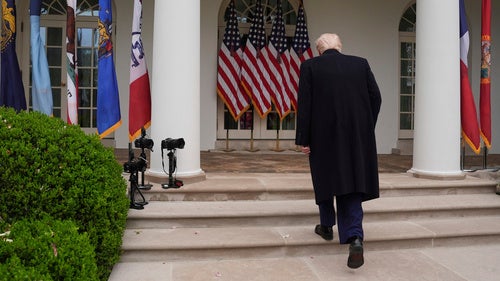
Even before the Supreme Court’s decision to overturn most of US President Donald Trump’s tariffs, historic allies had begun actively exploring economic relationships with other nations.
A few days out from the US Supreme Court’s 6-3 majority vote to overturn most of US President Donald Trump’s tariffs, the economic uncertainties linger, leaving more and more questions about the Trump administration’s economic strategy.
Predictably, Trump responded to the ruling by immediately announcing a 10 percent global tariff, and then, within 24 hours, said it would be increased to 15 percent when his team realized he could get away with such a move (albeit for only 150 days without congressional approval). Yet when the tariffs went into effect this week, it seemed as though they had been set at 10 percent and not 15 percent, leaving anyone affected even more confused.
Why the Trump administration thinks this kind of approach to trade policy can instill confidence in US businesses—never mind all those overseas—is a mystery that has added new questions to the persistent, underlying ones. Can companies claim refunds on revenues paid for imports that, in hindsight, weren’t supported by the US courts? Should the rest of the world stand by the trade “deals” they negotiated with the United States? And what about their commitments to investing in the United States as part of them?
Amid these understandable questions lies the obvious bizarre fact that the countries that appeared to negotiate better (or at least give Trump more of what his team deemed beneficial) have now ended up worse off—especially if the 15 percent tariff is ultimately implemented under the 150-day rule.
The Economic Reality
The situation the United Kingdom now finds itself in stands out as especially bizarre, especially when one remembers that the UK runs a bilateral trade deficit with the United States, making the grounds for any such tariffs extremely questionable in the first place. Meanwhile, the countries with vast bilateral surpluses—including many in Asia—that had been hit with considerably higher tariffs, are now indirectly benefiting. This of course is all further complicated by the fact that Trump’s tariff strategy is supposed to be reducing US trade and current account deficits. But of course, those who understand the very basics of international economics knew that the central tenet of this strategy was highly unlikely to succeed unless it also included a hidden agenda to boost domestic savings (and, in the process, reduce consumption) as a way of addressing the import demand.
"Recent data shows the US current account deficit is continuing to rise as a share of GDP—even though the much-watched bilateral trade deficit with China has fallen."
Recent data shows the US current account deficit is continuing to rise as a share of GDP—even though the much-watched bilateral trade deficit with China has fallen. Imports coming from China have simply reappeared as imports from other countries, which, to little surprise, have imported more from China. The predictable Trump response to this has been to try and hamper trade between those countries and China—an approach that doesn’t go down well with the independent decision-making of sovereign nations and will simply shift imports from China to the United States via other countries.
The overall balance of payments for any country is an accounting identity. Running a deficit on one side of the current account means, by definition, a surplus on the other—the net inflows of foreign capital. This applies to every nation: If you are running a capital account surplus, it equates to that nation requiring a net capital inflow to supplement its domestic savings shortfall, and vice versa. As a result, it is impossible for the United States to permanently reduce its external imbalance unless it persistently raises its domestic savings rate and reduces its dependency on foreign capital inflows. And of course, this is in polar opposition to the spirit of the Trump administration’s frequent boasting about the supposed massive investments coming from various parts of the world. If Trump is serious about reducing the trade and current account deficit, this is the last thing he should want.
The Deeper Consequence of a Rather Odd Strategy
A deeper consequence of this rather odd strategy has also unsurprisingly been sown. Many other countries, especially historic US allies, have started to realize that the United States might not be a reliable partner anymore and are thus actively exploring deeper trade relationships with other nations. Canadian Prime Minister Mark Carney and embattled UK Prime Minister Keir Starmer’s independent trips to China are evidence of this, as are the European Union’s trade deals with Latin America and India.
At the end of the day, while the United States may retain 25 percent of the world economy, 75 percent exists beyond it. If the United States chooses to insulate itself from foreign trade through blunt tariffs, other countries will most likely choose to engage elsewhere, ultimately reducing their dependency on US exports. This of course could mean that eventually the United States does reduce its imports, but it will come amid reduced wealth and perhaps reduced welfare relative to what might have been the case had it chosen a different economic approach.
As I argued in my immediate response to the suspension of Trump’s tariffs, a much smarter policy for any US administration would be one out of former US Secretary of the Treasury Timothy Geithner’s playbook, which would involve an attempt to negotiate with key trading partners to get them to commit to stronger levels of domestic demand growth and, in addition, to perhaps allow an appreciation of their currencies. Indeed, I wonder whether this may end up materializing in any case.
On a different note, the Supreme Court decision coincides with a period of notable wobbles in the artificial intelligence (AI) equity market excitement story. US economic data, including the real GDP data for the second half of 2025, make abundantly clear that there has been a major rise in domestic investment spending driven by those at the center of the AI boom, with a clear weaker trend in employment and, with this, some softening of the consumer. While this mathematically translates into stronger productivity and indeed could sustain real gains in productivity, if the new mood of the stock market persists, it is very likely that investment spending will start to slow. Such an outcome would make the Trump administration’s underlying lack of a cohesive economic strategy even more apparent.
The Chicago Council on Global Affairs is an independent, nonpartisan organization and does not take institutional positions. The views and opinions expressed in this commentary are solely those of the author.