A Healthier Alternative to Trump's Tariff Obsession

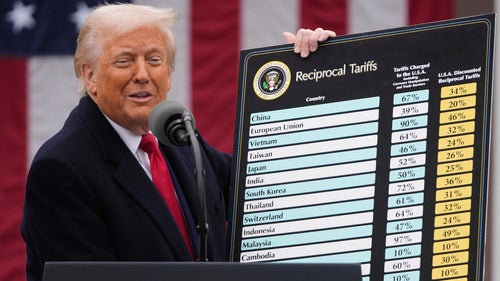
The US Supreme Court struck down US President Donald Trump’s sweeping tariffs. History offers a potential path forward for the economy.
In the immediate aftermath of the news that the US Supreme Court had ruled against the Trump administration’s widespread tariffs, financial markets showed very little reaction. This suggests that either the decision was largely anticipated or they believe US President Donald Trump is so committed to the principle that he will find some alternative use to achieve the same effect (at least in his mind).
The decision lands amid an intense debate in the United Kingdom over the arrest of a member of the Royal Family—the first in nearly 400 years. Still, there is an underlying sense that perhaps the UK democratic system does still work after all. Perhaps the same could be said with respect to the Supreme Court decision in the United States. However, if that were the case, I might have personally expected to see at least a modest celebration of the news.
Tariffs are a very crude and ineffective weapon to supposedly achieve a lasting improvement in the US external deficit, unless it is at the expense of much weaker US domestic demand through significantly higher prices for consumers.
Like most economists, I share the view that tariffs are a very crude and ineffective weapon to supposedly achieve a lasting improvement in the US external deficit, unless it is at the expense of much weaker US domestic demand through significantly higher prices for consumers. Back in December, on my first public call for the Chicago Council on Global Affairs on what might be achieved through the G20 under US leadership, I argued that an interesting and healthier alternative to the tariff obsession would be for Trump to resurrect a version of what former Treasury Secretary Tim Geithner tried under President Barack Obama back in 2011 and 2012, which was to get systematically important G20 countries to agree to common targets, both with respect to domestic demand and external imbalances. While this was resisted by Chinese authorities, I wonder today if, given the renewed major advance of the Chinese current account surplus and a seeming underlying desire by authorities in Beijing to boost domestic consumption relative to the rest of the economy, some smarter version of this would be more sensible for the United States to pursue. (Though it may be less eye-catching to some in the Trump regime.)
Combined with some underlying notable appreciation of the Chinese yuan (RMB) against the US dollar, this might be seen as the classic “win-win” that Chinese policymakers often talk about, not only for them, but also for the rest of the world. Doing so would allow us to move away from this reoccurring game of wondering “what happens next with the tariffs”—the constant thought of which almost definitely explains why markets are so subdued in their reaction today.
The Chicago Council on Global Affairs is an independent, nonpartisan organization and does not take institutional positions. The views and opinions expressed in this commentary are solely those of the author.
Related Content
 Global Economy
Americans of all partisan stripes agree free trade agreements are important, but Republicans want them with a side of trade barriers.
 Global Economy
Preventing other nations from growing to retain American greatness will only undermine the value of the dollar. In its 250th year, the United States must learn to distinguish between size and wealth.
 Global Economy
The global economy isn’t just slowing—it’s being completely reshaped. Here’s what that means for your future.