As Fears of China Wane, Americans Favor Greater Engagement with Beijing
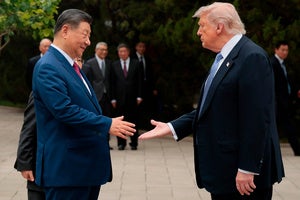
More than half of the US public supports a policy of cooperation and engagement with China, including a growing number of Republicans.
US President Donald Trump is set to host Chinese President Xi Jinping on September 24 for a formal state visit at the White House. This marks only the second US state visit for Xi, the first held in 2015 under US President Barack Obama. Since then, US-China relations have taken a turn from cooperation and engagement to competition and decoupling. American public opinion of China has also shifted over the past decade, with views turning sharply negative in the late 2010s and early 2020s—and now shifting again.
The 2026 Chicago Council Survey, fielded July 10-21, finds that American views of China have improved from the lows of 2024. Americans today feel more warmly about China, with the public less likely to view China as a threat, and more likely to favor cooperation over containment, though at levels lower than in the 2010s. This shift toward cooperation and engagement matches the general direction that Trump has taken since his May 2026 meeting with Xi in Beijing. But it is not one embraced by his base: Most MAGA Republicans continue to favor limiting the growth of China’s power rather than cooperation.1
Key Findings
- Americans rate China an average of 39 on a 0-100 feeling thermometer, up from just 26 in 2024.
- Four in 10 Americans (41%) see China’s territorial ambitions as a critical threat to the United States, down from 52 percent in 2022.
- Should China invade Taiwan, 38 percent of Americans favor the use of US troops, down from a peak of 52 percent in 2021.
- A majority of Americans (57%) say the United States should undertake friendly cooperation and engagement with China, while 40 percent favor actively limiting the growth of China’s power.
- MAGA Republicans (63%) favor limiting the growth of Chinese power, while non-MAGA Republicans (57%) favor an approach of cooperation and engagement.
- Democrats across the ideological spectrum favor cooperation and engagement with China (72% liberal Democrats, 64% moderate/conservative Democrats).
Views of China Continue to Warm
Though still cool, American views of China continue to warm from the all-time low found in 2024. Today, on a zero to 100 scale where zero represents a very negative feeling and 100 a very positive feeling, Americans give China an average of 39. This is up from an average of 26 in August 2024 and is the highest result recorded in Council polling since 2020 during the COVID-19 pandemic. Perceptions of China have improved across partisan lines in the past two years, with Democrats (45, up from 29 in 2024), Independents (42, up from 27), and Republicans (31, up from 20) all giving China warmer ratings.
Americans See Global Respect for China and the United States Moving in Different Directions
Americans are also more likely now than when last asked in 2021 to say China is becoming more respected in the world. Roughly a third of Americans say that “compared to 10 years ago,” China is respected more (33%), with similar proportions seeing China as respected less (31%) or about the same (35%). This is a notable shift from 2021, when six in 10 Americans (60%) considered China to be less respected in the world. Democrats and Independents are somewhat more likely to state that China’s respect in the world has risen (38% each, vs. 23% of Republicans); conversely, Republicans are the most likely to say China is less respected than a decade ago (41%, vs. 28% of Independents and 23% of Democrats).
By contrast, Americans—particularly Democrats and Independents—see the United States as losing global respect. Eight in 10 Democrats (80%) and two-thirds of Independents (68%), along with four in 10 Republicans (39%), say the United States is less respected in the world compared to 10 years ago.
Majority of Americans Favor Cooperation and Engagement with China
After a year of escalating economic tension between Washington and Beijing, Trump’s May 2026 trip to China ended with agreements to stabilize the relationship. This shift away from confrontation and toward cooperation is in line with the public’s own preferences. Today, a majority of Americans (57%) say the United States should undertake friendly cooperation and engagement with China, while 40 percent prefer a policy of actively limiting the growth of China’s power. This continues a shift toward engagement that has been underway since 2024, when support for containment was at its peak among the American public.
This growing support for pursuing engagement and cooperation with China is driven by parallel shifts across party lines.
The 2025 Chicago Council Survey found Democrats moving sharply in favor of engagement with China, breaking the brief bipartisan public consensus that the United States should limit the rise of China’s power. Today, Democrats (68%, similar to 66% in 2025) and Independents (61%, up from 56% in 2025) continue to favor an engagement approach to China.
Republicans have started moving in the same direction. Four in 10 (43%) now favor pursuing friendly cooperation and engagement with China, up from a third (33%) last year and representing the highest support for engagement among Republicans since 2019. Concurrently, Republican support for actively working to limit the growth of China’s power has declined each year since reaching a peak of 71 percent in 2021, falling to 55 percent today. (See Appendix figure 1).
One factor potentially moving American attitudes on China: disapproval of the second Trump administration’s tariff policies, including tariffs on imports from China. A March 2026 Chicago Council-NPR-Ipsos survey found Americans saw the tariffs as bad for all sides: bad for the Chinese economy (72%) and the US economy (66%) alike, and bad for their own cost of living (76%).
Declining Sense of Threat from China
Another factor pushing support for engagement higher is a declining sense of China as a threat. Overall, just four in 10 Americans (41%) see China’s territorial ambitions as a critical threat to the United States, down from 52 percent in 2022. This decline has happened similarly across partisan groups, with Republicans (49%, down from 62%), Independents (37%, down from 48%), and Democrats (35%, down from 50%) all less likely now than in 2022 to view Chinese ambitions as a threat.
Nor have Americans become more concerned about economic competition from China, despite the significant policy focus on Chinese overcapacity in critical sectors of emerging technologies and China’s control of rare earth supply chains. Just a third of Americans overall (32%) see China’s economic competition as a critical threat, and concern across party lines remains unchanged from 2024.
Declining Support for US Defense of Taiwan
As views of China as a threat have declined, so has support for using US troops to defend Taiwan from a Chinese invasion. Today, 38 percent of Americans favor doing so, down from a peak of 52 percent in 2021. That decline has taken place across partisan groups, with support for using US troops to defend Taiwan now at similar levels among Republicans (41%, down from 60% in 2021), Independents (38%, down from 49%), and Democrats (37%, down from 50%).
MAGA Republicans Remain Hawkish on China—Other Republicans Turn Dovish
In his second term, Trump raised tensions with Beijing by levying extensive tariffs on American imports of Chinese products and then sought to calm them through trade and investment agreements. His administration has also delayed selling arms to Taiwan, with Beijing warning that future US-China summits would be jeopardized by such sales.
These shifts in policy have not necessarily been aligned with the MAGA Republican base’s more hawkish instincts. In a March 2026 Chicago Council-NPR-Ipsos poll, MAGA Republicans were more likely than non-MAGA Republicans to favor restrictions on Chinese students in the United States, higher tariffs on imports from China, and significant US-China trade reductions, even if they led to greater costs for US consumers. MAGA Republicans were also more supportive of the tariffs imposed on China, seeing them as good for the US economy and job creation, while non-MAGA Republicans strongly disagreed.
Following Trump’s trip to Beijing in May 2026, and the resulting agreement on tariffs and goods purchases, Republicans across the board have softened somewhat on China. However, this masks a split opinion between the MAGA and non-MAGA wings of the Republican public. Today, a majority of non-MAGA Republicans (57%) favor engagement and cooperation with China, compared to 36 percent of MAGA Republicans. By contrast, MAGA Republicans continue to favor actively working to limit the growth of China’s power (63%, vs. 42% of non-MAGA Republicans).
Democrats Broadly Favor Engagement with China
For Democrats, China is a less divisive issue, with majorities of both the liberal and moderate/conservative wings of the party in agreement on China policy issues. Moderate or conservative Democrats are more likely than liberal Democrats to view China’s territorial ambitions as a critical threat to the United States (46%, vs. 28% of liberal Democrats) and are also more concerned about economic competition from China (34%, vs. 22% of liberal Democrats). However, neither issue is seen by a majority of either wing of the party as a critical threat to the country.
Similarly, Democrats across the ideological spectrum favor undertaking friendly cooperation and engagement with China (72% liberal Democrats, 64% moderate/conservative Democrats), while distinct minorities prefer an approach of actively limiting the growth of China’s power (33% moderate/conservative Democrats, 26% liberal Democrats).
Diverging Drivers of Support for Taiwan Among Partisans
There are also smaller, but still significant, differences within the parties on the question of coming to Taiwan’s defense—primarily among Democrats. Liberal Democrats are far more likely to support the use of US troops should China invade Taiwan (44%, vs. 26% among moderate/conservative Democrats). Republicans are less divided on the question, with MAGA Republicans (43%) and non-MAGA Republicans (37%) not showing a statistically significant difference on support for the use of troops.
At first glance, this might seem like a paradox: Liberal Democrats are the most likely to favor engagement with China and yet also the most supportive of defending Taiwan. As deeper analysis of the data shows, Republicans and Democrats do not tie their attitudes on China and on Taiwan together in the same ways. Among Republicans, support for defending Taiwan is linked to their views of China as a threat and their support for a policy of limiting the rise of China’s power, with all three items moving in the same direction. By contrast, Democrats seem to think about China and Taiwan separately, with those Democrats who are most supportive of engagement with China also the most supportive of defending Taiwan from an invasion by China. For Democrats, perceptions of China as a threat make little difference in support for Taiwan.
Conclusion: A Shifting Stance on US-China Relations
For two presidential terms—Trump’s first administration (2017–2021) and President Joe Biden’s administration (2021–2025)—the US-China relationship was dominated on the US side by a framework of great-power competition. Unlike the past framing of the bilateral relationship as one of strategic competition, the second Trump administration’s focus on China has been primarily economic. This is the lens through which Americans evaluate the administration’s China policy, with mixed reviews. As Chicago Council-NPR-Ipsos polling this spring found, the public sees the tariffs imposed on trade with China as having broadly negative effects for both sides and opposes further tariff increases.
Against this backdrop, the upcoming midterm elections could be especially consequential for US-China policy. The American public today is far less likely to view China as a critical threat and more supportive of engagement with Beijing. This is especially true within the Democratic Party, which may win control of one or both houses of Congress this November. Should that occur, these shifts in American perceptions of China and changing views on the US approach toward China may also shift US policy toward Beijing.
- 1
MAGA Republicans are those self-identified Republicans who also identify as a supporter of the Make America Great Again or MAGA movement. In the 2026 Chicago Council Survey, 61 percent of Republicans identifiy as MAGA supporters. For more details, see the Methodology.
If you would like more details on the data in this report, please contact the author:
Craig Kafura | ckafura@globalaffairs.org
This analysis is based on data from the 2026 Chicago Council Survey of the American public on foreign policy, a project of the Lester Crown Center on US Foreign Policy.
The 2026 Chicago Council Survey was conducted July 10-21, 2026, by Ipsos using its large-scale, nationwide, online research panel (KnowledgePanel) in English and Spanish among a weighted national sample of 2,156 adults 18 or older living in all 50 US states and the District of Columbia. The margin of sampling error for the full sample is ±2.2 percentage points, including a design effect of 1.04.
The data were weighted to adjust for gender by age, race and ethnicity, education, census region by metropolitan status, household income, and language dominance. The demographic benchmarks came from the 2025 March supplement of the U.S. Census Bureau’s Current Population Survey (CPS). Additionally, language dominance benchmark was obtained from the 2024 American Community Survey (ACS).
- Gender (Male, Female) by Age (18–29, 30–44, 45-59, and 60+)
- Race/Hispanic Ethnicity (White Non-Hispanic, Black Non-Hispanic, Other Non-Hispanic, Hispanic, 2+ Races Non-Hispanic)
- Education (Less than High School, High School, Some College, Bachelor’s degree or higher)
- Census Region (Northeast, Midwest, South, West) by Metropolitan status (Metro, non-Metro)
- Household Income (Under $25,000, $25,000-$49,999, $50,000-$74,999, $75,000-$99,999, $100,000-$149,999, $150,000+)
- Language Dominance (English Dominant Hispanic, Bilingual Hispanic, Spanish Dominant Hispanic, Non-Hispanic)
Partisan identification is based on how respondents answered a standard partisan self-identification question: “Generally speaking, do you think of yourself as a Republican, a Democrat, an Independent, or what?”
To examine differences within the Republican and Democratic parties, we further divide Republicans and Democrats into subgroups.
Republicans are divided into MAGA Republicans (the 61% of Republicans who also say they are part of the Make America Great Again, or MAGA, movement) and non-MAGA Republicans (the 39% of Republicans who say they are not part of the MAGA movement).
Democrats are divided into ideological groups: 63 percent of Democrats identify as liberal to some degree (12% extremely liberal, 33% liberal, 17% slightly liberal), while another 37 percent of Democrats identify as moderate (30%) or conservative to some degree (6%).
The 2026 Chicago Council Survey is made possible by the generous support of the Crown family and the Dr. Scholl Foundation.


Related Content
 Global Politics
The US and China may not want a war, but could they end up in one anyway? International relations historian Odd Arne Westad explains why he sees echoes of the years before World War I and the “warning” they hold for today.
 Public Opinion
Most younger Americans don't see China as a critical threat to the United States and favor a policy of friendly cooperation and engagement.
 Global Politics
Reports that Xi will forgo addressing the United Nations General Assembly ahead of his meeting with Trump in Washington raise uncomfortable questions about the role of multilateral institutions under great power compacts.
 Global Politics
Trump called Xi his “friend” during a May summit in Beijing. But that doesn’t mean the two leaders see eye to eye.