New Survey: Chicago-Area Residents Broadly Sympathetic to Immigrants, Say ICE Enforcement Has Gone Too Far
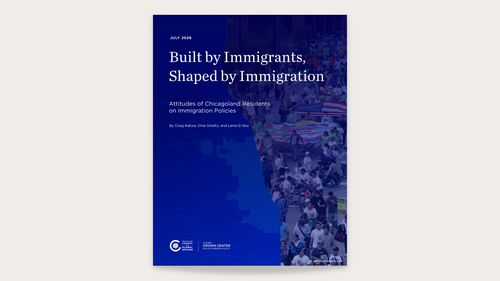
July 13, 2026—Chicago-area residents are broadly sympathetic to immigrants and believe federal immigration enforcement in the region has overstepped, a new Chicago Council on Global Affairs study finds.
The Chicagoland Immigration Survey explores how people across Chicago, suburban Cook County and Lake County think about immigration and immigrants, and how those local views compare with national opinion.
"Most Chicagoland residents see their region as welcoming to immigrants," Dina Smeltz, the Council’s managing director and chair of public opinion and foreign policy, said of the results. "Like the rest of the country, there are sharp partisan divides on the details, including the impact of immigration on American culture and economy, which immigrants should be admitted into the country and the best way to address undocumented immigrants.”
Key Findings
- Majorities say Immigration and Customs Enforcement (ICE) has gone too far. Six in 10 or more of Chicago, suburban Cook County and Lake County residents believe that ICE actions in the Chicago region have gone too far.
- Most residents sympathize with protesters and immigrants over ICE agents. Seven in 10 city of Chicago residents (72%) say they mostly sympathize with protesters and immigrants rather than ICE agents, as do six in 10 residents of suburban Cook County (60%) and Lake County (57%).
- Many residents report taking direct action. Substantial minorities say they have donated to immigrants or immigrant advocacy groups; signed a petition; attended an event or protest; or contacted a public official about immigration issues. Two in 10 city of Chicago residents say they have carried a whistle to alert others to ICE agents’ presence.
- Immigrants are widely seen as a benefit to the region. Across the city of Chicago, suburban Cook County and Lake County, roughly six in 10 residents say immigrants have been good for American culture, the U.S. economy, their local economy and their own communities.
- Few residents want to reduce legal immigration. No more than 21% of residents in Chicago, suburban Cook County or Lake County want to see legal immigration into the United States decreased. About four in 10 in each area favor keeping immigration levels the same, and a similar share favor increasing them.
- Broad support for a path to citizenship. Two-thirds of Chicago residents (66%) favor allowing undocumented immigrants to apply for citizenship, along with six in 10 Lake County residents (61%) and half of suburban Cook County residents (52%).
- Strong support for Dreamers. Eight in 10 Chicagoans (79%), and seven in 10 suburban Cook County and Lake County residents (72% each), favor granting permanent legal immigration status to undocumented immigrants brought to the United States as children, commonly referred to as "Dreamers."
For further analysis, explore the full survey report and attend the upcoming event.
"No city has been more deeply shaped by the complexity of America’s role as an immigrant nation than Chicago," said Council President and CEO Leslie Vinjamuri. "As the nation marks its 250th anniversary, these findings make clear that Chicago and the broader region have a vital role to play in shaping the future of U.S. immigration policy.”
The Chicagoland Immigration Survey was made possible by generous support from the Walder Foundation and Schreiber Philanthropy.
The data were collected April 13-23, 2026, among a sample of 1,500 adults in Cook County (758 in the city of Chicago, 742 in suburban Cook County) and 400 adults in Lake County. The margin of error for the Cook County sample is ±2.5%, and the margin of error for the Lake County sample is ±4.9%.
About the Council
Founded in 1922, the Chicago Council on Global Affairs is a nonpartisan, nonprofit organization dedicated to increasing knowledge and engagement in global affairs. Our in-depth analysis and expert-led research influence policy conversations and inform the insights we share with our growing community. Through accessible content and open dialogue drawing on diverse, fact-based perspectives, we empower more people to help shape our global future. Learn more at globalaffairs.org.