NATO Summit Debrief: What Comes Next After Ankara?
About This Event
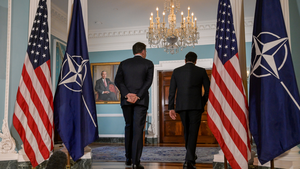
As NATO leaders prepare to gather in Ankara, Turkey for a pivotal summit, the alliance is facing mounting pressure to respond to an increasingly complex security landscape. Between Russia’s ongoing war in Ukraine, growing debates over defense spending and burden sharing, and new threats posed by emerging technologies, the challenges seem endless. Join former US Ambassador to NATO and Council Distinguished Nonresident Fellow for Defense and Security Julianne Smith and 20th Supreme Allied Commander Europe and 19th Commander of the European Forces General Christopher Cavoli in a virtual conversation with Leslie Vinjamuri as they discuss the summit’s outcomes, NATO’s future strategic priorities, and the alliance's role in shaping global security in an era of growing geopolitical uncertainty.
This transcript has been edited for clarity.
Leslie Vinjamuri: Hello, and welcome to the Chicago Council on Global Affairs for our online webinar. I'm Leslie Vinjamuri, president and CEO of the Chicago Council. I'm actually joining today from London. I am very honored and very delighted to be hosting two excellent authorities and former officials who have contributed many years to public service, to thinking, leading, and acting on behalf of, I think it's fair to say, the NATO Alliance, as well as the United States.
My colleague Ambassador Julie Smith is a distinguished non-resident fellow for security and defense at the Chicago Council. She was the US ambassador to NATO from 2021 to 2025 and had previously served in earlier administrations, as well as working across the think tank community in the United States, Germany, and the United Kingdom.
We also have General Christopher Cavoli, who was the commander of the US European Command and the Supreme Allied Commander Europe from 2022 to 2025. Thank you both for joining us today.
We are on the heels of the Ankara Summit, which is the immediate reason we are convening this conversation. I should say, my colleague, the vice president of research here at the Chicago Council, Dr. Ari Tabatabai, was in Ankara and has written extensively about this, so please take a look. She has helped lead and frame this conversation, and I'm sure we'll have questions.
I wanted to start by just saying we all know this has not been the easiest of periods. I think both of you know that the history of the alliance is less rosy. There have been ups and downs, but there's a tremendous amount of pressure coming from within and outside of the alliance. We're at a moment of multiple wars, but one in particular has preoccupied the alliance.
There's no shortage of troubles in a broader geopolitical context, which is also very challenging. There's a lot of technological change, which has very significant implications for how wars are fought and how deterrence works.
Having said that, Ambassador Smith, you wrote a great piece for the Council saying that in the lead-up to Ankara, there was a prevailing sense, certainly amongst America's European NATO allies, that the key challenge to be managed was less Ukraine, less Russia, and it was really about managing the United States in this very disruptive period. Coming out of it, do you think that that's proven to be the case? What was your overall estimation of the summit?
Julianne Smith: Thanks, Leslie. It's great to do this with you at the Chicago Council and, of course, with General Cavoli.
The summit was not a tale of two cities, but of two separate days in managing the United States. On the first day, the president arrives and has a bilateral meeting with President Erdogan. In some of the press avails that he had, it was clear that he was arriving in Ankara with a whole set of grievances: residual frustration over Europe's—in his words and mind—failure to come to the United States' aid in the Iran war, ongoing frustration over some countries' foot-dragging in terms of defense spending, and then a little bit of friction with Meloni in Italy. Overall just a lot of negativity about Europe and the United States. So there was anxiety in Ankara about how they would manage the next morning.
Next morning, different day. The president comes in and listens to allies. One leader quoted to him, "You've won the argument, Donald. Your leadership did it." And that, I understand, was the tone of the entire morning, basically praising the president for moving the needle on defense spending, admitting that Europe and Canada needed to do more and that they are well on their way.
So the president came out of the summit not scratchy, not grumpy, not upset with allies or bad-mouthing individual countries, but in fact talking about how the mood music was full of love and it was very positive. What this tells us is that the alliance is doing great work, but it is also consumed by a single member.
The efforts in large part at NATO still revolve around keeping the US onside and maintaining the Article 5 commitment, which was restated in the summit declaration. But I think what I said did, in some small part, turn out to be true, that there is a lot of managing the United States. It doesn't mean that no one at NATO headquarters or at SHAPE is getting any work done. That's not totally the case. But based on what I experienced as ambassador, it does feel like some of the adjacent work on cybersecurity, emerging tech, and some of the other work that the alliance used to use summits to highlight has been pushed aside in the name of managing the US president.
LV: And it's also a US president who is very occupied with another war.
JS: Indeed. Iran was casting a dark shadow over the summit because one could feel that the ceasefire was perhaps starting to unravel. A little bit of action on the part of the Iranians, a response from the United States, and that's kind of how we got through the weekend. Now we find ourselves on the other end of the summit, understanding fully that the ceasefire, according to the president, is not really holding, and that we're gonna reinstate the blockade, which was the news that broke this morning. So all of that did cast a bit of a shadow over the alliance in Ankara.
LV: General Cavoli, you know better than anyone, as does Ambassador Smith, that the question of burden-sharing is not new. It's fair to say that many people attribute the success of the movement towards burden-sharing, at least towards more spending, to the success of President Trump, and what some people read as disruptive has also been read, even by those same people, as leading to greater progress, for a variety of reasons.
Help us to understand the nature of the debate about burden-sharing and the trend lines. Are things moving in the direction and at the speed you estimate are necessary and important, and what do you see as the blockers and the direction of travel?
Christopher Cavoli: Thanks, Leslie, for having me here today. It's a real pleasure to be on with Ambassador Julie Smith, one of America's great diplomats, and somebody I was very, very lucky to work with and learn an awful lot from.
The burden-sharing debate has been going on since the beginning of NATO. Eisenhower complained about it. Every successive SACEUR has. It's happened for a variety of reasons. It's always been inside the context of a continent that was rebuilding while we were accelerating away from the war. Then it moved into another context during the Vietnam War, when we were occupied in Southeast Asia and wanted the allies to do more to provide cover.
The most recent friction has really come in the wake of the Cold War. During the Cold War, our cardinal direction was determined by the threat of a conventional Soviet invasion; we understood their plans and intentions, and we designed a plan to defend against it.
After the Cold War, that plan was no longer necessary, but unfortunately that plan had given us a number of things. It had given us a description of the forces that we required to defend the alliance. It gave us a description of the levels of readiness we had to maintain, what authority SACEUR had, and what authorities were reserved to the political level. It gave focus to our training efforts. So it was a very, very important document. But it fell into disuse after the end of the Cold War and was replaced with an intention to conduct out-of-area operations, which became the central focus of the alliance for the last 30-35 years.
Those operations are very different from large-scale territorial defense. They required much smaller forces. They were predictable. They were not done against peer adversaries. So a lot of the things we needed for territorial defense during the Cold War, we shed because they weren't optimal for the sorts of operations we contemplated in the Balkans, Afghanistan, and things like that.
All of our militaries got smaller. All of our authorities reserved higher and higher to a political level. We reduced our rates of readiness and on and on. All the countries in the alliance did that, to include countries that were new to the alliance as they came in. So it was indeed a shock in 2022 when we suddenly woke up and realized the warning signs were right. We had a real need to get back to collective defense as our core function, and we did so. In Madrid in 2022, the heads of state and government instructed my predecessor, Todd Walters, to immediately develop a strategy to defend the alliance's territory and to return to collective defense.
And five days later, I took command, and that became the story of my time. We wrote plans that gave us a force structure requirement, which is effectively the shopping list for the 2%. Unfortunately, by my math, 2% wouldn't cover it. It looked more like 3.7% of our collective GDP over 10 years, and that's where the 3.5% core defense spending goal came from.
That was just to build the organizations we needed, not to build readiness or infrastructure. The alliance decided to add on a percent and a half, and we got to 5%. So everything's in place, and we are trending in the right direction, but now it's time to do it. This summit, in the words of Mark Rutte, was the "just do it summit." This is the summit where we just say, "We've agreed. We've got a plan. Now, how are we gonna do it? We just gotta do it." So there are a lot of positive things that came out of it, I believe.
LV: Let me just ask you one follow-up question before I come to Ambassador Smith. For those of us watching this debate from the outside about percentages of spending, I think one thing that's always been puzzling is that spending money doesn't necessarily lead to good outcomes or efficiencies. Is there a serious debate that is taking place alongside that about how you spend that money?
CC: First of all, under the old agreement, to go to 2%, we had the 80/20 rule. At least 20% had to be spent on the acquisition of new equipment. There were some armies in the alliance that were spending a disproportionate amount on salaries and personnel costs, for example, which is not what we're looking for. So there's always been that.
But in this case, that force structure requirement gets turned through a process called the NATO Defense Planning process into very, very specific capabilities targets that are then assigned to each nation, and the nation negotiates with the NATO structures to agree to them.
At The Hague Summit last year, 100% of the capabilities targets required to execute the new family of plans were accepted by nations, so it's no longer the percentage that matters. In the old days, the 2% could be fairly vague. Now, there are specific things that nations have agreed to spend on, have agreed to produce, and those collectively add up to approximately 3.5%. So it is actually extremely precise.
A bigger question, I would say, is whether we're in danger of building an army of yesterday. When we do the NATO Defense Planning process, we have very rigid rules of the game, which allow us to get very, very precise, but they also express what we want in current capabilities.
In the last round, we instituted a program where a nation could come to us and say, "I know you asked me to build a tank brigade, but how about instead of a tank brigade with 230 tanks, I actually build one with 180 tanks plus all of these drones," or something like that. Come back with a technological answer based on future capabilities, and then we negotiate how that will work.
It combined the precision of the old NATO defense planning process, which made real and concrete the spending goals, with a flexibility that allows us to plan for the future and build a force for the future.
LV: Clearly, the aspiration and the planning are very impressive. Julie, before I ask you about Ukraine, you've talked a lot about the Chicago Council and spoken elsewhere about the problem of interoperability and redundancies. Reading off the summit, and the sort of progress over the last many months, and looking ahead, as there's this push for greater spending, as there is this coordination mechanism that General Cavoli has outlined, do you feel like the question of redundancies and interoperability is really one that's being grappled with in a meaningful way in the current context?
JS: Well, I think NATO's trying to do its best to ensure that this spending all comes together and creates a collective capacity for the alliance that's interoperable and covers all the different requirements that the alliance needs, particularly as we see some US disengagement. But the jury's still out, and we could get to the end of this decade and find that Europe has spent enormous sums of money, but perhaps on things that are a bit dated, as General Cavoli just pointed out. Or we have too many sets of the same types of systems, too many different air defense systems that aren't necessarily all interoperable with one another.
It used to be that a lot of European countries would purchase the majority of their capabilities, or huge portions of their capabilities, from the United States. Now, there's this drive for sovereignty, autonomy. Some countries feel compelled not to go with the best-in-class option and instead find their own sovereign capability, but some of those systems aren't necessarily interoperable.
We'll have to see how all of this unfolds. There are two scenarios. We get to the end of the next decade, Europe has spent upwards of a trillion euros on defense. We have a much more capable alliance that's stronger, has the strategic seriousness, and has built capacity that allows the United States to step back and focus on other threats in other regions.
Or there's another scenario where they muddle through. There's a lot of money being spent, but it's done in a way that is not always efficient or particularly well coordinated, which makes it a little more challenging. At the end of the decade, Europe doesn't end up with the capabilities or collective capacity it's seeking today in 2026.
I hope we end up with the former scenario, but we'll just have to see how this all unfolds. There's some interesting inter-European developments. The French and the Germans just kind of fell apart over FCAS, this fighter jet program. We want to make sure that all engines are firing and in a coordinated way that leads them to the outcome they're seeking. I very much hope that they get there, but we'll all have to watch this unfold in the years ahead.
CC: The central tension, for the sake of the viewers, is that NATO writes the plans and describes the forces needed, but then 32 individual nations procure and build those forces. And they have a variety of interests. Their interest is not only NATO. For example, in the US, we have many other parts of the globe we're worried about, and we don't necessarily drive our entire defense establishment based on the NATO requirements.
We can see this repeated 31 other times throughout the alliance. It's really hard to wrestle compliance with our standing agreements in place.
LV: Absolutely. And as you both know very well, if you add on top of that where we started, the concern many Europeans have about the United States, and therefore about their own sovereignty and autonomy. There's this sense looming large over Europe that there's a lot of political change coming, and that it's not clear whether new governments across Europe will all hold to the same commitments and values, and interpret their interests in the same way.
Even with that strategy and that strategic approach, there's a lot of politics and geopolitics, which you two know better than anyone, but that obviously complicates this entire picture.
Having said that, I want to be sure that we talk about a few other things, and one, of course, is the war in Ukraine.
Russia's opening salvo, as I watched it, was to launch a massive attack on Kyiv. It felt like it was a "Fine, NATO, you go ahead and have your meeting, and we're just going to show you that we're not really onside." At the same time, we've all been watching, and it feels like the momentum is changing, and the balance is perhaps moving towards Ukraine. The stories, even for those of us laypeople watching, are pretty impressive to watch.
But as former officials and experts, what is your read on NATO, its support of Ukraine, and the direction of the war in Ukraine? And how was that read through the summit? To put another fine point on that, there was obviously a lot of concern that President Trump might turn up and not be friendly with President Zelenskyy. You never know how that's going to go.
Ambassador Smith, maybe you could start us out with the question of Ukraine and what the summit revealed.
JS: It was a huge win for Ukraine. They did very well at the summit, in terms of concrete commitments. They walked away with $70 billion in pledges of assistance from all of the allies. That's not something to just shrug your shoulders at; it was a significant announcement.
Perhaps equally important, if not more so, the United States announced it would grant Ukraine a license to produce Patriot interceptor missiles locally. That's huge. Normally, only some of our closest allies receive a license like that, like the Germans and others. Zelensky walked away with concrete forms of assistance.
The mood music with President Zelensky and President Trump has just changed fundamentally. They started off on a really low note last year with some shouting and yelling in the Oval Office, just a visit that went completely off the rails for lots of reasons. And now, the president is quite complimentary toward President Zelensky and Ukrainians, their will to fight, and the fact that they are perceived, in large part, as winners who are kind of asserting much more strategic gains against the Russians.
They're reaching deep into Russian territory. In some ways, they've got Russia more on its back foot than we've seen in recent years. But also what's really interesting is the fact that Ukraine is now perceived as a security provider to Europe, not as a consumer.
In the days when I was at NATO, when the war first started, and the Ukrainians were asking for membership, part of the response was, "You will be a security consumer. We will be providing security to you," and the tables have turned. Ukrainians are now seen as security providers, and allies are increasingly looking to them for their technological depth and expertise. The capabilities that they're producing are not just autonomous systems but also howitzers and other capabilities that the alliance desperately needs.
So this was a tremendous win for President Zelensky. I have no doubt that he went home to Kyiv feeling much better about his relationship with the United States and NATO allies. The question is, does it stay that way? And we don't know. This is a peaks-and-valleys relationship with the United States, and one never knows going forward if it will stay at that current high.
LV: General Cavoli, I don't know if you want to also comment on that, and maybe I could add one question that we discussed in our transatlantic dialogue a little bit last week in Chicago. Is there much thinking about what NATO's role would look like when there's some sort of end, settlement, or cold peace in Ukraine? Is that part of the conversation yet, or is the focus still primarily on where we are today?
CC: No, the conversation about what happens afterward and what European security looks like afterward has been a conversation that's been going on pretty much straight through the war. It's increasing in tempo right now. People are starting to not predict an end to the war, but see that this is something that's going to end at some point. The difference is now it's very clear that Ukraine is going to emerge from this as a viable state with a massive military that is extremely well-prepared to fight and therefore deter the Russians in geography that wasn't part of the NATO construct before.
When I think of the NATO plans that cover that part of the world, accounting for a post-war period in which a friendly country has altered the geometry of the borderline with Russia it's a huge advantage for us. It will be a big advantage that we'll have to figure out how to capitalize on.
A couple of thoughts on how Ukraine got here and the advantages it could bring to the alliance if we handle it wisely. The first is that Ukraine, for a variety of reasons, became self-sufficient in almost everything it needs, including things like most of its intelligence and a great deal of its air defense.
That is a remarkable feat. President Zelensky said last week that the only thing he needs from the outside now is moral support and Patriot PAC-3 interceptors to stop ballistic missiles. Therefore, if he's gonna be able to make PAC-3s in Ukraine, that's a pretty big advance.
But that independence and self-sustainability that the Ukrainians have developed is because they've developed a very competent, very flexible, large-scale armaments industry. That armaments industry is going to teach us a couple of things about how to produce, innovate, and scale our armaments production.
There's a great deal of promise for the future, as long as we help Ukraine get through this period diplomatically and in a variety of other ways to ensure we end up in lockstep and together at the end of the conflict.
LV: Super interesting. I'm going to ask you one final question, and then we'll open it up again. I would just add, as a comment, that the moment you're talking about is also one where, for now, a very powerful European country will not be in NATO. I know that that's an outstanding question, but it is an interesting... It is a different dynamic than Europe has had for at least eight decades.
My final question before we open it up is about America's force posture. We know that this has been a deep and very significant concern for Europe. We know the numbers that have been articulated, the movements, but where does that conversation stand now, Ambassador Smith?
JS: Well, the United States has announced that it is going to be undertaking a review of US posture, and that review, in theory, will drop at the end of the year.
Some allies are a little bit on edge. They're worried that there could be some sort of dramatic announcement. I think their message to the President, Secretary Rubio, and Secretary Hegseth was a pretty simple one and was repeated, as I understand it, in multiple meetings. That was, "Just promise us that this review will be based on your best military advice and that politics won't get in the way. Just because you're frustrated with country X or country Y, they won't necessarily immediately appear on the chopping block because of how the White House or someone else in the administration feels about that country on a given Wednesday."
Allies are anticipating a change. They're not sure quite what to expect. They've heard some modest announcements being made in recent weeks and months. Assuming the US will continue to disengage in some fashion in the months ahead, and assuming that Europeans continue to work to provide their own security, is there a moment where the alliance is especially exposed? And could Putin find himself tempted to seize on that moment before Europe can provide everything it needs for itself, and at a time when the US is engaging in one form or another?
Will he be tempted to do something either through gray zone or hybrid tactics? Would it be more direct to use conventional forces to just dip into NATO territory? We can't be sure. None of us obviously can get into Putin's head, but it's a live question for the alliance. It's a real one for those countries on the eastern flank, and so they're gonna be watching this force posture announcement very closely to see if the United States is gonna move faster than Europe is able to provide for its own security.
LV: Very well put. That transition moment seems to dominate formal and informal conversations, especially in Europe. General Cavoli, would you like to add to that?
CC: Yeah. Our force posture decisions really have to be made from two perspectives.
One is what we believe we need to contribute to the alliance for the stated purpose of the alliance, which is to defend the territory of the North Atlantic Treaty Organization area. The other is, how does our force posture affect the US national interest?
For decades, we have been able to see the overlap in those two goals, and we've realized that having a certain amount of force, the right force with the right permissions, the right legal agreements, and the right infrastructure in place inside the European area has been hugely beneficial to us. Not only in NATO, but in our own national interest.
So many of the operations we've seen lately are not possible without significant work coming out of Europe. We need to remember that. When we talk about our force posture, it's not just the number of troops or large formations. That's part of it, but it is also pre-positioned equipment, infrastructure, and ammunition stockpiles.
And those things have to be enabled by good bilateral, legally binding agreements with nations on how we will use those forces and under what conditions we'll be permitted to deploy them. We have those agreements in place, and in some countries they're stronger than in others. It depends on the specific bilateral status-of-forces agreement we have.
But once you get the troops, the pre-positioned equipment, the infrastructure, the munitions, and the agreements necessary to do it, that's something we need to consider as we think about force posture too.
LV: Okay, excellent. Thank you. We have some tremendous questions. Some of them are quite specific, and some of them are more conceptual or strategic with respect to the alliance.
I'll ask a specific one: Israeli officials and analysts have been using increasingly belligerent rhetoric against Türkiye, some even going so far as to suggest Israel may go to war with Türkiye in the future. If Israel attacks Türkiye, a NATO ally, how do you believe NATO would and should respond? Sorry, not an easy question, very specific. Maybe you should do the "should"; it's really hard to predict the "would," but I'll leave it to you to decide on that.
CC: It's an important question, not specifically because I think that Türkiye and Israel are going to go to war, but because the alliance does not exist in a vacuum. There are regional tensions. There are tensions inside the alliance, and this is something that gets wrestled with all the time. The job of the Supreme Allied Commander for Europe is to make sure that he's ready to defend the right place at the right time. The decision to defend is made by 32 countries by consensus during Article 4 and 5 consultations. I can't predict how we would react to that one, but I do know that we would be capable of reacting to it.
LV: Let me follow up and ask you, Ambassador Smith, if NATO didn't respond to that kind of aggression, what would the consequence be for the alliance?
JS: This represents a certain level of nervousness that's always beneath the surface of NATO discussions. The allies have always worried about a scenario where any country in the alliance is, quote, "attacked" and the alliance opts not to respond collectively. We had some incidents while General Cavoli and I were at NATO, where kit was dropping out of the sky, and drones were dropping out of the sky on NATO territory.
It started to raise the question of whether NATO is only concerned with the question of conventional forces moving across borders? In that case, NATO knows exactly what to do. Where it gets a little blurry at times is when something below the threshold of a classic Article 5 scenario occurs, whether that's undersea cables being cut, or a cyberattack, or airspace violations, or drones dropping out of the sky and landing on your territory and potentially killing people.
That's why the alliance is constantly exercising. When I was at NATO, we would go through a number of scenarios and tabletop exercises where we would test some of our assumptions. Would the alliance respond using Article 5 or just Article 4 consultations for these types of scenarios?
That's where things get very complicated because there are allies that believe any danger or incident involving NATO territory should move to an Article 5 discussion. There are those who say, "Hold up, this doesn't quite cross the threshold." So that tension always exists inside the alliance. But that's exactly why allies are constantly testing those assumptions, doing tabletop exercises, and readying themselves for a whole variety of scenarios.
The worst-case scenario is that Putin does something in the next two and a half years, at which time the United States, for one reason or another, decides not to respond. That then does call into question kind of the credibility of Article 5 writ large, and that's the scenario that certainly Putin is seeking to create, and the alliance is seeking to avoid.
LV: It raises a question of whether you can have variable geometry within the NATO alliance, with Europe doing something and the US not.
JS: Coalitions are always possible, and we've used coalitions in many different scenarios throughout the last several decades. Then there's NATO proper, but NATO proper will not ever abandon the consensus rule. All 32 have to be yes in order for action to be taken.
Article 5, if you read the line in the treaty, does give each NATO member control over the decision-making to determine how they would contribute in an Article 5 contingency. So you're not mandated to respond in any certain way, but still, it leaves folks a bit uneasy about what this all would look like under certain types of scenarios.
CC: It's worth pointing out that the Israel-Turkey hypothetical doesn't really bear very well on a Russia question, right? Russia is named in NATO documents and agreed intelligence as a threat and an adversary. No place in NATO documents does NATO talk about Israel, let alone as a threat. So the reaction and how automatic a reaction would be really have to be considered very differently for the two cases.
LV: Thank you. And it also becomes very political, which everything is, but I understand that that is not the perspective that you both bring.
A good question here, certainly for both of you: Can you discuss the difference between burden-sharing and burden-shifting? And do we have a meaningful understanding of the current US administration's goal regarding this and what it will do in Europe? Is it more about burden-sharing or burden-shifting? Do you take that distinction as meaningful?
CC: Burden-sharing is a phenomenon, and burden-shifting is a process. If we believe that the burden is being unequally shared, we would like to shift to a point where the burden is equally shared.
I do agree that the burden is unequally shared right now, and has been for some years, especially in the wake of the out-of-area operations that we talked about. So a certain amount of burden shifting is required. I'm not alone in that. The entire alliance has agreed to that. It's been agreed for almost three years now, and we've been moving in that direction.
There is a question of speed. The process of burden shifting requires a timeline to be laid down and to be matched responsibly against the establishment of new capacity and capabilities in Europe. But we would probably like it to go faster than it's going to go if we don't have summits like we had last week.
LV: I will just add the caveat again; it's all political. Here in the UK, there's endless conversation about what cuts are going to have to be made, what taxes are going to have to be raised, because there is not a lot of growth. Raising that money to put into defense is a big ask for some European countries at this point in time. So it might be the right thing to do.
That doesn't make it easy to deliver on, and not always for bad or malicious reasons. It's just very difficult in a low-growth environment where you've created certain expectations domestically in your electorate for welfare, pensions, and all the rest of it.
I want to ask you a question about the Patriots. How realistic is the prospect that Ukraine will actually have the capacity to assemble Patriots while it remains at war, and do you think that the US will stick with the support for licensing it to do so? I know that the latter half is a little bit hard to speak to, but does either of you want to take the first part of this question?
CC: Yeah, I'll grab the first part. If we provide the intellectual property to the Ukrainians, and in a couple of specific instances, the components necessary to assemble Patriots, the Ukrainians will certainly figure out how to do it pretty quickly.
So it really depends on how quickly we want it to go, and whether we're willing to let it go. There are some serious questions about technology release that will have to be wrestled with, I'm sure. But the Ukrainians will be fully capable of producing it, especially if they're given specific components that are necessary.
They'll probably want to do it in distributed facilities, like they build so many other things, so that they don't present one large target. And they'll probably want to do it in protected facilities, so that the target will be hard to hit. It's not necessarily the case that the production would be done by Ukraine inside Ukraine.
I can imagine a world where there was a third-party agreement to do it someplace else for Ukraine. But these are great questions. In terms of how long we'll sustain it, I just don't know.
LV: We are at time, but I'm going to close with the big question, certainly for Europe and maybe for NATO. It's this idea of a concept of a dormant NATO; I haven't heard that term, you probably have. How realistic is the idea that the command structure could be largely turned over to European military leadership with a scaled-down presence of US conventional forces, but with the US maintaining the nuclear umbrella? Would this deliver on the balance and the relationships that political leaders are seeking? Is it viable? And could you maybe say a little bit more about your view on this debate or this discussion, this set of proposals for Europeanizing NATO? Because it really is dominating much of the discussion in Europe.
JS: I think we will get to a point where we will see a European pillar emerge inside the alliance, and I think that will translate into a more capable Europe, more forces in Europe, assuming more responsibility for the security of NATO member states, driving the agenda. But also potentially questioning US leadership and US interests.
For almost eighty years now, the United States has enjoyed a very unique position in the alliance. We have led the alliance. We have directed allies to move in this direction or another. We've often brought in new themes, whether it's AI, bringing China into the strategic concept, leading on a whole array of ideas and new initiatives.
It doesn't mean the US will stop doing that in the future, but we've been in a position where we have essentially been able to pat Europeans on the head and treat them like our little brother. Europe will stand tall eventually. They're going to look us in the eye, sometimes agree with US leadership, and sometimes challenge it. The alliance is going to look and feel different from what it has over the last seven-plus decades.
In terms of the command structure, General Cavoli will have thoughts on this, but I do not want to see a world where SACEUR is handed over to a European. This is a role that many European and Canadian friends treasure. They want the US to continue to remain in the driver's seat, continually putting an American four-star in that role to lead the alliance. It helps get rid of some of the debates across Europe about who will lead and whose forces are under whose command.
So on that front, I want to see the status quo. But in other areas, forces, capabilities, leadership, intent, initiative, all sorts of things can change across the alliance over the next decade in ways that would be welcomed by both the North American members of the alliance and the European members of the alliance.
But that particular leadership role of having an American sit as the Supreme Allied Commander Europe, is something, again, that is applauded by the members of the alliance and, frankly, is necessary right now.
CC: I would agree with everything Julie just said. I would add two things for consideration.
The first one is, as long as we are in NATO, there is an obvious implication that we would probably be willing to commit our forces and our sons and daughters to a fight to defend NATO. Would we want to do that under a non-US commander? That has not been the case in the past, but it is what we'd be signing up for when I hear some of these discussions.
And then when we talk about a dormant NATO—let's just take that term, dormant. Do we think that an alliance can wake up from a deep slumber at a time of need, which is a time of great peril in warfare, and have all the relationships, all the trust, all the faith in each other, all the interoperability necessary to be successful? Or would we pay a massive startup cost in lives and treasure?
LV: Well put, well said. I fear that many of the Europeans listening will have heard one word that you used, which was "probably." But I guess there's always, in any alliance structure or context, in anything that is ultimately a political decision rather than an operational decision, a degree of uncertainty. That's always been the case.
CC: Well, you have to give that probably in there, just granting arguendo in the current moment when you're talking with people who are talking about a dormant NATO, because that is implicit in their discussion. I do not believe the US would ever walk away from its commitment. I believe that this is all largely academic, storms inside a teapot.
LV: I am very glad you've said that because it's useful to understand, given your tremendous leadership, experience, and knowledge, and the perspective you bring to bear. And Ambassador Smith, thank you so much. This has been very useful, not only for the knowledge, but especially for the people. The two of you are bringing the knowledge and experience to bear on these questions that many people are asking right now at this crucial moment in time.
It's been great to have you both. We sincerely appreciate it. Thank you.


Related Content
 Geopolitics
Former Pentagon official Michèle Flournoy breaks down how America’s changing defense strategy could reshape the global order and US power.
 Global Politics
The British king’s skillful diplomacy and eloquent elevation of the US-UK relationship stands in stark contrast to a new transatlantic reality.
 US Foreign Policy
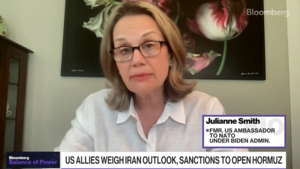
" Even talking about the US formally leaving or just slowly disengaging sends a very dangerous signal to Moscow," Council Distinguished Nonresident Fellow Ambassador Julianne Smith said of President Trump's remarks about withdrawing from NATO.
 Public Opinion
Majorities also oppose using US troops to overthrow governments in Cuba or Colombia, occupy Venezuela, and gain access to the natural resources of other countries.