What the Defense Industry Discussed at the NATO Summit
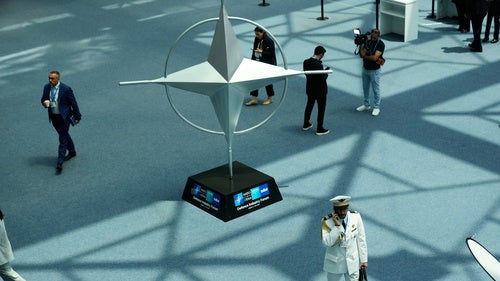
North American and European industry representatives met in Ankara to discuss how to enhance the alliance’s capabilities through increased production, cooperation, and joint procurement.
Defense spending topped the agenda as North American and European leaders gathered in Ankara last week for the 2026 NATO Summit. Reflecting this focus, defense industry representatives met on the sidelines for the Defence Industry Forum, where they discussed how to move beyond the spending debate and turn defense dollars into bolstered military capabilities.
“History has told us . . . that there was a lot of accountability required to ensure follow-up, to ensure that a spotlight was put on this, and that commitments didn't just remain commitments but fulfilled obligations,” said Council Distinguished Nonresident Fellow Deborah Rosenblum, former US acting undersecretary of defense for acquisition and sustainment.
She spoke with Council Vice President of Research for Security and Defense Ariane Tabatabai about what the forum accomplished and what it means for the alliance moving forward.
This interview has been edited for length and clarity.
Let’s get started with the Defence Industry Forum that just took place in Ankara at the NATO Summit. Can you give us a sense of what the purpose of this meeting was and what it accomplished?
Ari, welcome back. I know you were in Ankara yourself.
Fundamentally, this was the biggest success coming out of the summit. I am extremely heartened by the fact that this industry forum—the first ever attached to and associated with a NATO summit—was held. It is an incredibly important step that the alliance took in talking about—now that they have set the benchmark of 5 percent increase based on their GDPs—how they will spend that on their own defense, as well as the collective defense of the alliance.
I also think it is a really important deterrent message being sent to Putin and to Russia. The invasion has required the alliance to take a hard look not only at how it is replacing the military capabilities it's been providing to Ukraine, but also how it is shoring up its own defense in the event that Putin is not going to stop in Ukraine or there is continued gray warfare in Europe or something even more concerning and worrisome. There's been a tremendous amount of discussion around the need to have the industry producing more monies in the defense area, whether that be an individual country, through the European Union (EU), or backfilling in the United States. But with the exception of areas where there's been urgent Ukraine needs, until recently, the work has not been done or completed that's made it concrete. And over the past few years, NATO has spent a lot of time, particularly in the military committees, looking hard at where the capabilities and gaps are for the alliance.
What we had immediately before the summit was the benefit of a lot of hard work that NATO did in defining its military requirements, commitments made by finance ministers in European countries as well as the EU, and putting them together to say, ‘OK, in key areas like counter-drone surveillance, unmanned systems across multiple different domains, better air defenses—these are the areas that we need to be prioritizing, and this is the initial package that we are committed to with the following industry leaders and defense companies, both in the United States as well as in Europe, and this is how we plan to proceed to close those gaps.’
History has told us—whether it was previously under the Biden administration where countries would make commitments, saying, ‘We’ll backfill X or Y or we will provide F-16s’ or whatever the particular capability was that was needed—that there was a lot of accountability required to ensure follow-up, to ensure that a spotlight was put on this, and that commitments didn't just remain commitments but fulfilled obligations. We're now in the exact same place with the NATO Defence Industry Forum.
To me, it was encouraging to hear the Europeans having a more sophisticated conversation around burden sharing based on effects as opposed to pure defense spending. Do you think the conversation is going in the right direction? And what is missing from it, if anything?
I think it is absolutely going in the right direction. What's missing is ensuring that these big announcements aren't just occurring on the margins of a summit, once a year or episodically, but is extended and continued within the NATO infrastructure itself. What I'm thinking about very specifically is the Ukraine war and the need to really look hard at capabilities and revitalize, quite bluntly, the national defense armaments ministers, that structure within NATO.
We think a lot about the policy pronouncements that come out of NATO, the military strategies. But the part that remained a little bit moribund until the last five years was on the procurement side and what is the responsibility at very senior levels of the national armaments ministers. That really became revitalized following the invasion of Ukraine. The sophistication of those discussions increased to include things like co-production, supply chain, rare earths, and critical minerals, and how we can deal with those not just in a crisis, but over the longer term.
One of the interesting things that jumped out at me during the summit was that we are seeing a shift in the way the allies are talking about Ukraine. The shift is away from this view of Ukraine as a recipient of support, equipment, and financial aid, to one of Ukraine as a potential provider of security assistance. You were involved in crafting US policy in the lead up to the 2022 invasion of Ukraine and its aftermath. How would you like to see the lessons learned from the conflict incorporated into NATO defense planning?
Before the conflict began, there were absolute notions and ideas, certainly in the United States, as to how a war would be prosecuted. It wasn’t just in terms of what happens directly on the military battlefield, but areas around logistics, supplies, and what it looked like to have any kind of protracted active conflict. And honestly, a lot of the notions that the United States held were turned upside down on their heads.
As the war progressed, what we saw was Ukrainians’ ability to adapt and innovate in real time and not just on drones, but precision strike and surveillance, and in remarkable ways that continue to challenge, at least for the United States, underlying assumptions as to how future wars will be prosecuted and what will be important, be it in drones, counter drones, unmanned systems, or serious discussions around autonomy.
This isn't just limited to the ongoing conflict in Ukraine. We certainly have seen and continue to see it in the conflict in Iran. We are also seeing it with the way in which our military is thinking about any kind of future conflict in the Indo-Pacific. And you can begin to see it now in the level of experimentation that the US military is doing—the degree to which priority is being put on procuring things that are low cost, but that are in large numbers. We're beginning to that our reliance on highly sophisticated bespoke systems will still have their place and time, but they will absolutely be complemented by what we're seeing on the battlefields in both Ukraine and Iran, and in other planning that's going on for other parts of the world that we're involved in. And it's leading to some really interesting innovation.
We learned over time, probably not quickly enough, that what we needed to do and what the industry needs to do is fundamentally rethink the way in which manufacturing is occurring.
Members of the US defense industry would be the first to say we are learning a tremendous amount of lessons. We're learning it in partnership with the Department of Defense, and we're trying to adapt and bring things to the table that we can iterate on quickly, see how they do, and that would allow for a much more dynamic, innovative environment like we’re seeing in Ukraine.
Against the backdrop of some unsavory rhetoric, US President Donald Trump said he's going to be issuing licenses for Ukraine to build Patriots domestically. It remains to be seen if that actually does happen. Does Ukraine have the ability to produce Patriots domestically?
I don't think that they are going to be able to do it alone. There are going to be elements or aspects of it will be done in Ukraine, but other parts of it are going to be done in the United States. And a lot of the detail has yet to emerge on what we're talking about. Are we talking about PAC-2s that are developed by RTX, which are the older versions? Or are we talking about what Lockheed Martin is doing with the next generation of PAC-3?
Even if we were to wave our magic wands and they had a license waiting for them back in Kyiv, the reality from having a license all the way through to the manufacturing of the interceptors themselves is a very long period of time. This is more of a longer-term confidence-building measure and acknowledgement of the technological know-how that they have demonstrated broadly. I see it as a vote of ‘we're with you,’ as opposed to any magic bullet to help Ukraine with its air defense situation.
At the same time as this is happening, the United States is having its own challenges with its stocks being depleted during the Iran war. I assume, based on everything you said, that you don't believe that the licenses and Ukraine potentially producing them domestically is going to be a short-term solution to this challenge, right?
That’s correct. What's going to pay dividends over the longer term is a lot of the hard work that began under the previous administration the Trump administration is continuing of working very closely with industry around innovating. In the beginning, the notion was that we're just going to produce the way we've always been producing, we just need to have more of it. We learned over time, probably not quickly enough, that what we needed to do and what the industry needs to do is fundamentally rethink the way in which manufacturing is occurring.
The summit obviously was about NATO and European security and burden sharing, but a topic dominating the conversations was Iran. Where all of these things come together is in the Iran-Russia military cooperation that has been deepening as a result of Russia's full-scale invasion of Ukraine. The Iranians provided the Russians with Shahed drones, which the Russians have been using in Ukraine, and which they've been upgrading and building the capacity and the infrastructure to develop themselves. And the Russians have now started to send back those upgraded drones for Iran to use against the United States, Israel, and the Gulf partners. I assume this is not where the cycle ends. Iran is going to have lessons learned from this conflict. And those will find their way back into Russia and Ukraine. Do you think that the allies are doing enough to integrate themselves and to learn lessons from one theater to the other and incorporate that into their thinking and into their planning?
I am very worried about the multi-year pattern of cooperation amongst US adversaries. What we're continuing to see, as you rightly point out, is a level of sophistication in technology transfer, assistance, and capabilities development. And it's growing exponentially.
One of the things that I worry very much about is the way in which US foreign and defense policy has become very transactional. And I'm very worried that our relationships with our allies and partners, particularly in the NATO alliance, but not exclusively, certainly in the Indo-Pacific region as well, not devolve into that same pattern but rather that these be strong cooperative relationships that continue over time and adapt. Things shouldn't be stuck in the way in which they were 10 years ago. The burden sharing argument is very well placed in both theaters. But we cannot let it become transactional because we are now seeing our adversaries developing relationships with our adversaries that are much more akin to alliances.
I gather from everything we've talked about that you agree with me that there should be a Defence Industry Forum at next year’s NATO summit. The 2027 summit is already planned, but there are questions as to whether it will actually take place. If it goes forward and the allies decide to actually have a Defence Industry Forum, what would you want the allies to focus on? Would you change anything to the scope, organization, or anything else?
I absolutely want it to happen. And think it needs to happen as a part of the summit. It proved its usefulness and its success and is something that should be replicated.
The new elements that need to be introduced is public discussion and accountability surrounding commitments and announcements that were made, and where they are now in their obligation and implementation. That way these aren't just announcements for announcements' sake, but also a sense and a deterrent value of saying, ‘We are making real on this.’
The Chicago Council on Global Affairs is an independent, nonpartisan organization and does not take institutional positions. The views and opinions expressed in this commentary are solely those of the author.


Related Content
 Global Politics
From Turkey's F-35 ambitions to Zelenskyy's meeting with Trump, Council expert Ariane Tabatabai unpacks how burden sharing, Ukraine's evolving role, and unresolved tensions over Iran shaped this year's summit.
 Geopolitics
As NATO adapts to wars in Europe and the Middle East, Turkey is becoming harder to ignore. Aslı Aydıntaşbaş explains how Turkey is balancing its alliances, expanding its influence, and positioning itself as a middle power.
 Global Politics
Ahead of the 2026 NATO Summit, Council experts examine deeper fractures over threat perception, alliance trust, and Washington's commitment.
 Public Opinion
A new Chicago Council survey finds bipartisan majorities support the NATO alliance, including US troop deployments in Germany and Poland.