The World Cup Amplified Old Tensions and Deferred to New Politics

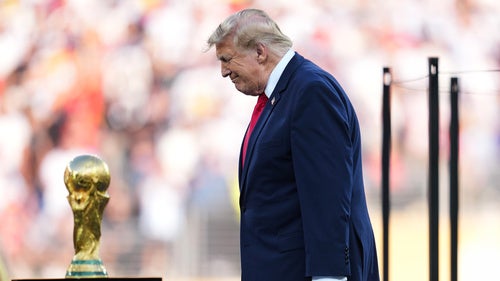
FIFA is increasingly bending to host countries on domestic politics, raising questions about whether global sporting events can still function as unifying forces.
The 2026 World Cup shattered both viewership and attendance records, with more than 6.8 million fans filling stadiums across North America during the expanded 104-game tournament. But its success also came with scrutiny, putting a spotlight on FIFA’s deference to the host countries—particularly the United States.
Concerns about US immigration policies were realized when the Trump administration denied visas to ticket holders from Morocco and other nations, stopped a Somali referee from entering the country, and detained an Iraqi player at the airport. And FIFA President Gianni Infantino’s close relationship with US President Donald Trump sparked outrage after officials overturned the one-game suspension against star US forward Folarin Balogun.
"Infantino is himself now a larger-than-life political figure," Council Senior Nonresident Fellow Alexander Cooley told the Council. "FIFA's governance, its relationship with host cities, its bylaws, its commercial decisions, all of these things now are being scrutinized in part because Infantino himself has styled himself to be almost like the head of a very important international organization."
He spoke with the Council’s Libby Berry about FIFA’s rule bending, the lingering tension between the World Cup’s North American hosts, and how domestic politics may shape international sports moving forward.
This interview has been edited for length and clarity.
The 2026 World Cup has come to a close. What do you think are the big takeaways from this year’s tournament? Did anything stand out to you?
I think the expanded tournament turned out to be a success. There were some cautionary tales about too many matches. In the end, the additional round turned out to have some of the most compelling and interregional games. We saw Morocco and the Netherlands and a great match between Cape Verde and Argentina.
The co-hosting turned out to be a success too.
On the political side, things were more uneven. There were concerns about immigration that unfortunately turned out to impact parts of the game. The Iranian players were initially told they could only fly in for their matches, then they were allowed to stay one more day. It's hard to imagine that this wasn't disruptive to their play and preparation, especially given the fact that they lost very narrowly. We know the Democratic Republic of Congo, for instance, had issues with visas, and a Somali referee was denied entry.
But in terms of everyday experiences, we saw a lot of good news stories. A lot of the fans that came to the United States were really in awe of things that the host cities offered, from the small businesses to friendly people to volunteers. There's a meme going on about the popularity of ranch dressing that was very popular among some European tourists. You hear a lot of goodwill stories of stereotypes about America sort of being overturned through interactions with local populations.
FIFA’s decision to lift the one-game suspension against US forward Folarin Balogun after US President Donald Trump called for a review of the red-card ruling led some to question the international soccer federation's independence. What did you make of the incident and other officiating disputes during the tournament?
When there is a preexisting set of concerns about the politics of a particular organization or the way things are done, any kind of incident that seems to provide evidence for or exemplify that gets magnified. The decision to overturn the one-match ban for the US lead striker was deeply unpopular in much of the rest of the world. It was the number one news story in places like the UK and in Europe. And it was presented as an example of Trump's intervention—and that FIFA was open to political interference because of Infantino and Trump’s close relationship. It was constantly mentioned that Infantino was trying to court Trump, and that he had given the “FIFA Peace Prize” at the World Cup draw in an attempt to ingratiate himself. These kinds of incidents highlight certain narratives that are already out there. In FIFA's case, it's the idea that Infantino cozies up to politicians and cuts special deals with them and is not a guardian or a steward of the game for all.
Recent polling by the Chicago Council and Buendía y Márquez found that majorities of Americans and Mexicans believed the World Cup would benefit their economies and boost tourism, while a survey by Angus Reid found Canadians were concerned about costs. Overall, do you think hosting paid off for North America?
I think the Canadian economic impact tended to be localized in Vancouver and Toronto. In the United States, the tournament was spread out through many more host cities. Initial Bank of America data says overall the economic impact was strong, estimated to be $20 billion.
There was also a net economic impact through advertising and television. Hundreds of millions of dollars of additional revenue were generated in these hydration breaks that FIFA introduced under the justification that in the middle of each half of play, players would need water because of the hot conditions. Essentially this created four quarters of the match, and Fox could show TV advertisements right in the middle in a way that they hadn't before.
Mexico also was quite successful given the hometown run in Mexico City and in the Azteca.
But I think [this year’s tournament] raises the question of if it is possible even for a single country that's not the United States to host it given all of the facilities, all the stadia, all the infrastructure investments that it needs? It seems like we're moving to a much larger-scale event. If it were difficult before to find the funds to host something like this, now it's becoming really prohibitive.
The Trump administration’s trade policies have strained US relations with both Canada and Mexico over the past year. How do you think the tournament impacted ties between the three nations?
I think the tournament tended to amplify narratives and concerns that were there before. You had all three North American leaders in one of the luxury boxes at the final, and there didn't seem to be a lot of warm interaction among them. The issues that are there on trade, on immigration, on a kind of lament about hostility and national stereotypes; they're still there. I don't think this was a great unifier.
At the same time, I think it is an interesting blueprint for how neighboring nations can co-host. Given the economic scale of what's required, I think it provides a model for the next World Cup where we're going to have Spain, Portugal, and Morocco all staging the event jointly.
The United States is set to host the 2028 Summer Olympics in Los Angeles. What do you think organizers learned from the World Cup?
That there is going to be a political spotlight on the events and on the games, and on the domestic political situation. Immigration, partisan divides, or using the games as a way of promoting a kind of domestic image—all of these are going to be live concerns in 2028. The narrative is that these games are meant to unify the country; they're meant to unify the world. But what we see instead is a lot of talking points around the politics of the host, as well as the broader geopolitics embodied in the games.
We don't know what geopolitics will be like in two years' time. We don't know whether the United States will be in conflict with another country that's invited. I think one of the issues that we're going to be looking at is Russia's participation in the games, with the International Olympic Committee (IOC) lifting a ban on that.
The narrative is that these games are meant to unify the country; they're meant to unify the world. But what we see instead is a lot of talking points around the politics of the host.
Another issue I think that's a very live one now for the IOC but also FIFA going forward is the participation of trans athletes. The IOC has aligned itself with the current US administration's view on banning the participation of trans athletes with biological male traits in the women’s game. The head of the White House committee announced that in negotiations with FIFA for possibly hosting the Women's World Cup in 2031, they are demanding a similar set of policies banning trans athletes. So, you're seeing these social and cultural divides in the United States being projected onto the governing bodies of these sports.
Anything else you think is important to understand about this moment in global sports?
There was an incident during this World Cup that got me thinking about FIFA's evolution on some of these political rights issues. A Paraguayan senator made racist comments about Kylian Mbappé, the French star player. FIFA used to have quite a strong set of anti-racism policies, which it's pretty much rolled back over the last few years under the mantra of not wanting to interfere or lecture on these issues.
I think what you're seeing is the stepping back from liberal-values advocacy that organizations like FIFA and the IOC once championed and deferring to host countries. As both the IOC and FIFA increasingly court non-liberal hosts, this is going to be an issue. Thinking about Saudi Arabia as a host in 2034, is FIFA really going confront Saudi Arabia over things like gender policies? Probably not. We saw in Qatar a dispute about the status of LGBTQ people, and Infantino actually threatened to issue yellow cards to athletes wearing rainbow armbands in protest.
It seems increasingly that FIFA is going to defer to whatever the domestic politics and the domestic laws of these organizing countries are. This opens up questions as to how inclusive these games are going to be—and the role of these federations in championing the rights of all athletes to participate.
The Chicago Council on Global Affairs is an independent, nonpartisan organization and does not take institutional positions. The views and opinions expressed in this commentary are solely those of the author.

Related Content
 Global Politics
With the tournament set to kick off at a moment of geopolitical strain, authoritarian powers are seizing an opportunity.
 Public Opinion
Americans and Mexicans think the tournament will be economically beneficial, while Canadians are concerned about costs.
 Global Politics
By barring Russian athletes from competing under the Russian flag, the International Olympic Committee demonstrated its power as a global norm-maker. Now, sporting federation leaders are seeking to distance their games from geopolitics.