Why the War in Iran Prompted a Global Energy Crisis—and How it Might End

The widening conflict in the Middle East underscores the recurrent vulnerability of fossil fuel energy systems—and why a pivot to renewables is critical.
The Trump administration’s attack on Iran has roiled energy markets. In response to US and Israeli strikes, Iran effectively closed the Strait of Hormuz by threatening shipping traffic, sending a fifth of the world’s oil and natural gas supplies offline almost overnight. In the two weeks since, oil prices have risen from $71 to more than $100 a barrel.
About 100-150 tankers transited the strait on an average day before the conflict began, carrying some 20 million barrels from the Persian Gulf and the Gulf of Oman to the Indian Ocean. Now, tanker traffic has dwindled to the single digits on some days. Eighteen ships have been struck by military attacks in or near the strait, and Iran’s new Supreme Leader Ayatollah Mojtaba Khamenei said Thursday he plans to keep the passage closed.
With no clear end in sight, questions surrounding the war’s long-term effects have begun to surface.How could the conflict shape economies and geopolitics? And what could its impact on energy prices mean for the transition away from fossil fuels?
What’s affecting energy markets
When it comes to energy prices, much depends upon the duration of the war. There are signs the conflict could drag on for weeks, if not longer.
It is worth noting that today’s oil prices are not unprecedented. The cost per barrel has risen to more than $100 on several occasions this century, most recently after Russia’s invasion of Ukraine in 2022. However, the rate of the current price increases have conjured fears of a 1970s-style energy crisis, with the combination of high oil prices and depressed economic growth potentially contributing to stagflation.
The White House and its supporters have suggested that Iran’s “unconditional surrender” is near at hand, and the current price hike will thus be transitory. They point to the decimation of the Iranian Navy, the steady decline in rocket attacks, and diminished drone strikes around the region as signs of impending victory for the United States. But even if US President Donald Trump declares victory and brings the fighting to an end tomorrow, lingering geopolitical uncertainty and the inevitable delays in getting shut-in oil wells back online could keep oil prices elevated for months.
Even if US President Donald Trump declares victory and brings the fighting to an end tomorrow, lingering geopolitical uncertainty and the inevitable delays in getting shut-in oil wells back online could keep oil prices elevated for months.
For its part, the international community is prepared to take extraordinary measures to bring down oil prices and get tankers moving through the strait again. The International Energy Agency announced Wednesday that member states would release up to 400 million barrels of oil from their strategic reserves—the largest single release of strategic oil reserves ever, and more than double what was released after Russia attacked Ukraine.
The Trump administration has signaled a willingness to direct the US Navy to accompany tankers through the Strait of Hormuz and further back tankers with up to $20 billion in reinsurance through the Development Finance Corporation. The United States has also bombed Iranian boats that were reportedly laying mines in the strait and issued a waiver allowing India and other countries to buy sanctioned Russian oil without repercussions until April 11. The White House is even considering temporarily waiving the Jones Act, which currently requires the use of American ships to move cargo between US ports.
Unfortunately, global shipping analysts worry these moves will not be effective in restoring supply and bringing down prices meaningfully. For shipping companies, insurance is not the issue. They simply cannot accept the risk of having their ships destroyed. As long as the threat of attack persists, real or imagined, there will be little appetite among major shipping companies to travel through the strait—even accompanied by a naval escort. At its narrowest, the strait is less than 25 miles wide, with shipping confined to two narrow sea lanes. This leaves ships extremely vulnerable to attacks from the surrounding high ground, something Houthi rebels in Yemen have demonstrated repeatedly in recent years in the Bab el-Mandeb, a similar maritime chokepoint that connects the Red Sea to the Gulf of Aden.
In the absence of a clean political settlement of the conflict, restoring confidence in the safety of transiting the Strait of Hormuz could ultimately require deploying ground forces on Iranian territory to prevent continued attacks along the critical shipping route. Setting aside the obvious military risk involved, even the consideration of such a deployment would likely be politically perilous for the Trump administration.
Releasing emergency oil stockpiles will not immediately fix the issue either, as the release of IEA member reserves will not happen all at once. Analysts believe that some 2-3 million barrels will likely come online per day, which will only partially compensate for the loss of some 15 million barrels per day to the closure of the strait. Markets are also arguably still underpricing oil on the unsubstantiated belief that the conflict will end soon. If these expectations are not realized, oil prices could conceivably rise to $150 a barrel or more.
As oil trades as a global commodity, even major energy exporters like the United States are subject to fluctuations in the market. Individual consumers and industries that depend upon oil and gas, including transportation and fertilizers, may need to adjust to survive a sustained uptick in costs.
The impact on countries and consumers
Globally, the current energy shock looks to be the most severe disruption since the Suez Crisis of 1956, which lasted nine days and affected 10 percent of global oil supplies. In that instance, there was spare capacity equal to some 35 percent of global demand, much of it in the United States. The current crisis, however, has affected a larger share of global demand, and analysts worry that major producers have limited spare capacity to bring online this time around.
Swing suppliers like Saudi Arabia and the United Arab Emirates are finding their infrastructure vulnerable to Iranian strikes and their oil exports subject to attack if shipped via the Strait of Hormuz. As a result, Saudi Arabia is rerouting its existing exports through a port on the Red Sea. Even with this effort, it may only reach 70 percent of previous export levels. Qatar, the world’s second- leading liquefied natural gas (LNG) producer, halted production last week after military attacks on its facilities. All of this will have a sustained impact on oil and natural gas prices.
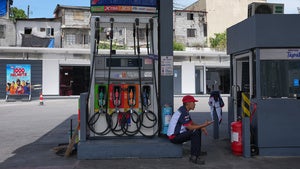
In the United States, a gallon of gas has increased to average of $3.54, a 19 percent price jump from late February. Still, Americans pay less for natural gas than other countries, as the United States is the world’s leading natural gas exporter and receives limited natural gas imports, primarily via pipeline from Canada. Other countries are much more sensitive to the price and supply of energy from the Middle East. India and Pakistan are heavily reliant on imported oil and gas, and the price spikes and shortages have forced them and other countries in the region to make uncomfortable choices. Pakistan has moved to close schools for two weeks and adopted austerity measures to reduce energy use. Bangladesh and Myanmar have introduced rationing. The Philippines is adopting a four-day workweek, summoning memories of the society-wide adaptation that was required during the COVID-19 pandemic.
Other fossil fuel-derived products are also at risk, namely fertilizer, which will impose higher input costs on farmers worldwide just as the planting season gets underway in the Northern Hemisphere. Such agricultural supply shortages could have a cascading impact on crop production over the coming months.
An incentive to decarbonize
A pivot to renewables and electric vehicles (EVs) will not provide an immediate solution to short-term energy shortages, but the current conflict in the Middle East—arguably at least the third major war in the region over the past 35 years—underscores the recurrent vulnerability of fossil fuel energy systems. As advocates of renewable energy often say, no blockade can stop the sun from shining.
A pivot to renewables and electric vehicles (EVs) will not provide an immediate solution to short-term energy shortages, but the current conflict in the Middle East—arguably at least the third major war in the region over the past 35 years—underscores the recurrent vulnerability of fossil fuel energy systems.
The current moment only reinforces China’s decision to transition to EVs, which now constitute more than half of new vehicle sales in China. The transition has enabled China to move beyond its peak oil demand and enhance its energy security with millions of what former US Department of Energy official Jigar Shah calls “negabarrels.”
Beijing is also set to be the beneficiary of other countries’ rising demand for clean technologies—including renewables, batteries, and EVs. Solar panel and EV imports from China are exploding in places as diverse as Pakistan, Cuba, and Ethiopia. Even the European Union and Canada—which have worried Chinese competition may hollow out their own auto sector—are also encouraging Chinese foreign direct investment, which will bring Chinese EV firms into their countries to make cars locally. This may create another source of vulnerability for importing countries, as solar panels (and the vehicles and batteries they power) do not require a constant flow of liquid fuels to operate. The Trump administration’s single-minded approach to promoting fossil fuel consumption at all costs bodes ill for US competitiveness over the medium term, as demand for hydrocarbons and internal combustion engines declines.
In targeting Iran, the Trump administration launched an illegal war of choice on a major fossil fuel exporter known to be capable of blocking a key chokepoint in the global economy. In the lead-up, Trump undercut alternatives to fossil fuels domestically by halting the buildout of renewables infrastructure supported by the Inflation Reduction Act and the Bipartisan Infrastructure Law. He further scrapped incentives and regulations that supported EV purchases. These moves have all deepened the vulnerability of the American consumer, and the wider US economy, to disruptions in global energy supplies.
Ultimately, the Trump administration’s decisions to eschew renewable energy and EVs and subsequently “punch a hornet’s nest” in Iran undermines both America’s moral standing and its strategic position. So far, it seems the only winners in the Iran war are China and Russia. Trump should declare “Mission Accomplished,” end large-scale military operations in Iran, and focus on restoring commercial shipping through the Strait of Hormuz. Until that happens, matters are likely to only get worse—for the United States and the wider world.
The Chicago Council on Global Affairs is an independent, nonpartisan organization and does not take institutional positions. The views and opinions expressed in this commentary are solely those of the author.


Related