What a Snap Election Could Mean for Israel and Netanyahu

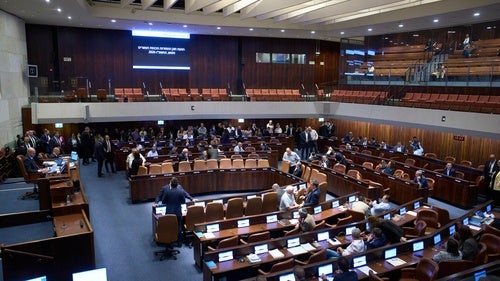
Disputes within the Knesset over a military draft bill could prompt a change in Israel's leadership. What would it take to get there?
In May, Israeli lawmakers voted unanimously to dissolve the Knesset, initiating a process that could result in a snap election and the potential ousting of Prime Minister Benjamin Netanyahu.
Israel’s 25th Knesset had been expected to be one of the few to serve its full four-year term. But while lawmakers successfully approved a budget in March, Netanyahu’s coalition government failed to pass legislation that would exempt ultra-Orthodox yeshiva students from mandatory military service, prompting key parties to call to disband the 120-seat Knesset. Faced with a possible rebellion, Netanyahu’s Likud Party submitted the dissolution bill in an effort to retain some control.
The earliest a snap election could be held is 90 days after the bill is passed. That means that even if the bill moves quickly through the government, it is likely that the election will occur just weeks ahead of the original October 27 election date. On Monday, the Jerusalem Post reported a range of possible dates between September 8 and October 20.
Netanyahu has pushed for the last possible date, believing it will give him time to pass parts of the agenda key to his base, including judicial reform. In the first of three readings, the Knesset voted on Tuesday in favor of a contentious bill that would severely weaken the ability of the judiciary to serve as a check on the government by dividing the position of attorney general into two roles.
A later election date would also give Netanyahu more time to potentially push forward military and diplomatic successes in Lebanon, Iran, and Gaza. The prime minister pledged “total victory” as his metric for success in the war against Hamas in December 2023. Yet Hamas remains in Gaza, Hezbollah is attacking the north of Israel, and the regime in Tehran is still standing (and negotiating with the United States to end the war). The prolonged conflicts are one of the main reasons the current coalition is polling well below the 61 seats it needs to be reelected.
Inside the Knesset Divide
Israel is a parliamentary democracy with a single legislative chamber. No party has ever received 50 percent of the vote outright, which means Israeli elections are largely focused on two things: determining which bloc can secure 61 seats and who will lead it.
Netanyahu is Israel’s longest-serving prime minister, occupying the role three separate times and largely uninterrupted since 2009. The current coalition is made up of five parties: Netanyahu’s Likud Party, Shas, the Religious Zionist Party, Otzma Yehudit, and New Hope. Considered the most right-wing government in Israel’s history, the cabinet is united by a desire to weaken the judiciary, assert traditional values, and, to varying degrees, foreclose any diplomatic horizon for the Palestinians—a commitment that was strengthened after the October 7 attack.
Though Netanyahu is the undisputed leader of the bloc, he has more in common ideologically with parties in the opposition, especially when it comes to national security issues. But Netanyahu’s ongoing corruption trials have pushed him into political alliances with Israel’s far-right, which has long advocated for judicial reform. His desire to spare himself from criminal charges has been a motivating factor in his continued attacks on the judiciary.
Recent polls show Netanyahu’s coalition party failing to secure a majority in the election, indicating a real pathway for the opposition to gain control.
Recent polls show Netanyahu’s coalition party failing to secure a majority in the election, indicating a real pathway for the opposition to gain control. At the end of April, former Prime Minister Naftali Bennett and current opposition leader Yair Lapid announced that they would join forces and merge their two parties. Led by Bennett, their party has been polling at around the same level as Netanyahu’s Likud Party. Current Knesset member and Yashar! Party leader Gadi Eisenkot has also emerged as a challenger. The former Israel Defense Forces (IDF) chief of staff, who lost his son in the early months of Israel’s war against Hamas, has been gaining in the polls since Bennett and Lapid announced their merger.
According to recent reports, officials close to Netanyahu are moving to disqualify the Arab Israeli Ra’am Party from the elections. Ra’am was part of the “Change Coalition” that briefly interrupted Netanyahu’s rule from June 2021 to December 2022. Led by Bennett and later Lapid, the historic coalition was the first to include an independent Arab Israeli party as an official member. But by creating such a government, supporters of Bennett, many of whom came from the less ideological but still pro-settler religious right, felt betrayed. After its dissolution, Netanyahu resumed power and his coalition worked hard to reestablish the taboo of working with Arab parties—a message that took on greater force after the events of October 7.
The Issues Driving the Opposition
The opposition has outlined several priorities. The first is the convening of a state committee of inquiry into the events leading up to October 7. Despite public pressure, Netanyahu has refused to back a commission likely due to his distrust in the judicial system and the possibility of being held liable given his position of power.
The opposition is also campaigning against judicial overhaul. Following the introduction of the proposal in 2023, hundreds of thousands of Israelis flowed to the streets each week tin protest, arguing the reforms would empower the sitting government by removing checks and balances. Netanyahu’s government is currently trying to fast-track pieces of the proposal in advance of the elections.
Were the opposition parties to come to power, it is also likely that ultra-Orthodox members would be required to serve in the military. While Israel’s Supreme Court has ruled such exemptions to be illegal, battles over the mandate have continued and is an issue that unites voters across the opposition and the coalition’s non-ultra-Orthodox base. In May, the IDF said they were in urgent need of 12,000 troops. The shortage amid a multi-front war has made the lack of military service burden sharing apparent to Israelis and, for many, pushed the issue to the top of the agenda.
The Future of Israel's Leadership
The election is expected to be particularly bitter. At stake is the future of Israel’s regional security approach and the balance of power between the legislative and judicial branches.
Who shows up to vote will dictate what happens. In recent years, Arab voter turnout has been 15 to 20 percent lower than the nationwide turnout, directly affecting the size of the blocs and the potential coalition math. When Arab parties have run as a joint technical bloc, turnout has increased. Should they pursue this path, the result could mean the Arab parties jump to up to 15 seats and the opposition is faced with the question of whether to include them in a coalition or find a way to work with Netanyahu or the ultra-Orthodox.
At stake is the future of Israel’s regional security approach and the balance of power between the legislative and judicial branches.
Several smaller parties currently polling at or below the minimum share of the national vote a political party must receive to enter the parliament (3.25 percent) could also impact the results. If they run and fail to meet the threshold, those votes will be wasted. For example, should the Religious Zionist Party fail to hit 3.25 percent, the coalition bloc would drop by four seats, giving greater representation to the parties elected. And there are of course scenarios where Netanyahu manages to retain his position. In the case of a deadlock, he could convince members of the opposition bloc to join him, meaning neither bloc would hold a majority.
Regardless of whether the election happens on September 8, October 27, or any date in between, the vote will be critical for the future direction of Israel. How it goes could determine whether Netanyahu cements his legacy in office or potentially in prison. And what happens has the chance of not just shaping the country but the entire region.
The Chicago Council on Global Affairs is an independent, nonpartisan organization and does not take institutional positions. The views and opinions expressed in this commentary are solely those of the author.