What the New World Screwworm Outbreak Reveals About US Agricultural Security

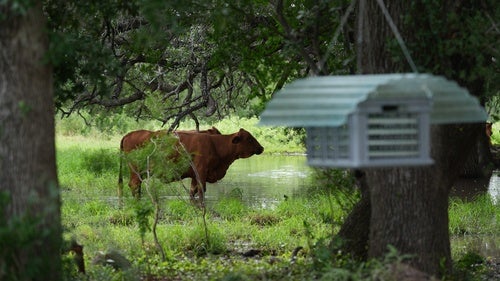
The parasite's reappearance for the first time in decades is emblematic of broader vulnerabilities in the agricultural sector.
New World screwworm has appeared in the United States for the first time in six decades, posing a major threat to the US livestock industry. The pathogen, timed as the federal government drives fewer resources into outbreak management, may force a reckoning in the agricultural sector as security gaps grow.
“The New World screwworm is emblematic on where we are more broadly on agricultural security,” said Council Distinguished Nonresident Fellow Deborah Rosenblum, who previously served as US assistant secretary of defense for nuclear, chemical, and biological defense programs. “We just have not seen the investments that are needed to keep us safe.”
She spoke with the Council’s Val McMakin about vulnerabilities in critical infrastructure, challenges in attribution of pathogens, and where things stand on readiness to respond to agricultural security threats.
This interview has been edited for length and clarity.
The parasitic New World screwworm has reappeared in the United States for the first time in roughly six decades. What does this kind of reappearance signal to you about how vulnerable United States agricultural security is more broadly?
The New World screwworm is emblematic on where we are more broadly on agricultural security. And even though this seems to be a naturally occurring event that is affecting beef in the United States, it does raise a number of vulnerabilities that could be there if there were to be some kind of adversary, terrorist, or nation state who is intent on fooling around with our food supply here in the United States.
There are also global implications because the United States is a major exporter of food to the rest of the world. The US Department of Agriculture (USDA) is in a tough spot. Their primary responsibility is related to trade policy and promoting the sale of United States agricultural products abroad. They really don't have the manpower or the funding to be able to dedicate to close some of these security gaps. I also think we're relying on very old technology. We're going to be sterilizing flies in order to cut down on the number of screwworm flies that are in the United States using old technology. We just have not seen the investments that are needed to keep us safe and secure in the agricultural sector.
You've pointed to some gaps like lack of staffing and not enough funding as key vulnerabilities here. Can you explain why those matter for the mitigation and response to an attack or to a pathogen like the New World screwworm?
I think there's some systemic problems. First and foremost is the fact that we don't have a new Farm Bill. The Farm Bill is renewed every five years but has been stalled. The last one we had was from 2017. Without a Farm Bill, USDA doesn't have enough funding to carry out the multiple missions, including security that it's been given. I think USDA is a little bit back on its heels right now because of the layoffs and furloughs that occurred in the beginning of the Trump presidency and administration. We just don't have the number of inspectors that are out there looking for where these gaps are. It also is not allowing us to have a policy discussion around having foreign countries being able to buy US farmland. There's been, over the last five to seven years, a large growth in Chinese ownership of US farmland. And while some of that needs to go through national security approvals in a process that we call Committee on Foreign Investment in the United States (CIFUS), the volume of purchases has far exceeded the ability of the federal government to stay on top of the licensings that are required there.
We also really don't have adequate risk communication around the agricultural sector in the United States. We often see the headlines, like in this case on the New World screwworm, but there is not adequate risk communications so that the public knows what is risky, what is not, and ways in which they can have an important voice in alerting officials if things don't seem right in their community. From a national security perspective, we have long been very concerned that in the event of crises—let alone an actual war—our adversaries would try and infiltrate our critical infrastructure. We've seen that certainly in the banking system and financial services, but we've really seen less policy discussion around the agricultural sector, which is pivotal to our economy and to the health of Americans, as well as those overseas who are reliant on US food.
I think a really good example here is, in 2024, there was an outbreak of highly pathogenic avian influenza or H5N1 which spread around the country. It killed 300 million birds, it drove egg prices as high as $8 per dozen in some cases, and it jumped to poultry, swine, cattle, and I believe even a peacock. Farmers and ranchers, when facing that prospect of depopulation, their lost income, and confidentiality risks with their neighbors and their communities, became very wary of testing and reporting. This made tracking and mitigation very difficult when coupled with the challenges you mentioned about the lack of a Farm Bill and inadequate staffing. Do you worry that the combination of those two things could be exploited by an external actor?
I really do. I think that from a national security perspective, when we look at the areas within the US mainland as well as Alaska and Hawaii, and we look at important sectors, it's very reasonable to assume that an adversary will go after the soft underbellies—areas that are not as secure as other areas. It's very reasonable to assume that adversaries will home in and see agriculture as a particularly vulnerable sector. In my mind, it's up there with water. I know there's been a lot of concern, particularly post-COVID, around wastewater surveillance but also surveillance of water systems more generally. We have not had that same wake-up call in the agricultural sector. It is a real vulnerability, and I think it's going to become worse if we don't have federal action, much better coordinated activity going on between states and localities, bringing industry much more actively into this conversation, and figuring out ways to avoid putting our farmers in a position of having to decide, ‘Well if I invest in vaccines but my profit margins are already very low, what does that mean?’ Anytime we create disincentives from taking preventative action in the area of security, I do think it is quite worrisome.
You've mentioned that a deliberate attack on our agricultural system might be almost impossible to distinguish from a natural outbreak. How might our policy response be impacted? This is spread across multiple agencies. You mentioned that USDA is the lead agency, but we have the Department of Homeland Security (DHS), state animal health officials, and others who are involved here. Can you talk a little bit about how that network of agencies involved might make it challenging to respond to an outbreak?
I think attribution, whether it's in agricultural security or in public health, is one of the most difficult things that the national security community wrestles with. The reality is a president very quickly in a crisis is going to ask, ‘Who is responsible for this? Is this an adversary or is this something that is naturally occurring? From a national security perspective, how do I look at this?’ And the inability to respond to that is going to be a major problem. Being able to get after the attribution question from a national security perspective is vitally important.
I also believe very strongly that the deterrent impact has a huge factor. The private sector and financial institutions are much better shored up against cybersecurity. They have spent investments and money, decades of looking after this issue. That has a deterrent value. We need to get to that same place in agricultural security where we can't guarantee that an adversary won't try to hit a soft underbelly, but if they know the reality that they're going to be caught quickly or that we're going to be alerted very early on that there's something wrong, it can get them to rethink.
Do you think there's enough conversation about agricultural security policy happening right now?
Not at all. Whether it is because of a million competing priorities, disruption to the ability of the federal government to be helpful in a variety of these circumstances, the delays in the Farm Bill, we just see multiple circumstances where when something goes wrong and it's like a flash in the pan, but then it goes away. There is no sustained dialogue, which in my experience is absolutely needed in order to make real progress.
Do you have any thoughts for how to make sure that New World screwworm isn't just a flash in the pan moment?
One, I do think it's really important that the public raises the Farm Bill with its elected officials. We're long overdue to get this particular element renewed. I also think there should be public pressure put on the Trump administration. They did a very good job early on in identifying agricultural security. There was a white paper, a series of executive orders that were put out that put a spotlight on this issue as well as laid out a variety of different roadmaps to be taken by different federal agencies. But I'm very fearful that implementation of that has lagged. Part of that goes back to the lack of consistent funding. We also have had a real depletion of the federal workforce that's contributed to that. We need our elected officials to ask more about this, hold hearings on this, and get a broader discussion going so that this doesn't just fall off the table.
The House-passed Farm Bill has a large focus on repayment for producers, training for veterinarians, and disease traceability, but less focus on the security tools you mention. Do you think that one of the gaps that exists is between the Farm Bill versus the National Defense Authorization Act? A lot of the security tools are handled in that authorization, and the Farm Bill has traditionally focused less on that.
We can't keep giving our military and Defense Department responsibility for everything if it happens to have a security word attached to it. I also would worry that it would let agencies and, in this particular case, USDA notably off the hook. I think that there are things that can be done, particularly at the executive level, where the president can ask the Department of Defense and other security agencies to help USDA and support them. But I fundamentally don't think responsibility should rest there or that our authorizers should put it there. It should be solidly as part of the Farm Bill.
The Chicago Council on Global Affairs is an independent, nonpartisan organization and does not take institutional positions. The views and opinions expressed in this commentary are solely those of the author.