The Upside to Donald Trump's Unorthodoxy

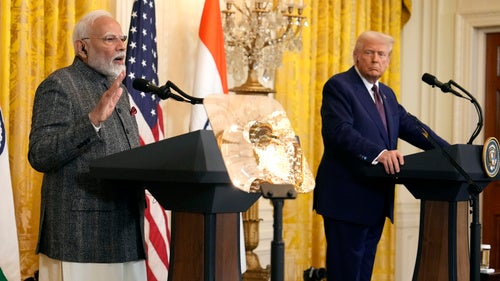
After months of punitive US tariffs, President Trump and Prime Minister Modi announced a trade deal between the world’s two largest democracies. But India has been following a now familiar pattern—building resilience in the face of a disruptive Washington.
US President Donald Trump announced this week that he and Indian Prime Minister Narendra Modi have agreed to a trade deal that will see US tariffs on Indian goods lowered to 18 percent. The deal comes just days after the European Union and India signed a massive free trade agreement, suggesting that President Trump is continuing to calculate and recalibrate his approach to secure economic but also geopolitical benefits for the United States.
While the details of the deal remain scant, it holds the prospect for patching the rupture between the world’s two largest democracies and putting the US-India relationship back on track. In a post to Truth Social announcing the deal, Trump referred to Modi as one of his “greatest friends.” Modi responded in kind, calling Trump a “dear friend” on X.
Bipartisan consensus on the strategic importance of the US-India relationship has grown over the last two decades, spurred on by the developing rivalry between the United States and China. The George W. Bush administration pushed through the nuclear cooperation framework, which signaled an end to a 30-year ban on nuclear energy trade with India. Between 2000 and 2014, trade between India and the United States grew from $19 billion to over $100 billion. President Trump and Prime Minister Modi exchanged high profile visits during Trump’s first term, with the two committing to further defense and technology cooperation.
The relationship between the two countries deepened during President Joe Biden’s tenure amid worsening tensions between the United States and China—but not without strain. Biden's pitting of democracy against autocracy was out of sync with India’s approach to its foreign policy. India’s abstention from a 2022 United Nations resolution condemning Russia’s invasion of Ukraine and the United States' decision to impose sweeping sanctions on Russia created further friction in the relationship. Still, the US focus on China as its pacing challenge, ensured that any challenges with India were overcome.
India welcomed President Trump’s return to the White House with an anticipation of a US foreign policy marked less by human rights and the promotion of democracy, and more by a personal connection and pragmatic cooperation. Trump’s decision just a few months into his second term to levy a 25 percent ‘reciprocal’ tariff and, later, a 25 percent penalty tariff over India’s purchase of Russian arms and oil came as a shock.
If the abiding question for this period is whether President Trump’s unorthodox approach is unlocking deadlocked situations and creating more permanent changes in the existing international order, then India’s response signals that the answer is yes.
If the abiding question for this period is whether President Trump’s unorthodox approach is unlocking deadlocked situations and creating more permanent changes in the existing international order, then India’s response signals that the answer is yes.
US tariffs on India have been costly. Hundreds of thousands of labor-intensive jobs in sectors including textiles, gems, jewelry, and seafood were put at risk, and the uncertainty surrounding the tariffs prompted the value of the rupee to fall.
If the cost to India of Trump's tariffs were minor, India may simply have waited it out. Instead, India’s response has been to build more resilience at home, adopting new market reforms designed to increase investment and drive economic growth. India has also sought to diversify its partnerships approach. The country recently entered into agreements with the United Kingdom, Oman, and Nordic countries, and is in talks with Peru, Chile, Israel, the EAEU bloc, and the Mercosur grouping.
India is not the only US partner that is looking to diversify its partnerships. Europe is doing the same, but not all of this is being coordinated by Brussels. Greece has made clear that the European Union and NATO cannot meet the full range of its security concerns in the Eastern Mediterranean. This week, Greek Defense Minister Nikos Dendias affirmed to an audience in Washington that the country is deepening its security and defense partnership with Israel.
The benefits of Trump’s unorthodox approach may also extend beyond US partners. On Thursday, the Chicago Council on Global Affairs hosted Comfort Ero, president of International Crisis Group, to share insights from the organization's report, “10 Conflicts to Watch in 2026.” The report is worthy of a close read, not least for its comment on President Trump’s unorthodox approach to conflict, which the report claims, “can be an asset.”
“It is hard to imagine another US leader meeting Syria’s new president, Ahmed al-Sharaa, while he was still a US-designated terrorist, or moving quickly thereafter to offer Syria vital sanctions relief,” the report states. “The president’s envoys, who often are friends or kin with a direct line to him, can act fast and take risks.” But the report adds that “the flip side of unorthodoxy, though, is inexperience,” and that negotiators may “squander” the very opportunities that the president unlocks.
If the upside to Trump’s unorthodoxy is the growing resilience among US partners and allies, then the downside is the loss of trust that the United States built over the years with its closest partners. Even if a deal between the United States and India salvages the economic ties between the world’s two largest democracies, it will take far longer to restore this trust. As thousands of policymakers and foreign policy experts convene next week in Germany for the Munich Security Conference—to which Germany's far right AFD party has been invited for the first time—we may also begin to see the contours of a transatlantic partnership that endures not only in the absence of trust, but in the presence of deep suspicion.
The Chicago Council on Global Affairs is an independent, nonpartisan organization and does not take institutional positions. The views and opinions expressed in this commentary are solely those of the author.