Trump Fractured NATO. Can a New Congress Restore the Alliance?
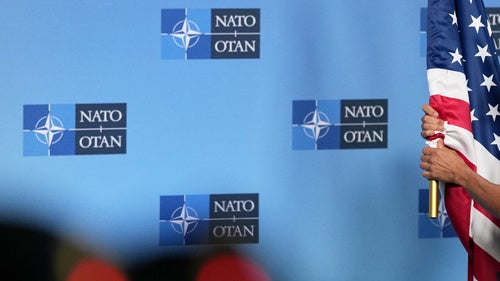
America’s allies are watching the US midterm elections closely and preparing for potential foreign policy shifts.
The transatlantic alliance is facing pressure on multiple fronts. Russia’s war in Ukraine shows no signs of slowing down, bringing the Russian threat closer to NATO’s eastern flank. The US-Israeli war against Iran continues to roil the global economy, raising gas and fertilizer prices. And US President Donald Trump’s repeated threats to annex Greenland and make Canada the 51st state have left NATO members wondering if they can still count on the United States.
Yet America's allies are hopeful the US midterm elections will spark some degree of recalibration. In fact, “there is tremendous expectation on the other side of the Atlantic that some sort of significant transformative change is on the way,” says Council Distinguished Nonresident Fellow Ambassador Julianne Smith, former US permanent representative to NATO.
She spoke with Council Vice President of Research Ariane Tabatabai about what is at stake for NATO as Americans head to the polls and whether a new Congress could actually put the alliance back on track.
This interview has been edited for length and clarity.
Ariane Tabatabai: What are NATO allies paying attention to when it comes to the midterms? What are they watching most closely?
Julianne Smith: Allies are watching very closely to try and get a gauge as to where the American public is on issues related to Europe, the European Union, to NATO, and Ukraine and Russia. They obviously have a basic understanding of the fact that our elections are not usually rooted in questions of foreign policy, especially the midterm elections. And yet, many of them are hoping to see some sort of shift or indication that the United States is positioning itself to put greater emphasis on its relationship with Europe. You'd be amazed—you encounter people all across Europe that are literally looking race by race at the midterm elections. There is tremendous expectation on the other side of the Atlantic that some sort of significant transformative change is on the way.
As you rightly noted, foreign policy doesn't drive elections, but the outcome of the elections is certainly going to shape certain parts of the Trump administration's approach to NATO and what it can and can't do. Can you talk to us about what the outcome of the midterms might mean for NATO?
Let's start with Ukraine. The Europeans were disappointed to see the United States cut off all security assistance early on in President Trump's tenure. And they are hopeful that, should control of the House and Senate change, perhaps America's policy vis-à-vis support for Ukraine could change as well. But it's important to be careful here.
Congress certainly does hold the purse, and if the Democrats take the House, they'll be in charge of appropriations. As we heard from some of the members of Congress that recently attended the Warsaw Security Forum, there are Democrats that are hoping that they could insert support for Ukraine back into various pieces of legislation and make that stick. That is a prospect, depending on the degree to which the ‘blue wave’ even happens. But ultimately, at the end of the day, the president will really control delivery of that assistance.
We have a program right now called the Prioritised Ukraine Requirements List (PURL), which allows Europeans to purchase American capabilities and weapons systems to send to Ukraine. If there was an effort to balloon that program or even to provide direct assistance to Ukraine and reverse our policy, we have to understand that this is a give-and-take between Congress and the executive branch, and the White House will continue to have its finger on the button.
On NATO and force posture, that's another interesting twist. The 2026 National Defense Authorization Act (NDAA) actually bars the administration from reducing US force posture in Europe below 76,000 troops for longer than 45 days. So, we already have a considerable bipartisan consensus on the need for us to maintain a rather robust presence in Europe. But what could happen is that we could see a flurry of hearings on force posture, with Democrats determined to try and learn more about the details of how that decision was taken. Congress has authorities and control over multiple security and economic and trade factors and issues, but it's always a question of how much the executive branch really acknowledges the role of Congress and how much Congress will work to exert those authorities. To date, we've seen Congress essentially handing over much of its power and influence to the White House. The three equal branches of government feel slightly off kilter at the moment, with the executive branch really trying to exert full control over how we posture ourselves on a variety of economic and security issues. What I would be watching for is the degree to which shifts inside the Republican Party, maybe tilting slightly away from the president, open up opportunities for Democrats and Republicans to reassert the authorities that they have over US policy writ large.
Let’s shift our attention to the 2027 NDAA, which has stalled in Congress. How do you think the outcome of the midterms might affect negotiations? Do you expect more provisions like the one you mentioned on force posture will make an appearance in the 2027 edition?
The 2027 NDAA will be very closely watched by treaty allies, by our adversaries, and by the Russians in particular. This will be the indicator of kind of what to expect over the long term, how Americans and Congress are thinking about our relationship with our closest allies. That whole negotiation as it unfolds in the weeks ahead, post midterms, will no doubt be affected by the results.
Obviously, we're all focused on what the Democrats will do if and when they take the House and the Senate. But we also have to watch the body language, the posturing, the maneuvering inside the Republican Party, where we may see some members moving again toward more traditional status quo relationships with our partners and allies.
I think, nonetheless, you will see some very subtle but important shifts among Republicans and those Democrats coming into office—some for the first time—and reevaluating how America has been treating its closest allies and partners. You're also going to see a number of investigations and hearings, no doubt, if the Democrats return to the House and Senate. And that will have, I think, a long-standing impact on those NDAA negotiations that will be unfolding in real time.
I want to come back to the question of the US role in NATO. Council polling has found a third of Americans (35%)—including half of Democrats (50%)—favor cutting back on US defense spending. But at the same time, majorities across the political spectrum continue to support NATO. What do you make of that?
I actually don't see a contradiction here. What it tells me is that Americans are deeply worried about affordability and the price of gas and whether they can put food on the table and buy a home. And therefore, many Americans are questioning how to find the right balance between investing in our own national defense and providing for the needs of everyday Americans.
By investing in something like NATO and in alliances around the world, we get a bigger bang for our buck. It pays to have partners and allies working hand in glove with the United States to solve shared challenges.
By that same token, I assume many Americans understand that by investing in something like NATO and in alliances around the world, we get a bigger bang for our buck. It pays to have partners and allies working hand in glove with the United States to solve shared challenges. Why try to tackle the war in Ukraine, the ongoing conflict in Iran, and the challenges posed by China alone when we have an unmatched global network of partners and allies? I think it's not hard to pair two sentiments: One, we need resources for Americans at home, but two, it will pay dividends to invest in international alliances and treaties with our closest allies so that we can act together. I think most Americans believe in and understand two words: stronger together. If you're facing some sort of international challenge, it's better to do that with friends and allies than to do it all on your own.
We started the year with tensions over Greenland. Since then, we’ve seen repeated comments from the president about making Canada the 51st state, global tariffs, and tensions among NATO allies about the war in Iran, of which they're not a party. Has the US role in NATO changed fundamentally? Or is there something that the new Congress can do to bring things back to normal?
I think we have to be honest and say out loud that the relationship has fundamentally changed. That does not mean that we have to give up on the relationship and assume that it's dead and gone. I believe that parts of it are still standing. But the entire bargain has suffered from a significant erosion of trust, rooted in actions taken by the United States over the last year and a half. Greenland is one of them. The tariffs would be another. The fact that, just in the last two weeks, Starlink has been turned off to our friends in Ukraine.
Going forward, for new members of Congress coming in and potentially, down the road in 2028, a new US president, the question is: How do we chart a new path with our closest partners and allies in Europe, one that isn't necessarily a mirror image of what we've enjoyed over the last 80 years, but one rooted again in cooperation and trust?
My hope is that as some new members arrive on the scene—frankly on both sides of the aisle—they will take time not only to address the very urgent needs of their constituents, but also to invest in relationships with our closest partners and allies; that they will meet with officials when they come to town and invest in an occasional trip or two across the Atlantic; that they will visit our friends in Kyiv who remain absolutely 100 percent still in the fight; and that they will find a balance between addressing those blinking red, urgent needs of their constituents while also understanding that part of their role should be working hand in glove with America's closest allies.
The Chicago Council on Global Affairs is an independent, nonpartisan organization and does not take institutional positions. The views and opinions expressed in this commentary are solely those of the author.




Related Content
 Geopolitics
At the Warsaw Security Forum, Trump’s diesel deal and domestic tensions clouded conversations between European and American leaders.
 Global Politics
As foreign ministers from Denmark and Greenland prepare to meet with Trump officials, Ambassador Julianne Smith explains what US actions to acquire the autonomous territory could mean for the United States’ most important alliance.
 Geopolitics
North American and European industry representatives met in Ankara to discuss how to enhance the alliance’s capabilities through increased production, cooperation, and joint procurement.