Can the Russian Threat Keep the Transatlantic Alliance Together?
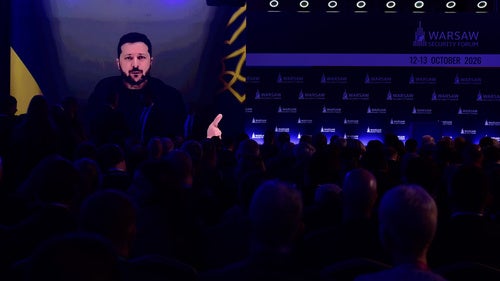
At the Warsaw Security Forum, Trump’s diesel deal and domestic tensions clouded conversations between European and American leaders.
US President Donald Trump’s Russian diesel deal announcement hung over last week’s Warsaw Security Forum, which drew American and European officials to Poland for two days of talks on European and transatlantic security.
Polish Prime Minister Donald Tusk was quick to name Russian aggression as the key issue European nations must come together to address, with General Alexus Grynkewich, NATO Supreme Allied Commander Europe (SACEUR), presenting a three-phase approach to alliance deterrence and defense.
But while officials appeared to agree Russia’s war against Ukraine must be ended, internal divisions, domestic tensions, and impending elections made for a more measured response and dampened energies on other matters.
Council President Leslie Vinjamuri and Council Vice President of Research for Security and Defense Ariane Tabatabai were in Warsaw for the forum, where the Council was a partner and the host of a panel examining how the US midterm elections could affect the NATO alliance and America's relationship with Europe. They spoke with the Council’s Christina Colón about US engagement, Grynkewich’s “theory of victory,” and what comes next for Europe, the United States, and the transatlantic relationship.
This interview has been edited for length and clarity.
Christina Colón: Leslie, what was the focus of this year's meeting?
Leslie Vinjamuri: Beyond a shadow of a doubt, the focus was on the war and on what Europe can do to deter Russia, but also to respond to the hybrid attacks that Europeans are experiencing. Secondly—and they're sort of dual priorities—it was what to do about the United States.
When we turned up to the Warsaw Security Forum, it was in the aftermath of the diesel agreement between US President Donald Trump and Russian President Vladimir Putin. That deal really cast a shadow over the entire conference. And then there was the so-called energy ceasefire, which of course Ukrainian President Volodymyr Zelensky led us all to believe wasn't really happening.
I think that context really shaped the political atmosphere, as did the looming US midterm elections, which many people continue to think might drive some sort of change in the US position.
One thing announced at this year's forum was a war plan or “theory of victory” by General Alexus Grynkewich, NATO Supreme Allied Commander Europe (SACEUR). What does this plan entail, and what was the response to it?
Ariane Tabatabai: It is not a war plan, and he was pretty specific about that. Rather, he framed it as what in the military is called the ‘commander’s intent’—essentially a vision for how things should be going. And it's this three-pronged approach that is really meant to allow for a common vision for the alliance to be able to seek deterrence and to achieve defense with its adversaries. It does not name Russia specifically, but it is very clear that it is focused on Russia as the primary adversary.
The three prongs are blocking an initial attack; if the attack persists, blunting it to prevent the enemy from making advances; and, if it is required, breaking the adversary's forces and their operational war-fighting system. The way it was received in Warsaw—and I think the way it's been received since then—was relatively positive. It lays out a common vision for the alliance at a time when gaps have emerged between the United States specifically and the European allies and Canada.
The major challenge is that there is still this gap between the resolve that SACEUR General Grynkewich was exhibiting in his speech and this vision that he formulated and what we hear from political leadership, including from US President Donald Trump. There are military relationships among NATO allies that are still very strong and forces that are working together very closely. Intelligence sharing is happening, operational cooperation is happening, exercises and training, and so on and so forth—all of those things are happening. However, you still have the political challenge of the divisions that have existed and continue to persist throughout the alliance since Trump returned to office in January 2025.
Let's talk more about these divisions. It’s not only the tensions within NATO, but the increasing tension between NATO and the United States, and particularly US President Donald Trump. And of course, as you said earlier, Leslie, this forum came on the heels of this controversial diesel deal. I'm curious to hear from you, what did US engagement look like at this year's forum?
Vinjamuri: In terms of the US official engagement, it was pretty limited. US Permanent Representative to NATO Ambassador Matthew Whitaker was there and some more junior administration officials. This has been the case across many official conferences since Trump has been office. He's not really very pro sending people overseas. There’s a reluctance to go among officials, a real sense that they need to be in Washington to serve the president and guard their turf.
Congress was a little bit more represented. Senator Roger Wicker of the US Senate Committee on Armed Services was there. Representative Jason Crow from Colorado was there, and Representative Jim Himes from Connecticut. Wicker, a Republican senator who has spoken out against Trump, was more circumspect. But he did say when asked on the main stage about the diesel deal that there is obviously a great deal of unhappiness about the fact that the United States has made a deal with Russia to lift sanctions and buy Russian oil and gas. And while Wicker didn't come out and say it's a bad deal or it's the wrong thing to do, he said it’s very unlikely to come to fruition.
The Democratic members of Congress who were there were asked time and time again what will happen if the Democrats win the House or possibly the Senate in the midterms, and what's going to happen if, after 2028, there's a US president from the Democratic Party. They were a little bit cautious, I would say, in saying that, on the one hand, yes, you'll get more diplomacy, you'll get more engagement, but at the end of the day, America is still going to want to see strong, capable allies, and the multiplicity of challenges that the US faces mean that they just need to have a stronger Europe. So, there was a little bit of reflecting a similar position—albeit without some of the rhetoric and harshness of the current administration. There was also a clear difference in terms of the Democrats' position toward Russia, and that mattered a lot at this conference.
Speaking to what my colleague, Dr. Tabatabai, was saying about the theory of victory, the other thing that stood out to me was that there was no clear sense of, ‘We will respond.’ There was no sense of, ‘We are going to win this war, we're going to defeat Russia.’
It was much more measured. I think people were relieved that there was clarity that an attack would be met with a response, but they were not relieved that it was again seen to be purely responsive and without a greater ambition when it came to tackling the fundamental challenge for the Europeans in the room, which is Russia's very clear and seemingly increasing aggression when it comes not only to Ukraine but also to NATO.
You just used the word ‘we’ there. Perhaps ironically and very well intentionally, the theme for this year's forum was ‘United We Stand.’ Ari, were there moments of unity on display?
Tabatabai: I think this is a bit of a self-selecting group, right? So yes, you had a lot of unity that was clearly on display at the forum, including from the US congressional delegation who were really trying to signal, ‘Look, don't pay attention to the rhetoric. Don't pay attention to what's going on at the White House. We stand together. We're a strong alliance.’
From the European side, the main unifying theme was the continued war in Ukraine. There was lot of interest in capturing lessons learned from the experience in Ukraine, which remains a really positive thing. And there was a strong condemnation throughout of the increased hybrid tactics Russia has been deploying against a number of European allies. Where I think there is nuance is in what it looks like to respond to these hybrid attacks and what the threshold is.
There were also a lot of conversations about how Europe should be taking more ownership of its own security. Everyone agrees that Europe should be taking more ownership over its own security, but there are debates over how that should happen.
But overall, I would say it was a pretty self-selecting group really interested in talking about supporting Ukraine, maintaining a strong alliance, and ensuring that the alliance survives and thrives despite the tensions that continue to exist in the transatlantic relationship.
Leslie, where do you see Europe and the transatlantic alliance going from here? And is there a role for the United States?
Vinjamuri: It’s an important question. It's the question really.
That fact is that there's so much uncertainty domestically, and not only in the United States. Ari traveled to Paris right after the conference, where protests have broken out across the country, and far-right National Rally party leader Marine Le Pen is seemingly the favored candidate in the country’s upcoming election—although obviously that's far from over. Elections in Germany have brought the far-right AfD party much more power and influence than they've previously had, casting a real question over the future of Germany's democratic and parliamentary systems. And those aren't the only two countries where there's a real concern about right-wing populism.
There was sense at the conference that some of that vote is being driven by people who are tired of hearing about the war in Ukraine. There's a perception that there's too much money being spent on Ukraine at a time when ordinary working-class people are suffering a similar kind of affordability crisis that we hear about from the United States. Housing is too expensive and social benefits are not enough, but also too expensive for the governments. Growth is a real problem.
So, while transatlantic relationship might be incredibly important at a headline level, when it comes to it, the question is whether the publics in the United States and across Europe are willing to make the trade-off—and they do see it as a trade-off—that it takes to secure and make possible those investments. And do we have the leaders that can really make the case for and put in place the policies that would secure the future of the partnership?
The other thing is that America's national security concerns are not the same as Europe's. And, quite frankly, there are real differences within Europe in terms of the level of threat faced by Russia. You don't actually hear that at a conference like the Warsaw Security Forum. There's sort of a doubling down on, ‘We're all sort of equally at risk.’ And one doesn't want to diminish in any way the seriousness of the Russian threat, especially hybrid attacks, but there is a difference if you're all the way across the Atlantic Ocean and you have a global military and economic footprint in the way that the United States does, and you're facing different kinds of aggression from China and different levels of threat and different levels of engagement that put you at risk as well as at opportunity. Undoubtedly, Russia becomes one of several priorities. So, I think there are just fundamental structural differences that make it harder for the transatlantic community to always be on the same page in rank order.
Ari, Leslie just mentioned that you traveled to Paris right after the conference. What is your sense of what is going on there? And what does it mean for the role France might wish to play when it comes to being a leader in the transatlantic alliance?
Tabatabai: French President Emmanuel Macron has tried to play that traditional leadership role that many of his predecessors wanted to assert, which is to say that France is a major nuclear power, a major military in Europe, and with the United States increasingly taking a backseat within NATO and withdrawing from Europe, that France would be taking that leadership mantle. There have always been questions around whether France would actually be able to do that, not least of all because there are serious questions throughout Europe about the French role and the French ability to fill those gaps, as well as some of the historical distrust that exists between France and some of the other European powers. But we're now seeing an even more diminished Macron.
Macron had been able to assert himself internationally despite his growing unpopularity domestically. Just earlier this year, he announced this new plan for what he calls advanced deterrence, Europeanizing the French nuclear deterrent. And that was fairly welcomed throughout the French political scene, even though there was a real concern that there would be pushback, especially from the far right and from the far left. He was able to appeal to the different parts of the political spectrum and get everybody on board. That is increasingly more challenging for him now. His political adversaries are seeking to take advantage of his popularity declining. And because he's a lame duck president at this point. In this context, he has, by the admission of his own government, really failed the test of this particular moment.
The minister of the interior noted that for all of its strength in terms of internal security and counterterrorism, the French security forces were completely ill-prepared for this moment. They were not able to deescalate the situation and get it under control. And what you're seeing is hundreds and hundreds of businesses that are having to shut down temporarily, hundreds if not thousands of people who have to go on unemployment, and millions and millions of euros in damages that have been caused for something that just a few months ago, even a few weeks ago, could really have been contained more easily.
Instead, we have a president who has not only failed to reassert control and make the protesters feel like they've been heard, but who gave a really poorly delivered address just over the weekend and then said, ‘I'm still going to go to the Middle East now and do a tour of four countries.’ Now, granted that tour is focused on bringing down the cost of living. The war in the Middle East is obviously deeply impacting a lot of economies around the world, including that of France. But the fact that he is just taking this moment to go to the Middle East while his country is still literally burning in some cases is just not that message of leadership that that he needs to be delivering. And that is certainly going affect his ability over the next few months to cement his legacy and to make sure that whatever comes next, some of the pillars of French strategic autonomy and French national security policy are in place and able to withstand a potentially very rough transition.
Vinjamuri: When Ari went to Paris, I went to Basel, Switzerland, to give a lecture at the University of Basel on America at 250 , and then to London for meetings. You know, there are a lot of countries in Europe, and one of the very big benefits of that is that even as we kind of worry more about France and also about Germany, the United Kingdom is now looking more solid and more competent. There are certainly still many bumps to come, but I think that the UK might kind of rise up as France is going into a bit of a downward turn. There’s a little bit of, you know, can you pass the baton in Europe and still maintain a degree of strength? I mean, look at Hungary. Hungary was led by Viktor Orbán, who leaned toward Russia. It's now had an election to a government that is much more naturally aligned with the dominant European position. So, I still think that there is room for optimism, even in this very precarious moment across Europe.
The Chicago Council on Global Affairs is an independent, nonpartisan organization and does not take institutional positions. The views and opinions expressed in this commentary are solely those of the author.



Related Content
 Global Politics