What a Le Pen Presidency Could Mean for France, Europe, and NATO

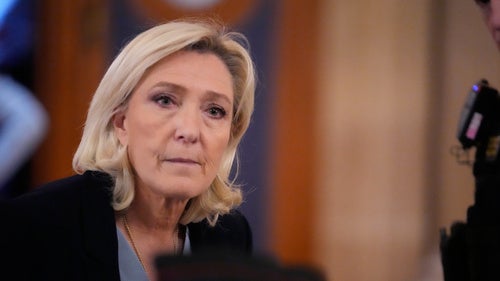
Far-right National Rally party leader Marine Le Pen has joined the French presidential race. Her victory would spark a complete departure from French foreign policy under Macron.
An appeals court in France dropped a bombshell on the French political scene when it cleared the way for far-right National Rally party leader Marine Le Pen to run for the French presidency a fourth time. Le Pen’s announcement that she will join the race ends speculations that she would pass the baton to her younger protégé and less-experienced party president Jordan Bardella. It also confirms the direction of the National Rally’s policy platform, particularly around economic issues.
Le Pen was found guilty of embezzling European Union funds in 2025 and sentenced to four years in prison. While the appeal court upheld its verdict, it reduced Le Pen’s sentence and lifted the ban against her holding public office. For now, however, the mandated ankle monitor will accompany Le Pen on the campaign trail as she continues her judicial saga and appeals the decision once again.
The much-anticipated 2027 election will end President Emmanuel Macron’s decade-long tenure marked by transatlantic tensions, the Russia-Ukraine war, and economic challenges and popular discontent at home. His party and others in the middle of the political spectrum have emerged from this period weakened and less able to appeal to the public. But Le Pen has her own challenges, including baggage associated with the legacy of her controversial and bombastic father, predecessor, and National Rally party founder Jean-Marie Le Pen.
Macron became president just months into US President Donald Trump’s first term. Despite a complicated relationship with his US counterpart, he managed to instill stability in French foreign policy, navigating the US withdrawal from the Paris Climate Accord and Iran nuclear deal. But Trump’s return to power created greater challenges for Macron, who found himself working against the belligerent US president and his threats to stop aid to Ukraine, withdraw forces from Europe, and annex Greenland, all while wars engulfed the Middle East—a region France has maintained historical ties and interests in from Israel to Iran via Lebanon and the Persian Gulf. As his country’s power waned, Macron tried to project strength and assert himself as an important decision-maker in world politics, even during the gradual withdrawal of French forces from its former colonies in Africa.
A Le Pen presidency would likely be a negation of Macron’s approach to international affairs and a complete departure from the past decade of French foreign policy.
A Le Pen presidency would likely be a negation of Macron’s approach to international affairs and a complete departure from the past decade of French foreign policy. Her party has long cultivated the brand of an anti-establishment movement, which extends to foreign policy. While Macron is a strong proponent of the European Union, Le Pen is a Euroskeptic and has advocated to withdraw France from the NATO integrated military command. And while Macron has been clear in his characterization of the Russian threat and announced an initiative aimed at Europeanizing NATO's nuclear deterrent, Le Pen is likely to veto sanctions against Russia and limit support for Ukraine.
Amid the unpredictability of Trump’s second term, Macron has worked to advance the French vision of strategic autonomy within Europe, asserting the country as a natural leader. Many European allies, however, have been skeptical of the French vision. They are more likely to reject it under Le Pen’s leadership.
Macron has already tried to insulate some of his initiatives, including the proposal to Europeanize France’s nuclear deterrent against a potential substantive swing in the country’s politics in 2027. But other lines of effort, such as burden sharing within NATO and the alliance’s Europeanization, will be underway when the elections take place and thus affected by them. Given the stakes for Europe and France’s role on the continent and in the world, Christine Lagarde has indicated that she could leave her position as the president of the European Central Bank before the end of her term to bring a European perspective to the debates in the lead-up to the elections—though she has thus far dismissed rumors that she may herself be running.
Back in May, the leader of the left-wing party La France Insoumise, Jean-Luc Mélenchon, joined the race. And other potential candidates have made announcements that they will enter the campaign as it picks up in the fall. But Le Pen’s National Rally is well-positioned to win or at least make it to the second round. That Le Pen will be launching her presidential campaign while fighting the judicial process only reinforces her image as an anti-system candidate among a public increasingly frustrated with establishment parties and leaders. It further comes at a time when issues pertaining to the judicial system are front of mind for many French citizens.
Like other countries in the West, France has become increasingly polarized, to the benefit of the far-right and far-left parties. The themes likely to dominate the campaign in the fall thus echo issues at play elsewhere, with the economy and affordability, immigration, and security—including the trade-off between defense spending and social programs—leading among public concerns.
Le Pen’s announcement that she will run in 2027 solidifies a divergent picture of the upcoming presidential election, with the far-right and far-left emerging as front-runners in a rebuke to the establishment politics represented by Macron. Yet despite significant policy differences, the two parties have adopted similar populist themes centered around what it means to be French and who is considered French—albeit from opposing positions.
As has been the case before in recent French history, there is a chance the National Rally party could make it all the way to the second round of the elections only to lose amid a French population repelled by the values that underpin its approach to immigration, national identity, and other issues. Nevertheless, Le Pen’s candidacy and likely progress in the electoral process adds another stress to Europe and the NATO alliance already facing a volatile Trump and wars on their southern and eastern flanks.
The Chicago Council on Global Affairs is an independent, nonpartisan organization and does not take institutional positions. The views and opinions expressed in this commentary are solely those of the author.