The Iran Deal Reveals the Limits of American Power

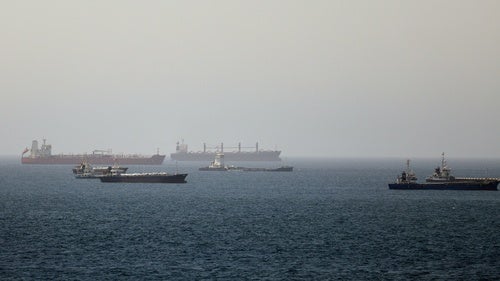
The desire to unlock the Strait of Hormuz will continue to focus the mind of the United States and its allies.
On Wednesday, US President Donald Trump signed a memorandum of understanding in the Palace of Versailles to end the war with Iran.
The initial deal extends the ceasefire by 60 days, reopens the Strait of Hormuz to commercial traffic, lifts the American naval blockade, and creates a window to negotiate Iran's nuclear program and the sequencing of sanctions relief. If the ceasefire holds and the talks succeed, both big bets, the agreement will bring relief to energy markets, the Gulf states, and the global supply chains that have absorbed months of disruption. It also has greater ambitions surrounding Iran's nuclear program.
Trump was quick to frame the agreement as a victory for the United States, referring to it as “very strong” at the G7 summit in France. Yet the deal noticeably defers nearly every hard question: the future of enrichment, the order in which sanctions come off, verification, who will pay for Iran's $300 billion reconstruction, the status of frozen funds, and the terms of regional deescalation.
Left out of negotiations, members of Congress have questioned the benefits of the agreement and whether Tehran can be trusted to hold up its end—even Republicans eager to see the costly, unpopular war come to an end ahead of the midterm elections. Trump has appeared undeterred by the criticism, calling those opposed “fools.” But rushing into a bad deal could prove more dangerous than failing to reach an agreement at all.
Rushing into a bad deal could prove more dangerous than failing to reach an agreement at all.
While the war has demonstrated what American power can still do (degrade Iranian military capability, mobilize financial pressure, threaten escalation, and move markets), it has also revealed the United States has struggled to convert its coercive capacity into a durable regional order for the Middle East.
The first and hardest test is Lebanon. Iran secured Hezbollah's inclusion in the memorandum, which commits both sides to the immediate and permanent termination of military operations on all fronts and to respecting the territorial integrity and sovereignty of Lebanon. In doing so, Iran has made an end to the fighting between Israel and Hezbollah a condition of the broader settlement. But Israel has signaled that it intends to keep troops in southern Lebanon indefinitely, and Israeli Prime Minister Benjamin Netanyahu suggested Monday that he did not feel bound by the US-Iran ceasefire agreement.
The picture is further complicated by a recent trilateral summit at which Israel and Lebanon agreed to dismantle and disarm Hezbollah and rejected any attempt to hold Lebanon's future hostage. Washington is now trying to hold together an agreement it negotiated with Tehran, but its success depends on actors it does not fully control and on an ally that was not at the table. If it cannot align Israel with the terms—and is not willing to condition US support of Israel in order to achieve this—then the memorandum becomes a mechanism for managing recurring crises rather than ending them.
The second test is the nuclear program. The memorandum defers enrichment, the disposition of Iran's stockpile, verification, and the sequence of relief. Iran holds an estimated 440 kilograms of uranium enriched to 60 percent—near the threshold for weapons-grade material—and the released text now points to a minimum methodology of down-blending that stockpile under the supervision of the International Atomic Energy Agency. While the mechanics still have to be built, Iran has mastered the politics of delay—and the current administration has not shown the patience required to sustain a complex inspection regime.
As such, the more likely near-term result is not a final settlement but a prolonged period of ongoing uncertainty and potential disruption, with the ongoing threat of a return to war, in which Iran banks partial relief, Washington claims diplomatic progress, and every party hedges against the chance that the talks fail. The strait can reopen, but the risk premium will not vanish. Mine clearing, insurance costs, shipping confidence, and a persistent drone threat will price into global commerce long after a deal is signed.
The third test is more about how the system adapts than any single negotiation. The war exposed a deeper vulnerability: Iran's chokepoint is effective because there is almost no way around it. The two pipelines built to bypass Hormuz, Saudi Arabia's East-West line and the United Arab Emirates’ Habshan-Fujairah link, can move somewhere between 3.5 and 5.5 million barrels a day in practice—a fraction of the 20 million the strait carries and assuming the bypass routes stay intact.
The Saudi line was struck in April, cutting roughly 700,000 barrels a day, and drone attacks repeatedly suspended loadings at Fujairah. Iraq's exports thus have essentially no alternative. Fossil fuel dependence now looks less like a question of supply and demand and more like a vulnerability embedded in global infrastructure.
Beneath all of this is a structural shift in the regional order, and especially the role of middle powers. Saudi Arabia, the UAE, Qatar, Oman, and Turkey are hedging, mediating, building their own defense relationships, investing in domestic industry, and seeking energy routes that reduce their exposure to both Tehran and Washington. The mediation that produced this agreement ran through Pakistan, Qatar, and Oman, not through the United States alone. These states still want American security guarantees, markets, technology, and diplomacy. They do not want to be trapped in an order that depends entirely on Washington's willingness, or its ability to enforce rules consistently.
These powers are working to maneuver in a world where proximity to US power creates both risk and opportunity. It is precisely why forums like the G20 and the G7 gathering this week in Évian-les-Bains retain their value even as the United States grows ambivalent about multilateralism. They give middle powers a way to organize around problems none can manage alone and try to shape—if not steer—US policy.
The Iran agreement ultimately reflects a recognition that the United States remains strong enough to disrupt the choices of others, but absent a more coherent strategy, its power is limited by adversaries and its ability to bring allies along will be compromised. Weaker powers retain the ability to compel Washington to negotiate, and allies retain the ability to withhold the cooperation on which any settlement rests. The question now—and the one the next 60 days will begin to answer—is whether America remains trusted, disciplined, and patient enough to keep all parties in order.
The Chicago Council on Global Affairs is an independent, nonpartisan organization and does not take institutional positions. The views and opinions expressed in this commentary are solely those of the author.