India Was Optimistic About Its Relationship with the US. Trump Changed Things

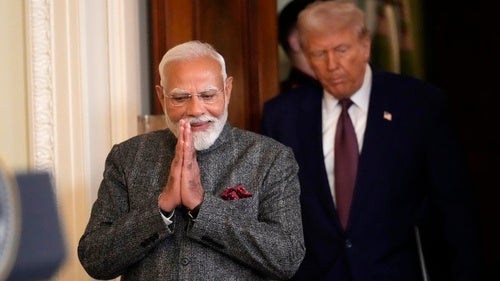
Since taking office, Trump has increased tariffs, restricted H-1B visas, and made a deal with China. What does that mean for India’s future?
India entered 2025 optimistic about what a second Donald Trump presidency would bring for the relationship between the two nations. Public opinion in India was far more positive about Trump’s return to the White House than in many American partner and ally countries, with one survey conducted by the European Council on Foreign Relations finding 75 percent of the country’s population to be “Trump Welcomers.” India’s external affairs minister sounded a sanguine note about what New Delhi expected from Trump, and Prime Minister Narendra Modi wished his “heartiest congratulations” to “my friend Donald Trump” on X. While tensions over trade and immigration were foreseen, most observers believed they would be manageable.
Instead, the United States dramatically increased tariffs on India during the spring and summer of 2025. Some of these increases resulted from the “Liberation Day” tariff approach of the Trump administration. However, the United States specifically targeted India as a strategy to reduce Indian oil purchases from Russia. Trump has also insistently claimed that he played a central role in de-escalating the India-Pakistan conflict of May 2025, which India’s Defense Minister Rajnath Singh has said is “completely incorrect.” Strikingly, the United States has pursued a rapprochement with Indian arch-rival Pakistan. Further, serious barriers to H-1B visas, which enable US employers to hire qualified foreign workers in specialty fields, have been erected and are predicted to affect the flow of Indian labor into the United States. While the Indian government has been fairly restrained in its response to recent US policies, there is no doubt that Washington’s credibility as a stable partner—never guaranteed in the best of times—has taken a severe hit.
India has benefited in recent years from the global expectation that, if its economic growth continues, it will be an increasingly major global player. Projections suggest that India could become one of the world’s very largest economies by 2050, driven in part by its massive youth population. India’s military is already among the biggest in the world, and the country occupies a strategic location, sharing a border with China and sitting astride crucial Indian Ocean sea lanes.
India’s future promise has encouraged American administrations to cultivate ties as a way of hedging against growing Chinese power in Asia. But the second Trump administration has appeared to care little about India’s potential. Openly putting the squeeze on India as a leverage play against Russia showed just how little Trump worries about losing India’s favor.
As foreign policymaking in Washington appears to rest on Trump’s ever-changing whims, it is difficult to predict how America will engage India through the rest of his presidency. That said, there are several key factors to watch for that will shape the US-India relationship.
A US-China Deal?
The first indicator, perhaps the most important, will be how China’s relationship with both the United States and India develops in the coming years.
India-China ties were badly damaged by the 2020 military clash in the Galwan Valley that resulted in the deaths of at least 20 Indian and four Chinese soldiers. The United States supported India in the conflict, sending military equipment and providing intelligence, which added momentum to US-India cooperation.
While the clash put China-India relations in a deep freeze for several years, New Delhi has recently pursued an improved relationship with Beijing. This has included reaching an agreement about de-escalation along the disputed border areas. Through stabilizing ties, India hopes to reduce the costs associated with large-scale military deployments on the border and expand economic engagement with China that can bolster Indian growth.
At the same time, Trump has also appeared intrigued by the possibility of deal-making with China. He has accepted an invitation from Chinese President Xi Jinping to visit Beijing in April and will host a state dinner for Xi later in 2026. It is hard to tell which position the United States will take in the year to come. Trump referred to his October meeting with Xi in South Korea as “highly successful,” and recent Chicago Council polling finds a majority of Americans favor undertaking friendly cooperation and engagement with China.
A more accommodative US position toward China would not bode well for the India-US relationship, as it would undermine the two nation’s shared concern over the People’s Republic of China that has contributed to previous convergence. The more that Beijing is seen as a severe threat, the more likely Washington is to look favorably toward India and return to the pre-2025 strategy of cultivating India.
"The more that Beijing is seen as a severe threat, the more likely Washington is to look favorably toward India and return to the pre-2025 strategy of cultivating India."
There are good reasons though to expect US-China competition to continue. Taiwan, technological primacy, maritime disputes in the South China Sea, and the structure of global trade remain key areas of contention between the two. However, if Trump is comfortable with something closer to a sphere of influence arrangement with China in Asia—likely with ongoing American support for Japan, South Korea, and perhaps Taiwan—India would become a lower priority, whether in receiving trade concessions or deepening technological and military ties.
If the United States is open to partially accommodating Chinese interests in Asia, India would have a stronger incentive to further de-escalate tensions with China. While India has shown over the decades that it will fiercely resist compromising its core territorial interests in the border dispute, it would need to adjust its broader Indo-Pacific strategy to a context in which American backing is, at best, uncertain. If India is concerned that Washington will cut a separate deal with Beijing, it could adopt a hedging posture—shielding strategic sectors of the economy, maintaining vigilance on the border, and seeking to retain influence over its neighbors, but backing away from being part of a broader balancing coalition against China.
Why Washington Isn’t Focused on New Delhi
A second question is whether Trump’s political room to maneuver will shrink, potentially creating pushback on his capricious approach to the India relationship. While Trump has acted with remarkably few political constraints thus far, a health crisis, economic collapse, or a Democratic takeover of the House of Representatives in 2026 could weaken Trump.
That said, a more constrained Trump would not necessarily be a panacea for improved US-India relations. Trump can retain control over foreign policy even if his domestic power is limited. More importantly, it is not clear how much political effort either Republicans or Democrats would put into rebuilding the India relationship when faced with other priorities. While there is support on both sides of the aisle for treating India with more respect, this is not an important electoral issue, nor at top of mind for the American public compared to domestic issues like healthcare, immigration, democracy, or inflation, among many others.
Furthermore, on the Republican side, an upsurge of vocal anti-India and anti-Indian American sentiment has laid bare real hostility toward India among a meaningful chunk of the Trump base. Restrictions on H-1B visas and other tactics to reduce immigration have been popular in MAGA circles, with Indians clearly targeted as part of these efforts. And among some Democrats, though likely a minority, Modi’s earlier embrace of Trump and general right-wing orientation may make changing America’s India policy a less-than-urgent priority. As India occupies relatively little space in American political competition and public imagination, even a less powerful Trump is unlikely to face serious pressure to reverse course.
New Delhi has handled Trump with relative restraint, and recent policy actions to improve trade suggest a softening of tensions between the two countries. Yet even once a deal is arranged, it has become clear to India’s leadership just how unpredictable American politics are. And there is no guarantee that a post-Trump American government would be more reliable.
India’s Path Forward
India’s long-term challenge is building the underlying power and capabilities to resist both Trumpian and Chinese coercion. Xi has not needed to adopt Modi-style bonhomie to manage the United States because of China’s accumulation of economic power. This is the level of global power that India’s leaders aspire to achieve through expanding its economy, accessing high-end technology, and generating good jobs for the Indian work force. But they know this will take time to achieve.
Indian leaders have several potential strategies they could deploy in the meantime to manage a mercurial America.
Placing faith in Modi’s personal relationship with Trump has proven unviable. Betting on the MAGA movement is similarly unwise given the deep anti-India strains within it. As a result, Indian leadership must broaden their outreach to a variety of constituencies in the American political system. Indian diplomats and others from the Indian establishment should thoughtfully engage across the political spectrum and the country—especially beyond the coasts—to educate Americans about the value of strong ties with India.
"Placing faith in Modi’s personal relationship with Trump has proven unviable."
It is also essential that India hedge against American unreliability by deepening other international relationships. India should maintain strong ties with Russia and continue to expand linkages with Europe, even if there are limits to what each of these relationships can provide and admitted tensions between them. India will be well-served by cultivating room for maneuver in its ties with Beijing, preparing to respond if China coerces India but maintaining space for a potentially more cooperative relationship that operates distinct from American policy. Within Asia, there are American allies like Japan and Australia that would welcome continued cooperation with India, whether or not it involves the United States. India should bolster these bilateral and multilateral relations.
In cultivating a broad web of other relationships, while trying to increase its own domestic capabilities and resilience, India will be best able to navigate the uncertainty in American foreign policy as it pursues global influence.
Related Event