The Ebola Outbreak Is a Test of International Health Cooperation

As the virus spreads, the United States is turning inward. Can the international community contain the outbreak without Washington?
On May 17, the World Health Organization (WHO) declared the latest Ebola outbreak a “public health emergency of international concern.” The designation was meant to usher in resources to slow the spread of the virus, which is suspected to have killed more than 200 people in the Democratic Republic of Congo (DRC).
The epidemic comes amid a decline in global health funding, precipitated by the Trump administration’s decision to withdraw the United States—the world’s largest donor—from the WHO in January. Cuts to the international response system meant that the virus likely circulated in isolated, rural populations in the DRC for months before it was detected and announced to the world.
Existing vaccines do not offer protection against the current Bundibugyo variant, which has furthered the virus’ rapid spread. A new vaccine for uninfected populations will take time to develop —perhaps as long as nine months. Already the virus has spread beyond the country, with 15 confirmed cases in neighboring Uganda . With cases rising, it will be difficult to contain without concerted international coordination.
What is Ebola and why is it dangerous?
Ebola is a communicable disease that scientists attribute to zoonotic transfer. The virus jumps from diseased bats, monkeys, or other species to humans and then spreads from person to person through contact with infected bodily fluids or contaminated objects.
Before the development of vaccines and treatments, around half of infected people succumbed to the virus, often dying an excruciating death. Medical professionals and family members are highly susceptible to infection during treatment. Even the body of a patient who has died from Ebola can be a source of infection, which is why health workers are often tasked with burying the dead. But in communities with strongly held death traditions, the disposal of bodies by medical doctors can be seen as an affront. In eastern DRC, angry crowds have stormed and set fire to Ebola treatment tents after being prevented from retrieving the remains of their loved ones.
Between 2014 and 2016, an outbreak in West Africa infected 28,000 people, more than 11,000 of whom died. The global community belatedly mobilized, putting forward billions of dollars in military, financial, and medical resources to stop the spread. In its wake, vaccines and treatments for some strains of the virus were developed. Vulnerable populations in countries susceptible to Ebola outbreaks—including the DRC—received vaccines through Gavi, the Vaccine Alliance, which brought together pharmaceutical companies like Merck and global health assistance funding from countries including the United States.
Such efforts brought down death rates and helped prevent the reoccurrence of another large-scale outbreak—until now.
What’s different about this Ebola outbreak?
What makes the current outbreak particularly worrisome is that there are no treatments or vaccines for the Bundibugyo variant. While Ebola is not highly transmissible, the fatality rate is around 50 percent, with mortality highly dependent on the strain and the availability and quality of treatment
Rapid field tests are also not designed to detect the current variant. False-negative tests can delay the identification of cases and care for those infected—outcomes particularly dangerous in a vast, severely impoverished country like the DRC. And the virus is spreading in rural areas in the far northeast of the DRC, where militant groups have made monitoring and treatment difficult.
What has been the US response?
The Trump administration has prioritized keeping Ebola out of the United States. Non-citizens who have been in the DRC, South Sudan, and Uganda in the last 21 days have been banned from entering the United States through mid-June, including green card holders. Such blanket restrictions on travel have historically been discouraged by the WHO, which believes them to be ineffective and costly for affected populations.
Meanwhile, American citizens who have traveled to any of the three countries in recent weeks have had their flight plans rerouted to Washington, Houston, or Atlanta for extra screening. The administration is reportedly considering sending Americans in the region who have been exposed to Ebola to a field hospital in Kenya for quarantine, though a Kenyan court has temporarily delayed the plan.
News of the plan came just days after a US doctor was evacuated to Germany for treatment after contracting the virus while performing surgery in a remote DRC clinic. The Washington Post reported that the Trump administration was reluctant to allow him to return to the United States for fear he might spread the virus, resulting in a delay of treatment. The White House has denied the claim.
Still, Washington’s response to the current outbreak stands in stark contrast to its engagement during the 2014-2016 Ebola outbreak. The Obama administration was similarly concerned about keeping Ebola out of the United States. Fears heightened after a Liberian man, who had lied about his contacts with Ebola patients prior to departure, fell ill shortly after entering the United States and later died in a Dallas hospital. The two nurses he infected fortunately survived.
Rather than simply try to keep the virus out of the United States, the Obama administration aggressively sought to staunch the epidemic at its source. President Barack Obama deployed more than 3,000 US personnel—including military, Centers for Disease Control and Prevention (CDC), and United States Agency for International Development (USAID) officials—to the region, where they built expanded treatment centers, conducted outreach on proper burials, and engaged in other measures to stop the outbreak. Their actions catalyzed other governments, namely Britain and France, who initiated parallel efforts to the US response in Liberia with campaigns of their own in Sierra Leone and Guinea. After the outbreak, the US government and international community sought to improve early warning systems and emergency response mechanisms.
How did US actions contribute to the current outbreak?
Cuts to US foreign assistance during the second Trump administration have both eroded US bilateral capabilities and undermined the WHO’s ability to respond to a crisis.
At the direction of Elon Musk’s cost-cutting Department of Government Efficiency (DOGE), USAID was shuttered in early 2025 and broader global health assistance budgets were slashed—including those supporting disease-monitoring networks.
Former USAID official Nicholas Enrich said before Congress shortly after he was placed on administrative leave in March 2025 that Trump appointee Tim Meisburger, then head of the USAID’s Bureau of Humanitarian Assistance, called Ebola a “scam” during a 2025 outbreak in Uganda because "there had only been ‘one death.’” At the time, the agency was pursuing waivers from foreign-assistance cuts to keep key life-saving interventions to Ebola in place. Enrich testified that they were instead instructed to “deprioritize activities related to neglected tropical diseases, MPox, Polio, Ebola, and any monitoring and surveillance activities.”
As a result, aid groups like CARE and the International Rescue Committee that received funds from the US government for rapid response and training on safe burial practices had to lay off staff, including community health workers.
The New York Times recently reported that the shuttering of USAID likely delayed detection of the current outbreak. Nearly a month passed between the first death from the disease and confirmation of the outbreak because initial samples from a local laboratory were delivered to the central government at the wrong temperature, a task previously overseen by USAID. Atul Gawande, a former senior USAID official, told the Washington Post that in 2022 an outbreak was detected within 48 hours and resulted in only one death. “Now, we are way behind—it’s been circulating for months or more, and it’s going to take just as long to respond,” he said.
The CDC, which typically coordinates early response and contact tracing of infected individuals, says it still has several dozen staff in central African countries. But what remains is a faint echo of the capabilities that the United States was able to mobilize during previous outbreaks. In an op-ed for the New York Times, medical doctor and Ebola survivor Craig Spencer said that the CDC has lost a quarter of its staff over the last year and has had no permanent director for 15 of the last 16 months.
The State Department has continued to deny that the closure of USAID has negatively affected the US response and said the country is contributing $23 million to the current effort and plans to provide additional funding in the coming months to support clinics. However, reporting from the Washington Post suggests that foreign assistance for the DRC has continued to decline significantly—from $1.4 billion in 2024 to $430 million in 2025—and only $21 million has been allocated for 2026.
What happens next?
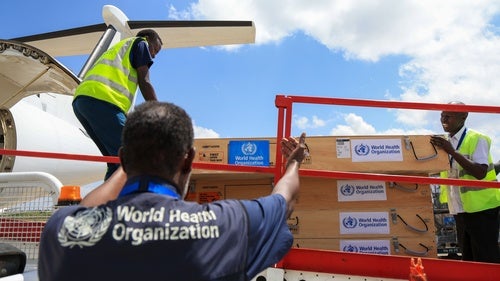
In the past, the US government would have mobilized trucks of medical equipment within hours of the outbreak being detected. It has taken weeks for this one. The WHO has tried to pick up the slack, but the United Nations agency’s resources and capabilities, which have always been limited, have been strained by the withdrawal of US support.
The United States cannot wall itself off from this problem, even if it restricts travel from affected countries. Going forward, there needs to be a serious coordinated international effort to stamp out transmission of the virus, provide treatment for those affected, and quickly develop new vaccines and therapeutics. All of this will require a significant pulse of resources and investment in treatment centers, contact tracing, community health workers, and scientific investigation. The United States can dedicate more resources for this outbreak and call on others to do the same.
The Trump administration would also be wise to allow CDC and other administration officials to reestablish information sharing with the WHO, which was suspended when the White House announced its decision to withdraw the United States from the agency. In the long run, the United States will need to rebuild the capabilities it shed under Elon Musk’s indiscriminate cost-cutting campaign, which has shown to have saved the United States little money and exposed the country to broader health risks.
The current Ebola outbreak demonstrates the difficulty of containing a deadly virus in the absence of a coordinated global health response. It is unclear if the WHO and broader international community can successfully tackle this Ebola crisis without significant financing, expertise, and leadership from the United States.
The Chicago Council on Global Affairs is an independent, nonpartisan organization and does not take institutional positions. The views and opinions expressed in this commentary are solely those of the author.