Can a New Congress Compel Trump to End the Iran War?

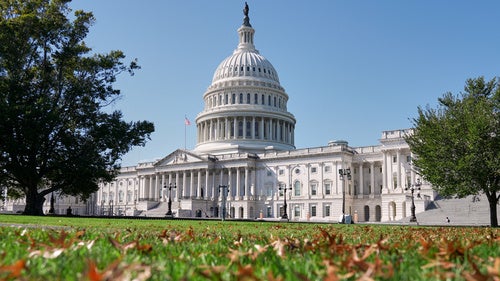
While the US midterm elections may spark congressional action on tariffs, Washington is backed into a corner in the Middle East.
Foreign policy isn’t a major concern for American voters . . . until it is. The upcoming US midterm elections present one such case, though not directly. As the recently released Chicago Council on Global Affairs survey of American foreign policy views makes clear, concerns about inflation are a primary driver of voting decisions for all Americans, regardless of party of affiliation. And the core culprits for that inflation are two foreign policy choices by the Trump administration: its aggressive tariff campaign and the war in Iran.
In both cases, the inflationary impact has been quite predictable. One need not be a Nobel laureate in economics to know that the increased costs due to tariffs, just like any increase in production costs, are passed on to consumers. While members of the Trump administration initially denied that was going to be the case, it is exactly what happened. As for the war in Iran, the damage to key oil transportation routes—namely through the Strait of Hormuz—as well as to oil production infrastructure throughout the Persian Gulf region had long been predicted to result from large-scale military action against Tehran, even by members of Trump's own administration.
For these reasons, the election on November 3 is going to go poorly for Republicans. The question is: How poorly? Will it only swing one of the two houses to a Democratic majority? Or will it instead result in a House and Senate overwhelmingly controlled by Democrats?
In either case, I expect more will be achieved in addressing tariffs than in addressing the war in Iran. This is because I can see Congress taking back control over tariff policy. While Democrats were already in favor of such a move, the recent decision by the Trump administration to ignore the bipartisan sanctions bill against Russia has now made Republicans keen to reassert control over this key economic lever. Furthermore, Trump’s use of tariffs was already found to be unconstitutional by the Supreme Court, which is dominated by conservative justices—including three that Trump appointed. In short, tariff policy is, at least relatively speaking, low-hanging fruit.
Things are not so simple with the war in Iran and never are when it comes to wars in the Middle East. Trump’s decision in February to launch a war against Iran has now effectively painted the United States into a corner, no matter who is in charge. This is because it’s unclear how the United States can extract itself from the current stalemate over the Strait of Hormuz.
Trump’s decision in February to launch a war against Iran has now effectively painted the United States into a corner in the Middle East, no matter who is in charge.
Can Congress compel US President Donald Trump to end the war? It can pass new war powers legislation, but to what end? Consider an extreme and unlikely scenario, where a fully Democratic-controlled House and Senate vote to impeach and convict Trump, removing him from office. He is then replaced by Vice President JD. Vance, a longtime skeptic of using military force abroad and one of the voices in the Trump administration who opposed the war. He would seem like a president who would want to end the conflict. But how? Does he simply declare the campaign over and pull US forces out of the Persian Gulf, allowing Iran full control over the Strait of Hormuz? That seems unlikely. Alternatively, does he choose to escalate the war by sending in US ground troops and ramping up the US bombing campaign against Iranian civilians? Given his distaste for foreign wars, this also seems unlikely.
To be certain, there are many areas of US foreign policy that could be substantially influenced by a dramatic change in the party leadership of the House and Senate. The distribution of US aid, perhaps even the reconstitution of the United States Agency for International Development (USAID), comes to mind. But while the war in Iran is likely to impact the midterm elections, the results of those elections are unlikely to impact the conflict.
The Chicago Council on Global Affairs is an independent, nonpartisan organization and does not take institutional positions. The views and opinions expressed in this commentary are solely those of the author.
Related Content
 US Foreign Policy
Journalist Steve Clemons predicts Democrats could benefit from a backlash to the war in Iran. But he warns that a Democratic Congress could lead to “several waves of constitutional crises.” What would that mean for Trump's foreign policy?
 Public Opinion
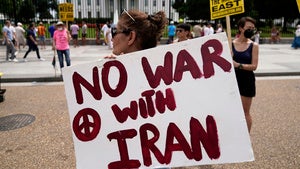
New polling finds 68 percent of Americans believe the costs of the war with Iran have outweighed the benefits, though Republicans stand apart.
 US Foreign Policy
As the midterm elections approach, the Trump administration has realized its strategy isn’t working. Will economic measures succeed where military operations failed?
 Public Opinion
Results and analysis of the Council's 2026 annual survey of American views on foreign policy.