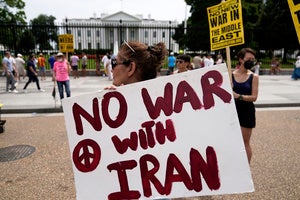
New polling finds 68 percent of Americans believe the costs of the war with Iran have outweighed the benefits, though Republicans stand apart.
The 2026 Chicago Council Survey, fielded July 10-21, finds the American public feels the US-Israeli war against Iran has not been worth the costs to the United States. At the same time, Americans overall feel no more threatened by Iran’s nuclear program than they did in 2023, despite the Trump administration’s stated aim to destroy such capabilities.
With negotiations underway to resolve the conflict, majorities of Americans approve of allowing Iran to sell its petroleum on the global market and forcing Israel to cease military operations in Lebanon. But they find it unacceptable to concede certain elements that are likely critical to Tehran’s compliance.
Key Findings
- By a 7-to-3 ratio, more Americans believe the war in Iran has not been worth the costs (68%) than believe it has been worth them (31%). Republicans stand apart from other partisans in their view that the benefits of fighting the war have outweighed the costs (63%).
- Despite the June 2025 US airstrikes to target Iranian nuclear facilities and five months of war with Iran this year, Americans overall are no less likely (49%) than they were in 2023 (49%) to see Iran’s nuclear program as a critical threat.
- When asked what they would consider acceptable US negotiating positions to end the war, majorities of the US public say it is acceptable for the United States to compromise by allowing Iran to export its oil and petroleum products globally (70%) and pledging to prevent Israel from taking further military action in Lebanon (58%).
- Americans are evenly divided on whether the United States should lift its economic and diplomatic sanctions against Iran (48% acceptable, 47% unacceptable) as part of a deal.
- When it comes to negotiations between the United States and Iran, majorities say it would be unacceptable for the United States to allow Iran to continue to develop its ballistic missile program (80%), keep its enriched uranium stockpile (74%), and maintain control of the Strait of Hormuz (68%). Majorities also see the United States compensating Tehran for damage done to Iranian civilian infrastructure as unacceptable (60%).
Most Americans See More Costs than Benefits in War with Iran
In June, the Center for Strategic and International Studies estimated the costs of the US war with Iran to be between $34 billion and $42 billion dollars, considering expenses related to personnel deployments, munitions, equipment loss and damage, fuel, security, and other related costs. In addition to the monetary costs, 18 service members have died and another 624 have been wounded since February 28. Considering the costs of the war to the United States versus its benefits, two in three Americans say it has not been worth fighting (68%), while the other third think it has been worthwhile (31%).
Most Democrats and Independents tend to think the war has not been worth the costs to the United States (91% and 76%, respectively). Republicans view the war more optimistically, with two-thirds saying it has been worth fighting (63%). Notably, Republicans who support the Make America Great Again (MAGA) movement1 are more likely to say the war has been worth fighting (77%) than Republicans who do not subscribe to the movement (41%).
These findings are consistent with Council polling conducted in May 2026, in which majorities said the US-Iran war was bad for Americans’ cost of living (86%), international relations (72%), reputation abroad (72%), and national security (65%).
Recent polling reveals Americans have taken a similar stance toward the war in Iran as other wars the United States entered following the September 11 terrorist attacks in 2001. More than 65 percent of Americans between 2012 and 2020 said fighting the wars in Iraq and Afghanistan were not worth the costs to the United States (see appendix tables 1 and 2). When it came to Iraq in particular, the majority of Americans between 2008 and 2012 did not think the invasion reduced the threat of terrorism in the Middle East and felt the war cost hundreds of billions of dollars that could have been better spent on needs at home (see appendix table 3).
Americans’ views of the Iran war as one not worth fighting align with the majority opposition to sending US troops to overthrow the Iranian government (65% oppose). Majorities of Democrats (84%) and Independents (71%) oppose putting boots on the ground to force a regime change in Tehran. However, a majority of Republicans (56%)—and two-thirds of MAGA Republicans (67% vs. 40% non-MAGA Republicans)—say they would support using US troops for that purpose, even though US President Donald Trump has said he would not commit ground forces to Iran.
Increased Polarization over Threat of Iran’s Nuclear Program
At the start of the conflict in February, US officials stated that one reason the United States had entered the war was to prevent Iran from obtaining a nuclear weapon. Yet despite the June 2025 Midnight Hammer air campaign targeting Iranian nuclear facilities and five months of the Epic Fury war with Iran, Americans feelings surrounding Iran’s nuclear program are akin to 2023 levels, with an identical percentage in both years seeing Iran’s nuclear program as a critical threat to the United States (49%). Moreover, a recent Washington Post-Ipsos poll finds that just a third of Americans are confident that fighting the war in Iran will put a stop to its nuclear development (31%). The remaining majority doubt this objective will be met (66%).
While overall threat perceptions have remained consistent over the past four years, Republicans and Democrats have grown more polarized than ever in these views. Today, Republicans are most likely to consider Iran’s nuclear program a critical threat (68%), while Independents and Democrats express lower threat perceptions. And while Republican views are similar to recent years (though lower than their peak of 75 percent in 2012), MAGA Republicans are more likely to view Iran’s nuclear program as a critical threat (74%) than are non-MAGA Republicans (58%).
Independents’ and Democrats’ lower threat perceptions likely reflect their opposition to the US military action rather than the efficacy of the US military campaign. The steepest decline in threat perceptions from Iran are evident among Democrats, who are less likely now than at any point in Council polling to consider Iran’s nuclear program a critical threat (35%), dropping incrementally since 65 percent in 2010. For their part, Independents are less likely to say that Iran’s nuclear program is a critical threat today (42%) than in Council surveys going back to 2010 (64%).
Nearly six in 10 Americans say that Iran is less respected internationally than it was 10 years ago (57%, up from 53% in 2021). As on other questions about Iran, there is a stark partisan divide: Republicans are significantly more likely to see a decline in Iran’s international reputation (70% respected less) than Independents (54%) and Democrats (46%).
Americans Unwilling to Concede Ballistic Missiles and Enriched Uranium in Deal with Iran
On June 17, the United States and Iran signed a 14-point Memorandum of Understanding (MOU) as an interim agreement in order to cease hostilities, open up the Strait of Hormuz, and start nuclear talks. Among other concessions, the United States and Israel would have to terminate military operations against Iran and in Lebanon, create a plan to raise at least $300 billion to reconstruct and develop Iran, and allow the export of Iranian oil and petroleum products to the global market. Iran would be on the hook for reaffirming that the country would not procure or develop nuclear weapons and would down-blend its highly enriched uranium under international supervision. Shortly after signing the MOU agreement, Iran launched strikes against several vessels in the strait, leading to retaliation from the United States.
When asked what elements of a potential agreement with Iran would be acceptable or unacceptable to them, Americans are most positive about the United States allowing Iran to export its oil and petroleum products globally (70% say this is acceptable)—including bipartisan majorities. A majority also believe that a US commitment to preventing Israel from taking further military action in Lebanon is acceptable (58%), though more so among Democrats (72%) and Independents (58%) than Republicans, who are more closely divided (47% acceptable, 49% unacceptable).
Americans are evenly divided on whether the United States should lift its economic sanctions against Iran (48% acceptable, 47% unacceptable). Six in 10 Democrats (59%) and a narrow majority of Independents (53%) approve of this potential component, with more Republicans finding it unacceptable (62%, vs. 34% acceptable).
Partisan differences are also clear when respondents are asked about whether the United States should compensate Tehran for damage inflicted on civilian infrastructure during US strikes. Overall, just 36 percent of Americans find this an acceptable concession, though a narrow majority of Democrats say it would be acceptable (53%). Majorities of Republicans (80%) and Independents (56%) deem it unacceptable. Partisans concur, though to differing degrees, that it is unacceptable for Iran to continue to develop its ballistic missile program (80% overall), keep its stockpile of enriched uranium (74% overall), and maintain control of the Strait of Hormuz (68% overall).
After several unsuccessful rounds of negotiations between the United States and Iran, Americans are not confident the parties will reach a negotiated settlement any time soon. A recent Reuters-Ipsos poll shows eight in 10 Americans expect the war to continue for an extended period of time (80%), while just 16 percent are optimistic it will end pretty quickly in a matter of weeks. The May 2026 Council survey also found that just two in 10 Americans are confident that Iran would comply with a deal to lift economic sanctions in exchange for limiting its nuclear program (18%); only half were confident in the United States to do the same (48%).
Conclusion
After more than five months at war with Iran, Chicago Council polling reveals that a majority of the American public seems to think there has been little to show for it and exhibits little appetite for expanding the conflict by sending in ground troops to overthrow the regime. Yet Americans are also clear that Iran should not be allowed to continue to develop its ballistic missile program, keep its enriched uranium stockpile, and maintain control of the Strait of Hormuz—all items Tehran is interested in protecting as part of negotiations. The American public at large does see preventing Israel from taking further military action against Lebanon as an acceptable compromise, though this might not be so acceptable to Israeli leadership. Ultimately, these results highlight the complicated and very partisan American opinion landscape on this military conflict and the difficult conditions surrounding negotiations.
- 1
Sixty-one percent of self-described Republicans say they consider themselves supporters of the Make America Great Again or MAGA movement.
Appendix Table 1
All in all, considering the costs to the United States versus the benefits to the United States, do you think the war in Afghanistan was worth fighting or not?
| Year | Overall | Republican | Democrat | Independent | R-D Gap |
|---|---|---|---|---|---|
| 2012 | 67 | 55 | 68 | 75 | -13 |
| 2014 | 71 | 65 | 73 | 76 | -8 |
| 2020 | 65 | 48 | 76 | 68 | -28 |
| 2021 | 63 | 51 | 70 | 66 | -19 |
Appendix Table 2
All in all, considering the costs to the United States versus the benefits to the United States, do you think the war in Iraq was worth fighting or not?
| Year | Overall | Republican | Democrat | Independent | R-D Gap |
|---|---|---|---|---|---|
| 2012 | 67 | 48 | 75 | 74 | -27 |
| 2014 | 71 | 58 | 76 | 78 | -18 |
| 2020 | 67 | 46 | 78 | 72 | -32 |
Appendix Table 3
Below are two statements about the Iraq war. Please mark whether you agree or disagree with each statement.
| Year | Overall | Republican | Democrat | Independent | R-D Gap |
|---|---|---|---|---|---|
| 2006 | 35 | 55 | 21 | 33 | 34 |
| 2008 | 38 | 70 | 18 | 28 | 52 |
| 2012 | 28 | 38 | 23 | 25 | 15 |
| Year | Overall | Republican | Democrat | Independent | R-D Gap |
|---|---|---|---|---|---|
| 2008 | 76 | 51 | 94 | 81 | -43 |
| Year | Overall | Republican | Democrat | Independent | R-D Gap |
|---|---|---|---|---|---|
| 2006 | 66 | 56 | 73 | 70 | -17 |
| 2012 | 71 | 63 | 75 | 73 | -12 |
This poll was conducted by Ipsos on behalf of the Chicago Council on Global Affairs between July 10–21, 2026, by Ipsos using the probability-based KnowledgePanel®. This poll is based on a nationally representative probability sample of 2,156 general population adults aged 18 or older.
The study was conducted in English and Spanish. The data were weighted to adjust for gender by age, race and ethnicity, education, census region by metropolitan status, household income, and language dominance. The demographic benchmarks came from the 2025 March supplement of the US Census Bureau’s Current Population Survey (CPS). Additionally, language dominance benchmark was obtained from the 2024 American Community Survey (ACS).
- Gender (Male, Female) by Age (18–29, 30–44, 45-59 and 60+)
- Race/Hispanic Ethnicity (White Non-Hispanic, Black Non-Hispanic, Other, Non-Hispanic, Hispanic, 2+ Races, Non-Hispanic)
- Education (Less than High School, High School, Some College, Bachelor’s degree or higher)
- Census Region (Northeast, Midwest, South, West) by Metropolitan status (Metro, non-Metro)
- Household Income (Under $25,000, $25,000-$49,999, $50,000-$74,999, $75,000-$99,999, $100,000-$149,999, $150,000+)
- Language Dominance (English Dominant Hispanic, Bilingual Hispanic, Spanish Dominant Hispanic, Non-Hispanic)
The margin of sampling error is plus or minus 2.2 percentage points at the 95 percent confidence level, for results based on the entire sample of adults. The margin of sampling error takes into account the design effect, which was 1.04. The margin of sampling error is higher and varies for results based on sub-samples. In our reporting of the findings, percentage points are rounded off to the nearest whole number. As a result, percentages in a given table column may total slightly higher or lower than 100 percent. In questions that permit multiple responses, columns may total substantially more than 100 percent, depending on the number of different responses offered by each respondent.


Related Content
 Public Opinion
But Republicans stand in stark contrast, favoring the Trump administration’s actions in Iran.
 US Foreign Policy
Trump celebrated his 80th birthday with a UFC fight and a preliminary deal with Iran, kicking off a 60-day clock for negotiations.
 Public Opinion
Recent polls show Democrats and Independents oppose US policy toward the conflict, while Republicans back the Trump administration's approach.
 US Foreign Policy
While few Americans want to see Iran develop a nuclear weapon, just half expressed support for US airstrikes against Iran’s nuclear facilities—and most believe direct military action would spark a broader regional war.