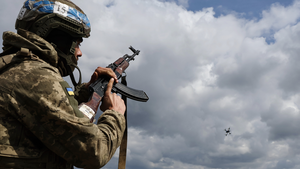
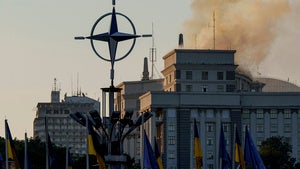
"As long as each provocation costs Moscow nothing more than a downed drone, Putin has every reason to keep escalating," Council Distinguished Nonresident Fellow in Defense and Security Julianne Smith writes.
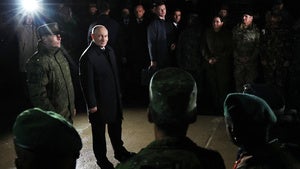
Alexander Kazakov, Sputnik, Kremlin Pool Photo via AP
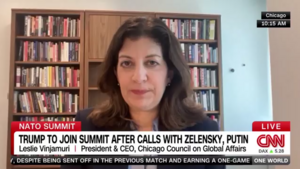
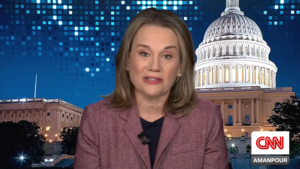
"Having that provocation on the eve of the NATO summit could lead President Trump to do what he should do, which is to double down on NATO's demonstration of unity," Council President and CEO Leslie Vinjamuri argues on CNN. "I mean, after all, this is this is a summit."
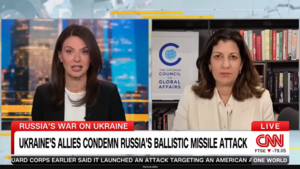
"Momentum should be on Ukraine's side, if only Europe and the United States could collaborate effectively to really take advantage of this moment," Council President and CEO Leslie Vinjamuri tells CNN International.
Council Senior Nonresident Fellow Paul Poast argues that multi-military involvement in the conflicts in Ukraine and the Middle East has reached the threshold of a world war—though not "at the level of World War I or World War II."
By barring Russian athletes from competing under the Russian flag, the International Olympic Committee demonstrated its power as a global norm-maker. Now, sporting federation leaders are seeking to distance their games from geopolitics.
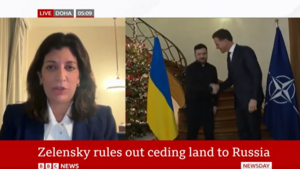
"The National Security Strategy would suggest [Trump's] not about to come to the primary defense of Ukraine, that he thinks this is clearly Europe's role and Ukraine's role, and there needs to be compromise," Council President and CEO Leslie Vinjamuri says.
"Russia is not prepared to make real concessions, and the middle ground that we really need between Ukraine and Russia right now seems further away than ever," Distinguished Nonresident Fellow Julianne Smith says.