The Paradox of President Trump's Peace Project

Trump can disrupt wars and force pauses but has yet to close one. The gap is creating space for middle powers—and an opening for China.
Within 24 hours this week, Washington and Riyadh offered two very different responses to a widening Middle East war.
On Wednesday, the United States launched a heavy new round of strikes against Iran after Tehran fired ballistic missiles at American forces in Jordan. The next day, Saudi Arabia unveiled a multinational maritime defense coalition to protect the Red Sea, Bab el-Mandab Strait, and Gulf of Aden after the Houthis declared a blockade on Saudi shipping. The first was another turn in the most recent cycle of escalation in a war launched by the United States and Israel. The second was an attempt by regional states to keep one war from closing a second maritime chokepoint.
The juxtaposition captures the paradox of US President Donald Trump’s peace project. At his inauguration, Trump said success would be measured “not only by the battles we win but also by the wars that we end—and perhaps most importantly, the wars we never get into.” His proudest legacy, he added, would be that of a “peacemaker and unifier.”
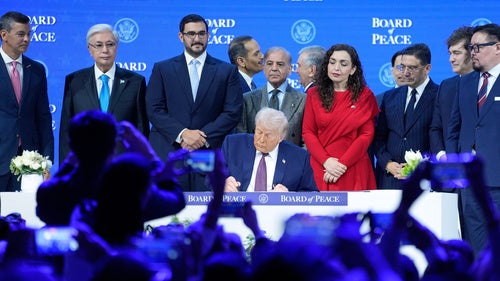
Eighteen months later, Trump has demonstrated his ability to disrupt convention, force pauses, and open negotiations. He has dabbled in multilateral peace diplomacy, creating a “Board of Peace” to steward peace deals. But he has not yet shown that American coercion—or this new style of multilateralism—can bring wars to a close, let alone produce durable settlements. And in the Middle East, Trump's disruption has led to outcomes that fall short of the status quo.
On Thursday, Trump announced that the Board of Peace had reached a “historic agreement” with Hamas to secure its disarmament. In an updated fifteen-point roadmap released Friday, the Board of Peace outlined that governance would be transferred to a Palestinian technocratic body, Hamas’ heavy weapons and tunnels put through a monitored decommissioning process, and Israeli forces withdrawn based on the “standards, milestones, and timeframes linked to demilitarization.” But Israel has not publicly endorsed the roadmap and has said Hamas must genuinely disarm before Israeli forces will move beyond the Yellow Line. Hamas has said Israel must first stop its attacks, increase aid, and fulfill its prior withdrawal commitments. Unless the US uses its leverage to ensure a sequenced delivery of these competing demands, success seems very unlikely and great power advantage somewhat meaningless.
Unless the US uses its leverage to ensure a sequenced delivery of these competing demands, success seems very unlikely and great power advantage somewhat meaningless.
Middle power peace diplomacy also has definite limits. Take the case of Ukraine, where Trump engaged in a negotiation circuit across Middle Eastern and European capitals, including Riyadh, Istanbul, Abu Dhabi, and Geneva. While the transnational efforts produced prisoner exchanges, they could not secure an agreement on territory, Ukraine’s military future, or guarantees that could deter another Russian attack. When Washington’s attention shifted to Iran, talks stopped.
Still, Turkey has continued to offer Istanbul as a venue and proposed narrower moratoria covering the Black Sea and energy infrastructure if a comprehensive ceasefire remains out of reach. The United Arab Emirates has used its access to both sides to keep delivering humanitarian agreements, successfully mediating its 25th prisoner exchange between Russia and Ukraine in June. Britain and France have organized a “coalition of the willing” around the harder problem of implementation, and the coalitions’ Multinational Force Ukraine (MNF-U) is ready to support Ukraine after a credible cessation of hostilities—and once the question of security guarantees has been addressed.
In the case of the Iran war, there have been an array of efforts that almost look like the seeds of a division of labor among the middle powers. After the United States and Israel opened the conflict in February, Pakistan helped broker an April ceasefire and, with Qatar, a June memorandum intended to stabilize it. Pakistan and Qatar then advanced another 10-day ceasefire proposal this month. Meanwhile, Oman has worked on answering the question of governance of the Strait of Hormuz. Its latest regional management proposal would divide responsibility between Oman and Iran, allowing voluntary payments for navigation and safety services. Tehran, however, has rejected the arrangement and demanded greater control.
Saudi Arabia’s new initiative aims to address a different part of the same problem. Representatives from 43 countries and the European Union participated in the meeting on the maritime defense alliance. Fourteen governments signed on to the coalition, with Saudi Arabia serving as lead and host.
But middle powers are hardly the only actors seeking to fill the diplomatic vacuum Washington has created and herein lies the more consequential challenge for international order. Beijing has long cast itself as a defender of peace, stability, and international rules, and is gradually becoming more ambitious. In March, China joined Pakistan in proposing a five-point framework for ending the Iran war. And in June, Beijing issued a white paper presenting China as a provider of international public goods and a champion of sovereign equality, international law, multilateralism, and practical cooperation. This month, Beijing initiated a new effort through Islamabad to restart negotiations between Washington and Tehran. China is Iran’s largest trading partner and principal oil customer, giving it leverage that Qatar, Oman, and Pakistan do not possess.
In a piece for Just Security, Daniel Forti and Richard Gowan identify Afghanistan as the clearest institutional test for China. Recently, China became the uncontested United Nations Security Council “penholder” responsible for shepherding negotiations over the UN mission in Afghanistan. It did so with conditional American acquiescence: Washington initially opposed China’s bid, later dropped its objection amid wider transactional diplomacy over Haiti, and then tested Beijing throughout the negotiations.
While China initially compromised rather than risk an American veto, it ultimately consulted across the Security Council and incorporated other members’ priorities. It preserved the mission’s humanitarian, political, and human-rights functions, and resisted American proposals that lacked wider support. The result was a unanimous one-year renewal of the mission, with Beijing assuming responsibility for maintaining multilateral machinery at precisely the moment Washington was questioning it.
It would thus seem that for middle powers seeking to elevate their own status on the international stage, a contribution to peace diplomacy would be advantageous. And for Washington, the best route forward in this case, but also in light of the challenge that China presents, may be to treat the champions of these efforts as co-authors of peace. Ceding the space to China would likely carry a far great consequence.
The Chicago Council on Global Affairs is an independent, nonpartisan organization and does not take institutional positions. The views and opinions expressed in this commentary are solely those of the author.