College Students Are Speaking Out and Protesting Israel-Hamas War

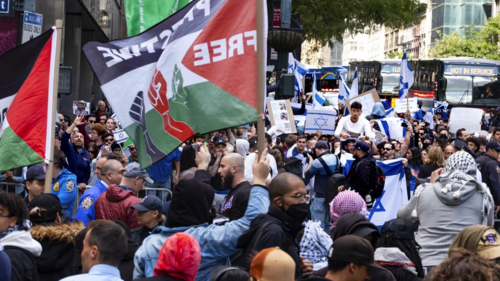
In the US, student groups are voicing their positions on the war between Hamas and Israel, including a statement by 34 Harvard University groups holding Israel responsible for the violence.
In short: Israel declared war on the Palestinian militant group Hamas after it launched an attack on Israeli soil on Oct. 7, taking at least 100 hostages. The attack comes after months of heightened tensions due to Israel’s ongoing treatment of Palestinians in Gaza and recent violence at a site sacred to both Jewish and Muslim people. In the U.S., student groups across the country have voiced their stances on the matter, including a statement signed by 34 Harvard University groups holding Israel responsible for the violence. The statement faced backlash both from the university’s former president and lawmakers on both sides of the aisle.
What's going on in Israel?
Hamas launched an attack on Israeli soil on Oct. 7 and took at least 100 hostages.
Hamas said the attack was in response to “Israeli attacks on women,” Israeli police raids on a sacred mosque in Jerusalem, and Israel’s treatment of Palestinians in Gaza.
Israel responded to the attack by retaliating with airstrikes and declared war on Hamas. Israel also sealed off Gaza from any incoming food and water, as well as cutting off electricity for the region’s 2 million Palestinian residents, half of whom are under the age of 19.
An Israeli military official said Hamas had “opened the gates of hell” into Gaza, and Israeli Prime Minister Benjamin Netanyahu said Israel would “return fire of a magnitude that the enemy has not known,” and that “the enemy will pay an unprecedented price.”
The death toll on both sides combined is at least 1,600.
What happened at Harvard?
After the fighting broke out in Israel, 34 Harvard University student groups issued a statement blaming Israel for the violence.
“The apartheid regime is the only one to blame,” the statement read. “Israeli violence has structured every aspect of Palestinian existence for 75 years. From systemized land seizures to routine airstrikes, arbitrary detentions to military checkpoints, and enforced family separations to targeted killings, Palestinians have been forced to live in a state of death, both slow and sudden.”
The statement – signed by multiple Palestinian and Muslim student groups, Harvard Jews for Liberation, and the African American Resistance Organization – was condemned by former Harvard president Lawrence Summers and Democratic and Republican federal lawmakers alike, many of them alumni of the university.
Harvard’s current president, Claudine Gay, condemned the Hamas attack.
What’s happening on other campuses across the U.S.?
Campuses across the country have seen groups organize events after the fighting broke out, including a vigil in support of Israel at the University of Vermont and multiple events in support of Palestinians being organized by local chapters of Students for Justice in Palestine.
There also have been several other events in the news:
- Jewish students at the University of Michigan held a vigil on Oct. 10.
- A vigil at the University of Florida for victims in Israel resulted in trampling that sent at least 30 students to the hospital.
- At Indiana University, after two Jewish student groups organized a gathering, members of the Palestinian Solidarity Committee organized a counterprotest for the same time as the Jewish student groups' gathering. There was some conflict between the two groups and campus police had to intervene.
- A pro-Palestinian event held by Boston University students was counterprotested by Israel supporters.
- One pro-Israel group and one pro-Palestinian group gathered separately at Ohio State University.
International students in Israel were also killed in the fighting, and three Northeastern University students were safely evacuated from Israel.
U.S. college campuses have become a hot spot on the issue of Israel and Palestinians. In 2021, the last time there was a flare-up of violence between Hamas and Israel, student groups supporting both Palestinians and Israel issued statements and organized events.
Those supporting Israel say that the statements and protests cause an uptick in “antisemitism and anti-Israel rhetoric,” while those who support Palestinians say that Palestinian voices are often silenced, and many receive death threats.
Antisemitism is on the rise in the U.S. and antisemitic incidents increased by 36% from 2021 to 2022. There is an ongoing debate over whether criticism of Israel is inherently antisemitic.
In 2021, Palestine Legal, a group that provides legal aid to those who support Palestinians, took on 280 cases defending supporters from suppression of their views. This is a 31% increase from 2020. More than half of these incidents happened on college campuses across the country.