The World American Alliances Were Built for No Longer Exists

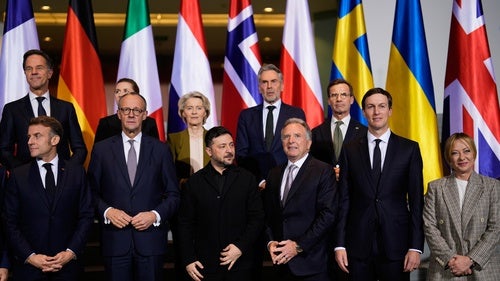
Alliances have long been one of America's greatest strategic advantages. At 250, the United States must redefine its partnerships for a transformed geopolitical and technological era.
Since the United States was founded, American leaders have understood the value of partners and allies. From the French alliance during the American Revolution to the creation of NATO post-World War II, sustained diplomatic outreach has been a strategic constant, shaping US success and global influence for more than 200 years. As America nears its 250th anniversary, two questions arise about the future of its unmatched network of alliances around the globe: First, will future US leaders and the public continue to view alliances as one of America’s greatest strengths? And, if so, will these leaders possess the will, innovation, and resources to reshape and redefine those alliances for a transformed geopolitical and technological era?
When the United States helped build a new international architecture in the aftermath of World War II through the formation of NATO, the United Nations, and the Bretton Woods system, it made alliances the backbone of US leadership. These partnerships worked because the countries involved shared threat perceptions and core democratic values, and because US economic and military preeminence provided stability and direction within relatively coherent blocs. The result was a historic strategic payoff: peace in Europe, Soviet containment, expanded global trade and prosperity, and technological innovation were all made possible through sustained, allied cooperation.
Today, the world for which America’s alliances were built no longer exists. Power is increasingly multipolar, and great-power competition has returned in more complex and multidimensional forms. Rapid technological disruption, from artificial intelligence and cyber capabilities to space systems, is reshaping the global balance of power far faster than traditional institutions can adapt. States and non-state actors are exploiting gray zone tactics—disinformation, cyberattacks, maritime disruptions—and blurring the line between war and peace. Economic interdependence, once viewed as a stabilizing force, is now complicating collective action as supply-chain vulnerabilities and dependencies create new leverage points.
"Looking ahead to America’s next century of statecraft, alliances must be reimagined to reflect new realities."
At home, skepticism about global commitments and the growing politicization of foreign policy are placing additional pressure on America’s role abroad. Allies, too, are recalibrating. Europe is redefining its security posture in the wake of Russia’s war in Ukraine, Indo-Pacific democracies are navigating China’s rise, and countries across the Global South are seeking greater agency within the international system.
Despite these pressures, alliances still matter and, in many ways, matter more today than ever. Their enduring hard-power value is clear, as collective deterrence, shared intelligence, and interoperability remain essential. Economically and technologically, alliances help secure critical supply chains, shape global standards, and coordinate industrial capacity in sectors where no nation can compete alone.
Looking ahead to America’s next century of statecraft, alliances must be reimagined to reflect new realities. First, they must broaden their scope, moving beyond traditional security cooperation to become whole-of-society partnerships that meaningfully engage industries, scientific communities, and civil society. Second, they need to build genuine multi-domain interoperability with shared data architecture, coordinated cyber and space strategies, and synchronized industrial bases capable of responding at speed and scale. Third, the political foundations of alliances must be modernized through renewed domestic engagement, clearer public narratives, and burden-sharing models that reflect 21st century capabilities. Finally, alliances must create stronger connective tissue across regions, deepening ties between Euro-Atlantic and Indo-Pacific partners, and aligning democracies on the rules and norms governing emerging technologies.
US success has always been magnified through alliances. America at 250 must choose to lead by updating these partnerships to be more flexible, global, and future-oriented. If it does, alliances will remain its greatest strategic advantage and one of the world’s best hopes for stability in a turbulent era.


Related Event

America at 250: The Arc of Global Influence
This content is part of the Council’s America at 250 initiative, a series of high-level dialogues, expert perspectives, public and private programs, and a signature conference focused on the critical questions that will define America’s future.