What a Fragmented ASEAN Means for US-China Competition

The Iran war’s ripple effects risk obscuring festering divisions within the Southeast Asian bloc—most notably its inability to develop a region-wide approach to Washington and Beijing.
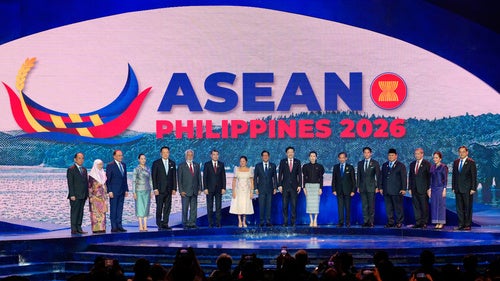
The Association of Southeast Asian Nations (ASEAN) summit kicked off amid a regional heatwave, making the theme—energy security, the ongoing crisis in the Middle East, and disaster resilience—uncomfortably well-timed.
Oil supplies have fallen dramatically across Asia, which received four-fifths of the Gulf’s exports before the Iran war broke out. Some countries have already tapped into their strategic reserves, while nations such as Vietnam and the Philippines are encouraging companies to adopt work-from-home arrangements, flexible schedules, or four-day work weeks to conserve energy. And many governments have advised ceasing or restricting the use of air conditioning.
The meeting offers a chance for the region to coordinate responses to overlapping economic challenges, including energy supplies, US tariffs, and Chinese competition. But the effects of the Iran war threaten to paper over festering challenges within ASEAN, most notably a longstanding inability to develop a region-wide approach to great-power competition.
The 'ASEAN Way'
Southeast Asia has long adopted a “don’t make us choose” approach to China and the United States. But the strategy is predicated on the belief that an “ASEAN Way” can generate enough regional coherence and coordination for members to chart an independent path. ASEAN’s consensus decision-making rule—which gives every member a veto over group decisions—is meant to manifest common, collaborative goals.
In practice, however, agreements have often devolved to the most reluctant nation’s position, and outside actors have been able to pressure individual countries to veto proposed policies. For years, China has pushed individual members of the block to water down or halt discussions on a Code of Conduct (COC) for the South China Sea, an agreement that could reduce military confrontations over rival territorial claim. Such rules would be very useful given escalating disputes between China and the Philippines over control of reefs and shoals. The Chinese Coast Guard has rammed multiple Philippine vessels over the past two years, prompting Manila to expand its coast guard stations and increase training with American troops.
Manila will once again push for an agreement at this summit. But this effort will likely face the same institutional obstacles and the added challenge of the Iran war pulling focus. A nonresponse could prompt the Philippines to further expand its security cooperation with the United States and other partners, and push Southeast Asia toward an “ institutional vacuum.” In the absence of international organizations that can effectively incentivize regional cooperation, members could seek out alternative multilateral groups or pursue independent foreign policies. Either approach would further weaken ASEAN’s coherence, leaving it—at best—a “zombie institution” that continues to shamble along while consequential discussions and decisions are produced elsewhere.
Between Two Great Powers
ASEAN’s approach to regional relations has been credited with cooperative security, non-intervention, and a sometimes myopic focus on economic win-wins. But it is only workable so long as US and Chinese interests in the region focus on “friendly” competition in trade and business. In recent years, China has used its growing military power to exert power on regional states, and Washington and Beijing have increasingly viewed each other as rivals in a great-power competition. As a result, members have been forced to choose between Beijing and Washington, or between economics and security, undermining the forum’s search for a consistent, group-wide strategy.
While ASEAN may be able to encourage positive-sum cooperation among members, it is constitutionally incapable of managing contentious, zero-sum security challenges.
While ASEAN may be able to encourage positive-sum cooperation among members, it is constitutionally incapable of managing contentious, zero-sum security challenges. Consequently, this year’s summit retreats to common ground on economic cooperation and natural disasters. But even here, ASEAN could struggle to develop a clear, common approach with the Iran war stressing the region’s supply chains, which were already fragile due to ongoing maritime disputes.
Washington’s policies in the past year have only added to the economic pain. ASEAN members received four of the top six tariff rates imposed during “Liberation Day,” ranging from 44 to 49 percent. Beyond the absolute increase in costs, Southeast Asian countries have also suffered from differential tariff rates, where their competitors’ products are comparatively cheaper because of lower tariff hikes. And the US administration is threatening to impose additional tariffs unless Southeast Asian states can root out the transshipment of Chinese goods .
The ASEAN summit thus faces significant challenges in developing effective responses—even to its stated themes. The group can continue to avoid coalescing on an organization-wide position on great-power competition, but not without incentivizing individual members to embark on their own policies and strategies. Such fragmentation would weaken ASEAN, and China would likely be the biggest beneficiary.
For Southeast Asian nations, China’s trio of global initiatives—the Global Security Initiative, the Global Development Initiative, and the Global Civilization Initiative offer at least a semblance of more stable foreign relations than the United States. Beijing has also stepped up its diplomacy with Southeast Asia, offering support to manage the war’s fallout, such as providing jet fuel. This stands in marked contrast to Washington’s efforts, which in some cases has involved pressing countries to purchase American energy. Thailand’s foreign minister noted in a recent interview that a lack of US support forced the country to borrow $12.2 billion to address cost-of-living, energy, and food supply challenges.
Still, since 2008, Vietnam, the Philippines, and Myanmar have shifted significantly toward Washington, in part seeking security coordination in response to Chinese military activities. This means the United States has an opportunity to not only maintain but deepen its ties to Southeast Asia. Stronger statements of support, lowering tariffs, increasing military information-sharing and coordination are all measures that could cement these behaviors into long-term trends in Washington’s favor. But given ASEAN’s institutional constraints, the United States may have to pursue this strategy in a piecemeal fashion, rather than appealing to the bloc as a whole.
The Chicago Council on Global Affairs is an independent, nonpartisan organization and does not take institutional positions. The views and opinions expressed in this commentary are solely those of the author.