Trump's Iran Strategy Falls Short on Solutions

Unless Trump can devise a secure—and cost-neutral—plan to reopen the Strait of Hormuz, the United States will lose even more global goodwill.
This analysis was first published in the Times of India and adapted for this publication.
Thirty-two days after the United States and Israel launched strikes on Iran, US President Donald Trump chose Passover to make his first public appeal to the nation in the face of an unpopular war for which the objectives have been opaque and confused at every juncture, and that has widened and escalated beyond his control.
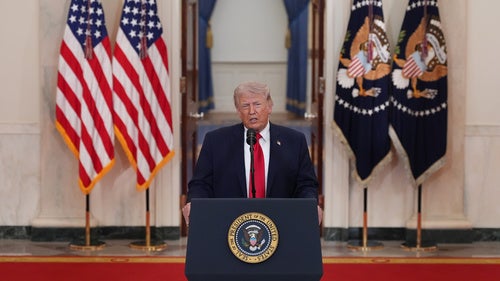
At 19 minutes, his speech Wednesday was rushed and struggled to reframe the destruction and havoc that has been unleashed across West Asia. Trump also used the speech to recast the rising economic costs at home in the United States as a price worth paying for future generations. Americans should be proud, Trump claimed, to support a war that would remove the threat of Iran for their children and their grandchildren. He pressed energy-dependent nations to solve the Strait of Hormuz problem, although he offered no roadmap for achieving this.
When Trump's speech was announced, many Americans anticipated the TACO principle would prevail and he would claim success and stand down, leaving others to pick up the pieces. But even Trump is struggling to confidently project victory as Iran's nuclear capabilities remain unchanged since last June, the Strait of Hormuz stays effectively closed, missiles and drones hit Gulf states and Israel, prices continue to escalate, and the death toll rises.
Instead, Iran has leveraged its asymmetric advantage, effectively shutting down nearly 20 percent of the world's oil and gas transit, inflicting pain across the globe.
In this context, one of no good policy options (and no deal in sight), retreat is also politically unpalatable. Trump announced plans to escalate US attacks for at least two to three more weeks, threatening to take Iran "back to the stone ages" and hit "each and every one of their electric-generating plants" if there's no deal.
Trump claimed several victories, stating that the Iranian navy and air force were decimated, its missiles "just about used up," and that the current effort would remove Tehran's capability to launch a missile that could strike the United States—something that experts believe Iran will not achieve for at least another decade.
Trump also asserted the United States’ energy independence, ignored the reality that oil prices are set globally, and pushed the rest of the world to buy American to secure their energy needs. And in a clear reversal of the Pottery Barn rule (you break it, you own it), he called on those dependent on the previous frictionless transit of oil and gas through West Asia to "build up some delayed courage” and take back the strait.
Of course, there is a yawning gap between Trump’s claim to success and the steady buildup of US forces in the region. With around 50,000 American troops deployed, including an increase of nearly 10,000 troops in recent days, escalation rather than de-escalation looks likely.
A ground invasion would be risky and could have grave consequences in human terms. The administration has also not explained what its purpose would be or how it would deliver greater stability. For a war that is already unpopular with Americans, a ground invasion is likely to further erode public support. A Reuters/Ipsos poll suggests that just 7 percent of Americans support such a course. Meanwhile, US midterms are looming on the horizon. As instability in the Strait of Hormuz continues and the economic impacts of the war accelerate, ordinary Americans may soon become disillusioned.
Unless Trump can devise a stable—and cost-neutral—plan to reopen the Strait of Hormuz, the United States will also lose more global goodwill. Iran now looks set to control the strait (calling the bluff of those who claim the United States is willing or able to enforce a rules-based economic order), thereby subjecting others to the vagaries of Iran’s exercise of its own economic power.
The search for a credible but also comparable alternative to America’s role as a guarantor of the international order will be accelerated by the war with Iran.
For US partners and allies, relying on the United States during Trump’s second term has now involved more than one year of living with ongoing disruption and uncertainty. But this has not yet translated into an alternative framework or policy for global or regional governance.
Instead, there have been piecemeal and pragmatic steps taken by middle powers to solve discrete problems based on national more than collective interests. India has pursued quiet efforts with Iran to try and get its ships through the strait. China has done the same.
While Canadian Prime Minister Mark Carney’s call to middle-power action at the World Economic Forum in Davos was inspirational, many question if his vision is achievable—especially at scale and on the difficult problems of war and peace. Can middle powers coalesce and step up? This may be unrealistic in the current threat environment. But there are emerging signs of ambition. The United Kingdom has offered to lead a coalition to stabilize and reopen the Strait of Hormuz, though only after hostilities end.
The search for a credible but also comparable alternative to America’s role as a guarantor of the international order will be accelerated by the war with Iran. But the world faces a dilemma. So far, those who are able to lead do not appear to be willing, and those who are willing may not be able. Whether anyone will replace the US role in underwriting a rules-based order and manage the transition to a world that is increasingly multipolar and unanchored from American power remains to be seen.
The Chicago Council on Global Affairs is an independent, nonpartisan organization and does not take institutional positions. The views and opinions expressed in this commentary are solely those of the author.