The Sacralization of the Iran War

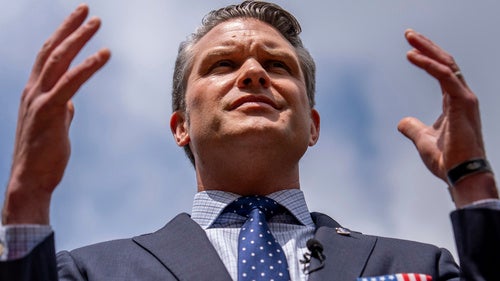
US Defense Secretary Pete Hegseth’s deployment of religious rhetoric in the Iran war has come under increased scrutiny. What happens when the line between political conflict and religious warfare blurs?
“God is good,” US Defense Secretary Pete Hegseth said in a press briefing the morning after a two-week ceasefire between Iran and the United States was announced. “Our troops, our American warriors, deserve the credit for this day, but God deserves all the glory.”
It was not the first time this week that Hegseth invoked religious language in his official communications about the war. On Monday, he compared the rescue of a downed US airman in Iran to the liturgical Triduum, the three days spanning Holy Thursday to Easter Sunday: “Shot down on a Friday—Good Friday, hidden in a cave—a crevice—all of Saturday, and rescued on Sunday. Flown out of Iran as the sun was rising on Easter Sunday, a pilot reborn.”
Hegseth’s use of religious rhetoric in justifying US actions has come under heightened scrutiny in recent weeks as the Trump administration attempts to rally Americans around the increasingly unpopular war in the Middle East. Trump has offered several, often contradictory reasons for the US operation, including preventing Iran from developing nuclear weapons, destroying Iran’s navy, and weakening its regional proxies. But none of these explanations appear to have convinced the US public of America’s continued engagement in the region, with 59 percent saying the United States made the wrong decision in using military force in Iran.
While Hegseth’s frequent religious invocations have served as a reminder of the prominence and growing influence of Christian nationalism in American political and military leadership, they have also worked to recast the Iran war as a sacred obligation. Evangelical leaders throughout the country have spread Hegseth’s vision from the pulpit, speaking especially to the one-third of Americans who identify as Christian nationalist adherents or sympathizers. As members of Congress debate the constitutionality of such use of religious rhetoric, Hegseth continues to signal both to the United States’ chief ally and its central adversary in the conflict that the head of the so-called ‘Department of War’ sees himself—and the US armed forces he oversees—engaged in an existential struggle.
A Holy Worldview
Hegseth is a member of the Communion of Reformed Evangelical Churches (CREC), an archconservative network of congregations. CREC beliefs dictate that there should be no distinction between religious and political spheres, and that the church should be militant in reforming the world. Early in his tenure as secretary, Hegseth instituted monthly Christian prayer sessions at the Pentagon as part of a broader push to integrate “all of Christ” into “all of life.” In February, he invited CREC leader Douglas Wilson to deliver a sermon at the Pentagon, where Wilson said there was “no greater armor” than “the name of Jesus Christ.”
The line was reminiscent of Hegseth’s 2020 book, American Crusade, in which he described Americans as Christian knights who must “pick up the sword of unapologetic Americanism . . . and push Islamism back.” While Trump may be known as a 19th-century president, Hegseth’s worldview belongs elsewhere in history: 1095, a time of holy war and conquest in the Middle East. He has routinely returned to biblical, crusader, and apocalyptic language when speaking about the military’s recent actions in the Middle East, blurring the line between political conflict and religious warfare. During a worship service on March 25—the Pentagon’s first since the Iran war broke out—Hegseth prayed for “every round” to “find its mark against the enemies of righteousness and our great nation” and for “justice” to be “executed swiftly and without remorse.”
But Hegseth is not the only leader who sees themselves engaged in a holy war. Israeli Prime Minister Benjamin Netanyahu has referred to Israel’s military campaigns in the Middle East as a “War of Redemption”(Milhemet HaTekuma), in which all battles are being carried out against a symbolically aggregated enemy: Amalek, a biblical nation that repeatedly attacked the Israelites and encompasses Israel’s contemporary adversaries. On March 2, Netanyahu spoke from the site of an Iranian ballistic missile strike in Beit Shemesh and cited Deuteronomy 25:17, saying, “Remember what Amalek did to you.”
For more than 60 years, the United States has maintained a “special relationship” with Israel. Evangelical support for the country—often described as “God’s foreign policy”—is grounded in interpretations of divine promise and prophecy. But Hegseth’s invocation of religious rhetoric communicates that the two nations are fulfilling a holy mandate in the Middle East.
Hegseth’s use of apocalyptic and moral terms not only resonates with Israel. For Iran, Shia Islam is a “totalizing ideological framework.” The doctrine of velayat-e faqih, or ‘Guardianship of the Jurist,’ interlinks spiritual and political authority, making national security a sacred duty. The Islamic Revolutionary Guard Corps (IRGC) is mandated by Iran’s constitution to extend the sovereignty of God’s law, and political scientists suggest that the hardliner adoption of the Islamic eschatological doctrine of Mahdism rearticulates the IRGC as “military vehicle" that will ready the world for the reappearance of the 12th Imam.
The sacralization of the conflict by all major players begs the question: What does a durable diplomatic resolution look like in a divinely ordained war?
Whether intentionally or not, the Hegsethian Christian nationalist edifice and language communicate to the Islamic Republic of Iran that the leader of the US war department has a cosmic stake in the conflict—and reinforces Iranian leadership perceptions that the United States is the 'Great Satan.' There have been reports of intensified recruitment efforts within Iran—including the enlistment of increasingly young volunteers—under slogans invoking martyrdom, sacrifice, and loyalty to the Islamic republic. “The Shia are prepared to be martyrs of their faith,” a recent AI-generated video released by supporters of the Iranian government stated. “It is the Islamic Republic of Iran that they are defending—not just their land, not just their culture, not just their history, but their faith.”
Separation of Church and State?
In March, members of Congress requested an investigation into alleged reports of military commanders using apocalyptic theology and religious prophecy to justify US action against Iran. The 30 representatives who submitted the request urged Department of Defense Inspector General Platte B. Moring III “to assess whether Secretary Hegseth’s extreme religious rhetoric has metastasized into segments of the military chain of command in ways that contravene constitutional protections, departmental rules and standards, or professional military norms.”
Around the same time, Americans United for Separation of Church and State filed suit against both the Department of Defense and Department of Labor for withholding records on the planning of the monthly prayer services. The documents were requested as part of an ongoing investigation into the religious neutrality of the prayer services, which are held during work hours in government offices and broadcasted on the Department of War’s internal TV network. The government’s role, Americans United CEO and President Rachel Laser said, “is to serve the public, not to proselytize.”
But for Hegseth, his service as secretary of defense is mutually imbricated with his Christian militarism. Claims that “America’s military achieved every single objective” do not suddenly erase Hegseth’s worldview and positionality. In the Christian militaristic outlook, the central adversary is morally irredeemable, and the battle is cosmically entrenched and existentially consequential. This view powerfully mobilizes evangelical audiences in the United States and religious-nationalist constituencies in Israel, while signaling to Iran an existential threat that demands full societal activation. The sacralization of the conflict by all major players begs the question: What does a durable diplomatic resolution look like in a divinely ordained war?
The Chicago Council on Global Affairs is an independent, nonpartisan organization and does not take institutional positions. The views and opinions expressed in this commentary are solely those of the author.