In New Delhi, Crisis Furthers an Embrace of Multipolarity

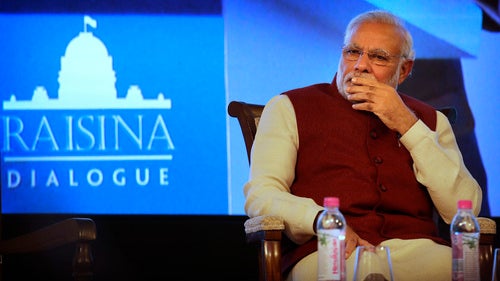
Across the first two days of the Raisina Dialogue, the Global South and Europe worked to forge a way forward amid profound disruption and uncertainty.
The annual cycle of high-level international conferences moved this week to New Delhi. After meetings in the ski resort of Davos and the Bavarian city of Munich, the world’s most populous country and fourth-largest economy provided a more realistic backdrop for high-level debate on geopolitics and geoeconomics. While the widening war in the Middle East forced hundreds to abandon their travel, more than 3,000 people turned up to the 11th annual Raisina Dialogue, which proceeded with a sense of urgency and organized disarray apt for the moment—and an unparalleled energy and ambition that has come to define Raisina.
If the Munich Security Conference takes the pulse of the transatlantic community, the Raisina Dialogue plays a similar role for the Global South. But it has also become a meeting place for Western and Global South leaders and their expert communities. On Thursday evening, Indian Prime Minister Narendra Modi and Finnish President Alexander Stubb arrived to a packed hall (and a spillover room).
Modi inaugurated the Dialogue and Stubb delivered a speech that extolled the virtues of values-based realism—declaring the era of Western dominance to be over, describing the current world as one where “might makes right,” and proclaiming that the Global South, and especially India, will decide what the next order will look like. In a moment that was as eloquent as it was out of touch, he concluded by calling for a new San Francisco moment (where delegates met in 1945 to draft and sign the United Nations Charter), but in Delhi. He added calls for UN reform, a permanent seat for India on the UN Security Council, and the strengthening of regional organizations and integration
But the remainder of the Raisina Dialogue took on a different tone—embracing the move to multipolarity amid the profound uncertainty unleashed by the crisis in the Middle East. Indian External Affairs Minister Dr. S. Jaishankar repeated that multipolarity was “not going away” and that multilateralism would have to find its feet in this new context. For India, multi-alignment is a foreign policy strategy that preserves its strategic autonomy, an overriding imperative, and a form of deterrence. On day two of the Dialogue, India was angered as news emerged that Iranian Navy ship IRIS Dena was torpedoed by a US submarine after it completed an exercise with India’s Navy.
In a defensive speech on the second day of the conference, Iranian Deputy Foreign Minister Saeed Khatibzadeh claimed the high ground for Iran, condemning the United States and Israel for executing an illegal war, negotiating in bad faith, and bombing Iran illegally. He went on to claim that the United States and Israel were seeking to establish a Greater Israel and put an end to the existence of Iran, and that Iran had no option other than to respond as it had. Few speakers at the Dialogue made the same strong case for Iran, but equally, few were surprised by Iran’s response.
US Deputy Secretary of State Christopher Landau led the US delegation. Landau recited the core impulses of US President Donald Trump’s foreign policy approach, stressing that the United States and India were moving ahead to finalize their trade deal, and (in a silent reference to Washington’s failed ambition to get China to play fair on matters of trade) noted that the United States would not be making the same mistake with India. After a sharp rupture in the US-India bilateral relationship last summer, there appeared to be clear, if measured, attempts by both parties to restore the relationship.
Longstanding critiques by the Global South of the international order’s failure to be inclusive or equitable have been overtaken by a far worse fate: The United States—the key architect of the order—has turned its back.
None of this, however, could mask the most dramatic change in the Dialogue: the marked, silent shift away from the United States. In almost every room, there was a shared recognition that the international order is no longer fit for purpose. Now, longstanding critiques by the Global South of the international order’s failure to be inclusive or equitable have been overtaken by a far worse fate: The United States—the key architect of the order—has turned its back. Trust is broken. Alliances are not quite working. And the United States does not appear to be especially interested in creating the foundations for a new reformed multilateralism, despite what was said in Munich.
Across the first two days of the Raisina Dialogue, it became clearer that the United States not only lacks a clear objective in Iran, but that it lacks a clear strategy or objective for the world. If that is true, and if Stubbs is right that the future of the order will be decided by the Global South, then the imperative and necessity of the Raisina Dialogue are far more important than Davos or even Munich.
In the early 2000s, the Chicago Council on Global Affairs established a strong connection to India under the leadership of Marshall M. Bouton. Strengthening ties with India was seen as forward-looking and visionary at the time. Today, engaging with India, and the Global South, is an urgent necessity.
The Chicago Council on Global Affairs is an independent, nonpartisan organization and does not take institutional positions. The views and opinions expressed in this commentary are solely those of the author.