The G7's Overriding Goal: Getting Through

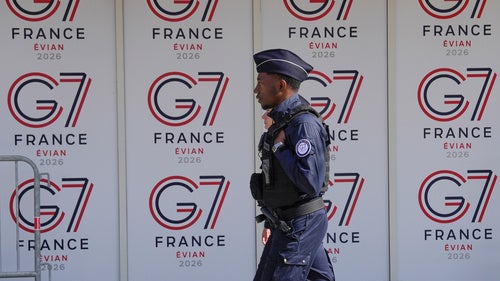
Despite geopolitical turmoil, France is using the G7 to ensure Europe remains relevant as the United States and China pursue further bilateral diplomacy.
The leaders of the world's major industrial democracies will gather at Évian-les-Bains on Monday for the G7, and the perennial question arrives with them: Can the group maintain its relevance in the face of global power shifts, a disruptive US leader that is philosophically opposed to multilateralism, and rapid technological change?
In material terms, there is every reason for the G7 to be ambitious. The group—which includes Canada, France, Germany, Italy, Japan, the United Kingdom, and the United States—accounts for about 45 percent of global GDP at market prices and under 30 percent in purchasing-power terms. While this represents a steady slide from its 1980s dominance, the Seven still spent roughly $1.37 trillion on defense in 2025, close to half the world's total. And keeping the United States on board presents the opportunity for concrete gains.
France’s Emmanuel Macron, hosting his final summit as president, is also not one to settle for irrelevance. So, he has taken on the biggest issue there is: China.
But Europe's China problem is really a Europe problem. The European Union (EU)'s goods trade deficit with China worsened from €65 billion in the first quarter of 2024 to €98 billion in the first quarter of 2026, even as it remains concentrated in the sectors that matter most for Europe's industrial future. At a recent meeting outside London, one former official described this threat from China as ‘existential’ for Europe. This is the second China shock in practical form: cheaper, higher-value Chinese manufactured goods pressing directly into Europe's industrial base.
Europe has made strides on its China policy since the COVID-19 pandemic, but it still struggles to align internally—and the squeeze is tightening from both directions. The second China shock is hitting European industry just as Washington's own China policy has become harder to read but portends to be aiming for strategic stability. In the recent meeting between US President Donald Trump and Chinese President Xi Jinping, the phrase strategic competition did not appear. A more transactional and less predictable United States leaves Europe stuck between Chinese industrial power and American bilateralism. That leaves an awkward question for the G7. If Washington is cutting its own deals with Beijing, how much scope is there for the G7 to act coherently?
Despite these challenges, France is determined to lead, and it has dressed the ambition in history. The official theme of the Évian summit harkens back to the group’s founding in Rambouillet in 1975: Make the reduction of global imbalances and inequalities the priority and position the G7 as a space for dialogue among the major advanced industrialized democracies, rejecting might-is-right on one side and pure moral posturing on the other.
But Macron’s vision for the G7 is bolder than the historical parameters might suggest and seeks to move beyond the original club, perhaps to ensure that Europe does not become irrelevant in the face of direct US-China diplomacy. On Thursday, Macron chaired a videoconference bringing the G7 together with China, the International Monetary Fund, and the summit's invited partners to address global economic imbalances. The French called it "a new willingness on the part of China, the United States, and Europe" to attempt coordinated steps, and, in a display of great self-awareness, France pressed its diagnosis: China overproduces, America overconsumes, Europe underinvests.
On Deep Dish this week, I spoke with Mathieu Duchâtel of the Institut Montaigne about what the G7 can deliver. In a recent paper, Duchâtel and coauthor Joseph Dellatte analyze supply-chain resilience, access to critical minerals, and reduced exposure to economic risks—key concerns that have moved from the margins to the core of G7 politics. The paper argues that China sits at the center of many G7 economic-security concerns, but allies differ over how directly to name the problem and how much authority to give any common mechanism.
As Duchâtel put it, "there is clear alignment on China as being the source of many of our economic security problems," an assessment that did not change after the recent US–China summit. So, France has put its energy where results are within reach: critical minerals, framed as the kind of multilateralism that "prevents vulnerabilities and reduces coercion potential."
The G7 could centralize the process of building new mining, processing, and recycling projects capabilities. But Europeans are hedging on multiple fronts, attempting to remain a relevant partner in US-China diplomacy, hedging against US coercion, and managing internal barriers to cooperation. One initiative under consideration is a permanent critical minerals secretariat for the G7, but not under American leadership due to fears access could itself become a tool of coercion. Separately, the EU is building a stockpile of its own led by Italy, France, and Germany. Duchâtel calls it incremental, won "one project at a time." But Europe's own efforts are trapped in a two-level game between governments and the European Commission. Across the alliance, he told me, there is "no coordination among various economic security initiatives whatsoever."
The effort to maintain some semblance of unity among its members, engage China and the wider emerging world, and advance a longer-term agenda may all be stymied by the urgency of war.
In the face of these challenges, the G7 faces an uphill battle in bringing coherence to the economic security agenda. The overriding goal for the Evian summit, which extends far beyond economic security, is unity, which in practice means (even for Macron) keeping Trump on board. France pulled climate off the environment agenda, a "pragmatic decision" to keep partners at the table, and is planning short, Biarritz-style thematic declarations rather than the long communiqués Washington has criticized. South Africa, a regular guest at past summits, wasn't invited because of a reported US threat to boycott if it attended. (It also was not invited to the December G20). France denies the pressure and says it chose to invite Kenya instead because of Macron's planned visit to the country later this year. Either way, the G7's outreach to the rest of the world still bends to its most powerful member. Indian Prime Minister Narendra Modi was invited personally by Macron in Mumbai, especially notable because of India's BRICS chairmanship. Brazil, South Korea, and Egypt will all be attending. Syrian President Ahmed al-Sharaa may also become the first Syrian leader ever to join a G7 summit.
But the effort to maintain some semblance of unity among its members, engage China and the wider emerging world, and advance a longer-term agenda may all be stymied by the urgency of war. The G7 convenes amid renewed fighting in Iran and an unstable Lebanon, ongoing US threats to return to war alongside the elusive search for a deal, and with the International Energy Agency calling the closure of the Strait of Hormuz the “largest supply disruption in the history of the global oil market.” The G7 has already been operating as a crisis manager this year, holding an emergency finance and energy ministerial in March that resulted in a coordinated release of 400 million barrels of emergency reserves.
The Middle East is not the only front that is top of mind. G7 leaders are working on security guarantees for Ukraine amid a live intragroup fight after Trump issued a temporary sanctions waiver on Russian oil and a meaningful shift in momentum on the battlefield toward Ukraine. On June 8, G7 agriculture ministers met to discuss the chokehold in the Strait of Hormuz and how to mitigate impacts to food and fertilizer trade.
Ultimately, this period will be one that is defined by a pragmatic realism that recognizes there is a mutual self-interest in keeping the torch of multilateralism alive. In 2027, the G20 passes from the United States to the United Kingdom, and in 2028, London inherits the G7 leadership after America’s year at the helm. This will give the UK back-to-back years of exceptional convening power, but also two successive years of following a disruptive US leader—including in the year of the next US presidential election. It also comes at a time when the UK is facing its own internal political turmoil. In this context, making a success of the multilateral architecture will not be easy, but there is an important opportunity in trying.
The Chicago Council on Global Affairs is an independent, nonpartisan organization and does not take institutional positions. The views and opinions expressed in this commentary are solely those of the author.
Related Content
 Global Economy
As the G7 prepares to meet, economic security is becoming harder to ignore. Mathieu Duchâtel explains what's behind the push to make supply chains more resilient and where the biggest challenges remain.
 US Foreign Policy
The forum combines middle powers ambition with great power access. But the US presidency promises a narrow agenda and unpredictable leadership.
 US Foreign Policy
The Trump administration’s national security strategy calls for US dominance. But in embracing a G20 agenda of multilateralism, the United States could affirm its role as a world leader—and elevate its ability to set the terms.