Even in Retreat, America Will Remain Globally Consequential

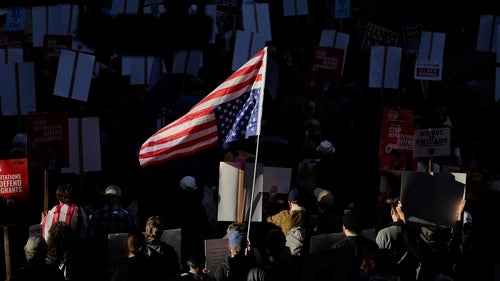
The world will continue to watch the outcomes of US elections, cultural conflicts, and social protests, which will shape global debates about justice, identity, education, and democratic possibility.
For nearly eight decades, successive Republican and Democratic administrations have shared a certain core conviction: that US security and global influence depend on maintaining robust alliances, promoting open markets and trade, maintaining leadership in innovation, defending democratic principles, and building international institutions to anchor these commitments.
The second Trump administration’s National Security Strategy signals a fundamental break with these principles, which have guided American foreign policy since 1945. Through it, Washington has announced it is time the United States shed its commitments to Europe and East Asia in order to focus on homeland security and the preservation of dominance in its own hemisphere. Tellingly, there is no longer a strategic vision for managing great-power rivalry with China or Russia, nor a focus on countering Russia’s global disinformation campaigns and election meddling or on providing alternatives to Beijing’s overseas development and investment initiatives.
America’s much-heralded approach to soft power—which made the nation a global model of individual rights, openness, and liberal values—has also been eagerly discarded. The elimination of the US Agency for International Development (USAID), the dismantling of Voice of America as a global media outlet, the cutting of democracy promotion programs, and the abandonment of anticorruption enforcement through tools like the Foreign Corrupt Practices Act represent the near liquidation of what was once a formidable American soft-power infrastructure. These institutions and practices were never perfect, of course. US rhetoric on democracy frequently exceeded its actual support, and the United States presided over several catastrophic decisions, not least the invasion of Iraq in 2003. But they provided substance to the claim that American leadership meant something beyond raw power.
With the United States no longer championing liberal values, what principles now confer legitimacy in international affairs? Alternative norms and values, such as a Western civilizational mission—now offered as a counter to an adversarial European Union—traditional values, and/or Westphalian sovereignty offer partial alternatives, but none project liberalism's universal aspirations or provide a coherent blueprint for how international cooperation on urgent issues should be structured or how the world should be governed.
"Even in seeming retreat, America remains globally consequential as it prepares to enter its 250th year."
Instead, Trump's frenetic and self-styled “dealmaker” persona itself has become the organizing principle of US foreign policy. Whether rushing to mediate international conflicts and take public credit, negotiating new commercial agreements, or managing artificial intelligence (AI) governance, American engagement now unfolds as a series of discrete transactions—opportunistic, rushed, driven by personalities, narrow in scope, and conspicuously detached from alliance commitments, institutional frameworks, or long-term partnerships.
The resulting international response reveals both anxiety and relief. In Europe, Washington’s seeming hostility toward NATO and the European Union has sparked a “1989 in reverse” moment, reigniting feelings of abandonment and accelerating debates over strategic autonomy. Denmark, a NATO member, has designated the United States as a security threat in response to US public territorial ambitions in Greenland. Governments in the Global South have responded more ambivalently as they have experienced many previous cycles of the United States seemingly abandoning security and economic commitments. While many welcome the end of American moralizing over the importance of good governance and human rights, others recognize that a purely transactional United States will be indistinguishable from other external patrons scrambling to access their natural resources. And a disengaged United States would further give a green light to autocrats to crack down at home.
Yet, even in seeming retreat, America remains globally consequential as it prepares to enter its 250th year. The world is watching with fascination the outcomes of US national and local elections, intense cultural conflicts, and social protests, which, in turn, continue to shape global debates about justice, identity, education, and democratic possibility. The recent election of political newcomer Zohran Mamdani as New York City's mayor generated as much attention overseas as any one of Trump’s global retrenchment announcements, showcasing America’s capacity to produce new political figures when least expected.
What may be the most striking dimension of this anniversary moment is that America’s dramatic retrenchment seems to have only intensified global fascination with America's internal struggles. At 250, it is the real-time unfolding of America's own story that will shape how the world imagines the future of American power.


America at 250: The Arc of Global Influence
This content is part of the Council’s America at 250 initiative, a series of high-level dialogues, expert perspectives, public and private programs, and a signature conference focused on the critical questions that will define America’s future.