Can the Next Secretary-General Bring the UN Back to Relevance?

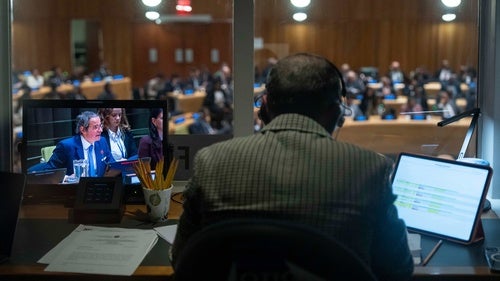
The contest to succeed António Guterres is underway. As candidates put forward their visions, the more pressing question is what kind of leader the moment demands.
The contest to choose the next United Nations secretary-general, slated to take office in January 2027, is unfolding at a moment when the institution’s claim on the world’s attention is waning. International cooperation is under assault from every direction. The Security Council is paralyzed by great-power rivalry. War has returned to Europe in a form that shredded old assumptions. The last five years have seen Russia’s full-scale invasion of Ukraine, escalating US coercion and military pressure against Venezuela in the Caribbean, and a widening war involving Iran, each testing core rules on sovereignty, nonintervention, and the use of force. Through it all, the UN has largely been left on the sidelines with respect to high-stakes matters of war and peace.
The potential to reverse this erosion of relevance should be the central test in selecting the next secretary-general. The office has many formal duties, administrative responsibilities, and ceremonial obligations. But it has one overriding mission now: making the United Nations matter again. A new secretary-general must restore the UN as a locus of action rather than just rhetoric, a forum where global leaders feel compelled to show up in person, and an institution whose initiatives shape outcomes rather than running behind them.
Should the UN remain a spectator gallery for international conflicts, the normative authority of the institution and the treaties and norms that underwrite it will continue to wane. The failure to buttress those principles in the current decade could mean that they are consigned to permanent desuetude, undoing some of the most fundamental contributions of the UN and the post-World War II system to deterring and mitigating global conflict.
If the UN were to disappear, or simply to continue to wither, it could not be replaced. At a time of intensifying polarization and competition globally, it is impossible to imagine the five permanent members of the UN Security Council—much less the organization’s entire membership of 193—agreeing on broad parameters for the use of force, human rights, international crime and corruption, arms control, or the other hundreds of subjects governed by UN treaties.
Bold Agendas and Shared Framework
The urgency is obvious. The UN’s most tangible diplomatic success in recent years was the Black Sea Grain Initiative, brokered by the UN and Türkiye in July 2022 with Ukraine and Russia as signatories, which reopened a safe maritime channel for Ukrainian food exports and helped stabilize global food markets amid the war. That achievement took skill and persistence, and it saved lives. But the grain deal stands out because it was an exception, contrasting with periods when the United Nations was at or near the center of international peace and security in a sustained way.
Dag Hammarskjöld helped invent modern peacekeeping during the Suez Crisis and died on a mission to the Congo, embodying the image of a secretary-general as a leader willing to hazard prestige and life itself in the field. Secretary-General U Thant played an important mediating role during the Cuban Missile Crisis, carrying proposals between Washington and Moscow when the threat of nuclear war loomed. Javier Pérez de Cuéllar’s quiet diplomacy as secretary-general helped secure the Iran-Iraq ceasefire in 1988.
At its best, UN leadership can pull states, markets, activists, and publics into sustained engagement around a common problem.
The UN has also mattered when it has set bold agendas. The Millennium Development Goals, shepherded into being by then Secretary-General Kofi Annan, gave the sprawling development field a common set of benchmarks that rallied governments, NGOs, and philanthropy. Their impact was concrete: Extreme poverty fell from 1.9 billion people in 1990 to 836 million in 2015; mortality for children below age 5 was cut by more than half; and more than 6.2 million malaria deaths were averted. Those gains had many causes, but the discipline of common goals, comparable indicators, and public accountability—all set in place at the UN—mobilized money, ministries, and political focus. The Sustainable Development Goals (SDGs), inaugurated in 2015, inherited that logic and broadened it with less dramatic but still considerable success.
The Paris Agreement offers a similar lesson. While it has not solved climate change, the process brought nearly every nation into a shared framework, established a cycle of increasingly ambitious national commitments, and created a transparency and stocktaking system that keeps pressure on governments after the summit stage goes dark. At its best, UN leadership can pull states, markets, activists, and publics into sustained engagement around a common problem.
The Right Candidate
When selecting a secretary-general capable of saving the institution from marginalization, three traits are key. The first: sheer force of personality, which matters probably more than diplomats like to admit. Some of the most memorable figures in UN history did not need permission to become visible, nor did they fit a fixed model of personal charisma; Thant and Annan both projected power through low-key calm. Thant’s quiet seemed to embody deep wisdom, whereas Annan radiated grace and warmth. Hammarskjöld was closer to a central casting version of a global diplomat.
The office needs someone able to sit with presidents and prime ministers as a peer, armed with intellect, command of global intricacies, and enough confidence to go toe-to-toe with people who would prefer a compliant steward. Even lower-level UN leaders have, at times, broken through to capture the public imagination and build faith in multilateral possibilities. Nineties-era UN High Commissioner for Refugees Sadako Ogata transformed refugee protection by treating it as a politically contested mission and by pushing beyond bureaucratic caution. Sérgio Vieira de Mello made an impression across Cambodia, the Balkans, Kosovo, East Timor, and Iraq by combining field credibility, acute political instincts, and a dashing persona.
To exert force of personality as an asset in the second quarter of the 21st century will require an ability to capture attention via today’s channels of communication. This demands willingness to embrace social media, create vertical videos, and generate memorable soundbites when speaking off-the-cuff to scrums of reporters and on podcasts. It will also require working with strategists and professionals to spin up and stage-manage moments that recapture attention at a time when the action seems to have moved to Davos, Munich, and Silicon Valley confabs. While the candidate need not come in as a master of these mediums, they must convincingly commit to marshalling them as part of the job. The UN needs a leader whose presence makes governments, media, and publics feel that when this person speaks or shows up, something consequential is likely to follow.
To exert force of personality as an asset in the second quarter of the 21st century will require an ability to capture attention via today’s channels of communication.
Second, a new secretary-general must have a demonstrated track record of readiness to take risks, both personally and politically. For the UN to reestablish itself as the conflict resolution forum of choice, its leader must be willing to insert themself into the world’s most wicked problems. Pérez de Cuéllar’s engagement on the Iran-Iraq war and Annan’s later mediation in Kenya are examples of how both the secretary-general and the UN grow in stature when leaders accept exposure.
Candidates should be judged by whether they have shown willingness to step forward with initiatives that stood a chance of public failure with meaningful fallout. At this stage, cautious irrelevance is a greater danger for the UN even than visible defeat. Its next leader should demonstrate resilience and the ability to bounce back from high-profile setbacks that are unavoidable at the UN. Both Hammarskjöld and Thant were willing to antagonize the UN’s most powerful member states when required. Hammarskjöld took on Britain and France in pushing for a peace settlement over the Suez Canal and later stood firm when the Soviet Union tried to get him ousted over his peacemaking efforts in the Congo. Thant persisted in outreach to US President John F. Kennedy and Soviet leader Nikita Khrushchev over the Cuban Missile Crisis even after White House officials urged him to butt out. The next secretary-general should show a similar willingness to sacrifice a second term or worse if their sense of responsibility to the UN Charter and the cause demands.
Third, the next secretary-general must be a hands-on problem-solver who does not confuse process with consequence. The UN’s current chief, António Guterres, has pushed ambitious frameworks such as the 2024 Summit of the Future and the Pact for the Future. Yet while trying to position for the future, the UN is fast losing the present. Lengthy resolutions do not answer the present hunger for visible, concrete intervention that changes events on the ground, nor for a sense that rules and order survive. The next secretary-general must resist the instinct to retreat into abstractions when fighting is raging, and the organization’s authority is being snuffed out. The successful candidate must be willing to dig in on conflict mediation. The job requires travel to capitals and borderlands, sustained contact with belligerents, and the patience to stay in prolonged high-pressure negotiations long after the cameras leave.
The Next UN Secretary-General
In April, the UN held town hall-style interviews with four announced candidates for the secretary-general post: Michelle Bachelet, the former president of Chile and former UN High Commissioner for Human Rights; Rafael Grossi of Argentina, director general of the International Atomic Energy Agency and a career diplomat in non-proliferation and crisis diplomacy; Rebeca Grynspan of Costa Rica, an economist, former vice president, and current secretary-general of UN Trade and Development; and former Senegalese President Macky Sall. The field, for now, is decidedly smaller than in recent years; in 2016, the UN considered 13 candidates. Some observers have predicted that future candidates may enter the race as prospects for the current contenders become clearer. Guterres, civil society organizations, and some governments have come out in forceful support of the appointment of the institution’s first woman leader. But given its opposition toward policies that advance individuals based on race, gender, and other identity-based characteristics, the Trump administration is expected to be unwilling to prioritize the choice of a woman candidate.
While the public dialogues with candidates may seem like a primary contest of sorts, the real decision will happen behind closed doors when the five permanent members of the Security Council—China, France, Russia, the United Kingdom, and the United States— signal who they are ready to support and whom they are prepared to veto. The group will ultimately recommend one candidate to the General Assembly for appointment. Given the sharp geopolitical divisions within the Security Council, prospects for coalescence are uncertain at best. While no government has expressed the intention to veto any of the current candidates, it’s assumed that specific aspects of their records—like Bachelet’s tenure as the UN’s High Commissioner for Human Rights—will evoke specific national sensitivities. There is also a risk that governments revert to the lowest common denominator: a consensus candidate that is seen as unthreatening to the national and geopolitical interests of key powers but lacks the force of personality and will to write a compelling new chapter for the world body.
While some predict that the Trump administration may torpedo candidates who demonstrate the capacity for the bold independent leadership necessary in this moment, that should not be assumed. Trump is prone to bullying international counterparts, but he has also shown flashes of admiration for leaders who project force, tactical skill, charm, and popular appeal. He praised New York City Mayor Zohran Mamdani after their first White House meeting, has a warm relationship with NATO’s Mark Rutte and, until recently, spoke favorably of Italy’s Giorgia Meloni despite political differences. There is a chance that the right combination of qualities might enable a potent candidate to win over Trump at least long enough to take the job and have a fighting chance of making it through the president’s remaining years in office.
What is clear is that at a time of intensifying polarization and competition globally, the United Nations must lead if it is to survive as the world’s foremost multilateral body. Though battered and flawed, it remains the only universal international institution with an agreed mandate to preserve peace and security. The secretary-general has long been judged one of the world’s toughest jobs. For someone coming in without the right qualities, the moment could well make it impossible. If the next leader cannot bring the UN back to vitality, the future of global cooperation will become increasingly fragmented, transactional, and opportunistic.
The Chicago Council on Global Affairs is an independent, nonpartisan organization and does not take institutional positions. The views and opinions expressed in this commentary are solely those of the author.
Related Content
 Global Politics