Built, Not Given: America at 250

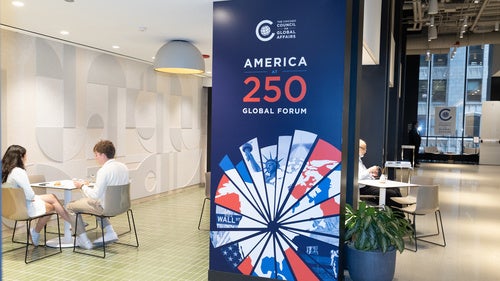
My reflections from the Council's America at 250 Global Forum on the sources that fueled American power and influence and what is now at stake.
This weekend, the United States marks 250 years since its founding. As I wrote in the spring, this is not a moment for a birthday party or a funeral, even if many Americans neatly line up on one or the other side of this divide. This is a moment to ask a more probing question: What are the sources of America's power and standing in the world, and what is at stake as the nation marks its 250th? That question ran through nearly every conversation at the Council’s America at 250 Global Forum. Below are some of the insights I'm carrying into this 250th year.
Reasonable people disagree about the future international order, especially whether it will return to its former state. But we should avoid false binaries.
Princeton University’s G. John Ikenberry refused to write the order’s obituary. The case he made rests on structure and precedent, not nostalgia. When the League of Nations closed in 1946, Lord Robert Cecil declared, "The League of Nations is dead. Long live the United Nations.” Ikenberry expects the same reinvention, as the alternatives on offer are "blocks, zones, [and] imperial spheres.” Former US Permanent Representative to NATO and Council Distinguished Nonresident Fellow Julianne Smith agreed the order must be "reimagined and reformed and reshaped," starting with pragmatic cooperation on artificial intelligence, supply chains, and critical minerals to earn back a glaring trust deficit.
Still, not everyone at the forum shared that confidence. Council Distinguished Nonresident Fellow Evan Medeiros argued that we are living through "an era more defined by order dissolution than order creation.” But while past orders collapsed fast and violently, this one is unraveling slowly, though accelerated by what the rest of the world reads as American self-abdication. Charles Kupchan of the Council on Foreign Relations agreed, quoting Italian Marxist philosopher Antonio Gramsci, saying, "The old is dying, and the new cannot be born; in this interregnum, a great variety of morbid symptoms appear.” But it was the University of Chicago’s Robert Pape who supplied the sharpest formulation: The guarantor of the order's one core rule—that war is an unacceptable solution—no longer believes in it, and that has implications that will outlive the current US president.
My own view? We have considerable agency in shaping the future, and not only through elections. This is true even in a world of considerable political, geopolitical, economic, and social constraints. It's entirely possible that in a few short years, we could be embarking on the reimagining and rebuilding of the American state, and a new set of institutions that address the core global problems, including AI. Of course, it's not hard to imagine a diminished role for the United States in a world of ongoing disarray with competing and multiple alignments far less than the sum of its parts.
Trade is America’s central liability.
Former United States Trade Representative Katherine Tai recounted how Washington squandered the bargain underneath. Models showed that it would take three to five generations for economic equilibrium to settle under the North American Free Trade Agreement (NAFTA), but policymakers proceeded to take “no care to address with any intention or policy the distributional impacts.” The impact has been institutional, with Trade Adjustment Assistance lapsing in 2022 and later ceasing to exist. The University of Chicago’s Raghuram Rajan noted that "what we've got wrong is how to help those who get hurt." Tai's warning for the next fight for the economy was blunt: "AI feels like, to us, NAFTA on steroids."
I would add that populist politics and a backlash against globalization have been fueled in part by multilateral and regional free trade agreements. I am watching to see whether a politics of backlash against AI, led by Gen Z, becomes a major political force, even possibly driving young voters to the polls across the United States. It's possible to imagine this leads to a recalibrating of the power and autonomy of the Magnificent Seven and a drive toward greater regulation and a new social contract. It's also possible to imagine a scenario where China's success creates an even more competitive space and shrinks the space for this kind of domestic conversation and social change.
The Iran war may be the end of Middle East coherence.
Columbia University’s Lisa Anderson offered the most arresting historical marker. Seen from the region, the Iran war looks like a Suez moment—"the last hurrah of American imperialism." Anderson's deeper point, however, was Middle East coherence. The region is largely held together through external imposition, like "iron filings looking for the magnet." But the United States seems to “have lost its magnetism,” putting the region at risk of devolving into subregions and proxy contests.
The New York Times’ David Sanger, who joined me for a live recording of the Council’s Deep Dish podcast, said his read of the Trump administration’s readiness to make a deal stems from US President Donald Trump's fear of becoming the “next Herbert Hoover.” Iran’s use of the Strait of Hormuz is thus ultimately “a really interesting lesson for all of us in asymmetric warfare, of using economic tools to hold off a much more powerful enemy,” he said.
It's very difficult to see our way through the short term and, for now, it certainly feels like the unintended consequence of the war with Iran is the diminution of America's leverage, influence, and soft power over its allies and partners in Europe, the Gulf, and South Asia. But in the long run, middle powers need powerful friends, so it is also possible to imagine the West and its partners emerging together on the other side of this—especially if the China challenge becomes more severe.
AI is more than a race.
The Foundation for American Innovation’s Dean Ball was quick to say that calling the moment we’re in a “race” is a “lousy metaphor.” When it comes to AI, he said, the United States is in "an unbounded, multidimensional, indefinite-length competition.” The American advantage will thus come less as a Manhattan Project and more like the dollar system—primacy through protocols and an installed base that the rest of the world builds on. Jill Hruby of Anthropic’s National Security and Public Sector Advisory Board widened the frame, noting that the entire ecosystem, including chips, compute, and data centers, is moving "many orders of magnitude" faster than the grid that must power it.
Well heard on the energy requirements that AI is already demanding. The idea that America's AI advantage is more infrastructural than a horse race makes intuitive sense. But many of America's traditional allies are aware of this, ambivalent, and trying hard to avoid complete AI dependence the kind the dollar system equivalent would portend. But if Ball proves to be right, then America's power has a bright future, and the declinists may be looking in the wrong place (the Strait of Hormuz). My former colleague, Alex Krasodomski of Chatham House, jointly authored a great paper on AI governance, a concept many are skeptical about. However, one of our panelists suggested that regulation is a sequencing game, with regulation following—not preceding—most significant new technologies.
Concentrated wealth and democratic politics cannot coexist.
For a conversation built on disagreement, UnHerd Editor Sohrab Ahmari and New York Times columnist Jamelle Bouie found striking common ground. While Ahmari called Citizens United "wrongly decided" and backed Senator Chris Murphy's constitutional amendment to keep out corporate cash and Bouie would have Congress simply legislate the ruling into irrelevance, both agreed that today's concentration of wealth is the greatest threat to democratic politics. And they both landed on the same structural fix: Expand the House. Bouie proposed growing it from 435 members to 635 or 870, while Ahmari cited Patrick Deneen's figure of 4,000.
I never expected this to be such an agreeable panel. All I would add is that at a time when generational divides are growing on key matters of foreign policy, and the divisions within America's political parties are as big as they are, it's pretty clear our political categories are no longer fit for purpose.
America has closed its doors before.
Bolder Futures Founder Karthick Ramakrishnan supplied the historical frame that the 250th anniversary demands. In 1924, America shut its doors, he said, "our version of Make America Great Again." It took WWII, when Washington needed allies in Asia, to creak the door open, allowing Asians to naturalize for the first time. The 1965 Immigration and Nationality Act then rebuilt the system around family reunification and skills. He said, however, not to assume this moment is "a high fever that's gonna break" with the status quo ante returning. The 1924 closure lasted for a generation, he reminded, and what comes next "depends on what elites do."
While it does indeed depend on what elites do, it also depends on AI, and on the US economy, which has so far been pretty strong. But if the anticipated AI job wipeout pans out, then the backlash against immigration, and the anti-immigrant populist playbook, is bound to continue. The recent Supreme Court ruling allowing the federal government to remove temporary protected status for citizens of Syria and Haiti certainly does not suggest an opening any time soon. Still, there is clearly a fundamental commitment, even in an ideologically divided Court, to one of America's most basic rights: birthright citizenship. Will America continue to deliver global power and influence from its role as an immigrant nation? Perhaps.
The Chicago Council on Global Affairs is an independent, nonpartisan organization and does not take institutional positions. The views and opinions expressed in this commentary are solely those of the author.