How will the New Congress Handle China?

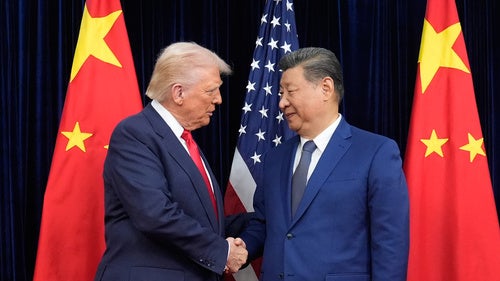
Taiwan and AI will serve as litmus tests for how the next Congress wants to engage with Beijing.
On the surface, US-China relations might appear to be on an upswing ahead of the US midterm elections. US President Donald Trump choreographed the appearance of positive momentum and personal rapport with Chinese President Xi Jinping when Xi visited Washington in September, with the two leaders explicitly endorsing the pursuit of “constructive strategic stability” in the bilateral relationship. But behind that façade, actual policy direction on both sides continues to be driven primarily by mutual distrust and a seemingly zero-sum competition for global power and influence.
The outcome of the midterm elections is unlikely to substantially alter this bifurcated trajectory or address its inherent tension. Even if the Democratic Party regains a majority in the House of Representatives and/or the Senate, there is no clear consensus among Democratic officials themselves on how Washington should deal with China. Some appear to support a more cooperative and less confrontational approach to Beijing than the adversarial posture adopted by most Republicans. But both those Democrats and some Republicans have been pushed off balance by Trump’s own surprisingly accommodative approach to Xi. And neither party in Congress appears to have any clear notion of what “constructive strategic stability” in US-China relations is supposed to look like, let alone whether and how to pursue it.
After the polls close, Trump himself will probably continue to pursue his unrequited bromance and ill-conceived vision of détente with Xi, especially when they meet again in China for the November APEC summit and in Florida for the G20 summit in December. Beyond that, he will likely continue to ignore any effort by Congress to guide or constrain his engagement with Beijing.
Neither party in Congress appears to have any clear notion of what 'constructive strategic stability' in US-China relations is supposed to look like, let alone whether and how to pursue it.
Against this backdrop, two issues will be litmus tests for the new Congress’s approach to China. The first is Taiwan. There appears to be a loose bipartisan consensus that Trump has been too accommodative to Xi by postponing arms sales to Taipei and holding it partly responsible for cross-strait tensions. But it remains doubtful whether Congress will exert pressure on Trump to reaffirm US support for Taiwan—or be able to do so successfully—because the Republicans so far have declined to do so and Trump will disregard the Democrats.
The second and potentially more consequential issue is artificial intelligence (AI), which is fast emerging as a core issue in the US-China strategic competition. Notwithstanding Trump’s personal rapprochement with Xi, he and other members of his administration have explicitly declared the United States must “win” the AI contest with Beijing. Many Democrats appear to share that view.
At the same time, US-China cooperation may be vital in managing the potential dangers unregulated AI poses to international security. The next Congress will need to determine how to reconcile the competition with China for strategic advantage on AI with the imperative for collaborating with Beijing to address this shared global risk. Indeed, confronting and managing this dilemma—working out the terms of peaceful coexistence and the right mix of competition and cooperation—will be the central challenge of US-China relations for the foreseeable future.
Still, the 120th Congress that will take office in January 2027 is unlikely to have much time to focus on China policy in the near term. Indeed, if the Democrats win a House and/or Senate majority on November 3, it is altogether possible that the interim period will be dominated by Trump’s efforts to contest the election results and complicate the seating of the new Congress. And if a Democratic majority ultimately succeeds in taking office, it will almost certainly be preoccupied with efforts to investigate Trump’s administration and curb his executive power. Such efforts could limit its ability to make substantial progress on policy issues like China, where there is no clear consensus or agenda waiting to be tabled.
The Chicago Council on Global Affairs is an independent, nonpartisan organization and does not take institutional positions. The views and opinions expressed in this commentary are solely those of the author.


Related Content
 US Foreign Policy
Prospects for positive breakthroughs and stabilization of the US-China relationship will remain limited as long as the two sides are focused more on maneuvering for advantage than on working to define the concept.
 Public Opinion
More than half of the US public supports a policy of cooperation and engagement with China, including a growing number of Republicans.
 Technology
Without buy-in from Washington and Beijing, proposals aimed at reining in artificial intelligence are unlikely to move the needle.
 Global Politics
Trump called Xi his “friend” during a May summit in Beijing. But that doesn’t mean the two leaders see eye to eye.