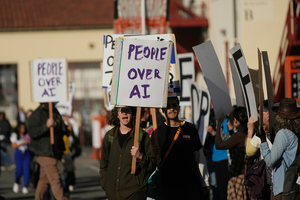
Half of Americans also say artificial intelligence poses a critical threat to the vital interests of the United States over the next decade.
Since OpenAI launched ChatGPT in 2022, Americans have rushed to integrate the user-friendly artificial intelligence (AI) chatbots into schools, homes, and workplaces. The large language models (LLMs) that power the chatbots have also rapidly advanced over the last four years, driven in large part by competition between the United States and China over the research, development, and adoption of the technology.
Yet data from the 2026 Chicago Council Survey, fielded July 10-21, show Americans are wary of the social and political risks posed by the widespread adoption of AI, with many in favor of additional regulation of the advanced technology.
Key Findings
- A slight majority of Americans believe there is not enough regulation of advanced technologies like AI (52%), compared to less than two in 10 who say there is just enough (16%) or too much regulation (15%).
- Half of Americans think AI poses a critical threat to the vital interests of the United States in the next 10 years (51%).
- Four in 10 Americans say they do not know enough about AI to assess the risks and benefits of adopting the technology (40%). However, of those who know enough to opine, twice as many think the social and political risks posed by the technology are not worth the economic, technological, and scientific benefits (39%, up from 27% in 2025) as those who think the benefits are worth the risks (21%).
- Democrats are more likely than Republicans and Independents to say the risks of AI are not worth the benefits, AI poses a critical threat to the United States, and there is not enough regulation of the technology.
Public Considers Current Regulation of AI Insufficient
The Trump administration has pursued a deregulatory approach to the development and adoption of AI technologies, favoring innovation and global leadership over “excessive state regulations.” But Americans would prefer greater protection against the potential risks associated with widespread AI adoption.
A bare majority of Americans say there is not enough regulation of advanced technologies like AI (52%), with partisan consensus. Six in 10 Democrats (60%), half of Independents (51%), and a plurality of Republicans (45%) agree there is currently not enough regulation of AI. Americans across the board have grown more likely to think there is insufficient regulation of these technologies since 2025, likely due to more widespread usage of AI and its application across industries.
The public has also grown more knowledgeable about AI over the last year, with more now able to provide an opinion on its regulation: Just 16 percent say they do not know enough to say what level of regulation they prefer, down significantly from almost four in 10 who said the same in 2025 (37%).
Democrats are divided on the current level of AI regulation. Seven in 10 liberal Democrats say AI is not regulated enough (70%), compared to just 43 percent of moderate or conservative Democrats. GOP supporters are also divided, though to a lesser degree: Republicans who do not support the “Make America Great Again” movement (non-MAGA Republicans) are more likely to say there is not enough AI regulation (54%) than Republicans who support the MAGA movement (40%).1
A February 2026 Pew Research Center poll further suggests that relatively few trust the federal government to implement AI regulation. Two-thirds of Americans have little to no confidence in the US government to regulate the use of AI effectively (41% not too much confidence + 26% no confidence at all).
Public Describes AI as Critical Threat to the United States
Since ChatGPT’s launch, major AI labs and tech giants have pitched their LLM-powered products to public markets and commercialized the technology’s usage across industries. The aforementioned 2026 Pew survey also finds AI has now become part of Americans’ daily lives, with half of the public reporting having used AI tools like ChatGPT, Gemini, or Copilot and one in four reporting using these tools on a daily basis. Yet despite trillion-dollar valuations, IPOs on the horizon, and widespread usage, AI companies are struggling to gain the public’s confidence.
The 2026 Chicago Council Survey finds half of Americans think AI poses a critical threat to the vital interests of the United States in the next decade (51%), compared to 41 percent who think it is an important but not critical threat and just 8 percent who do not see it as a threat at all.
Republicans are less concerned about AI, viewing it as less of a critical threat to the United States than Democrats and Independents (45% Republicans vs. 54% Democrats and 53% Independents).
MAGA Republicans are just slightly more likely to say AI poses a critical threat to the United States than non-MAGA Republicans (47% vs. 41%, respectively). There is a slightly wider difference between the Democratic camps, with nearly six in 10 liberal Democrats viewing AI as a critical threat (58%), compared to five in 10 moderate or conservative Democrats (47%).
Americans Tend to Think Benefits of AI Not Worth the Risks
When asked about the merits of adopting AI technologies, a significant proportion of Americans say they do not know enough to say or give an opinion (40%), including more than a third across all partisan groups (43% Republican, 41% Independent, 35% Democrat).
However, among those who choose to opine, twice as many believe the social and political risks are not worth the economic, technological, or scientific benefits (39%) as those who say that they are (21%). The public has grown more wary of the risks these technologies may pose in the last year (39%, up from 27% in 2025), with just two in 10 today viewing the benefits as worth the risk to society and governance (21%, down from 29% in 2025).
Republicans who share their view are divided in their assessment (31% risks outweigh benefits vs. 27% benefits outweigh risks)—with similar proportions among MAGA (29% risks outweigh benefits vs. 29% benefits outweigh risks) and non-MAGA Republicans (34% risks outweigh benefits vs. 26% benefits outweigh risks).
Half of Democrats, on the other hand, think the social and political risks of AI are not worth the benefits (47%, up from 29% in 2025). Liberal Democrats are more likely to agree with this statement (54%), compared to just a third of moderate or conservative Democrats (36%).
Other polls show Americans are also thinking about the environmental impact of the growing number of data centers being built across the United States to power AI technologies. A July 2026 AP-NORC/EPIC poll finds at least half of Americans are worried that AI will hurt the environment (47%), cause power outages (53%), and impact the water supply (57%) as a result of data center development.
Conclusion
In short, although AI is quickly becoming an integral facet of everyday life for many in the United States, more Americans believe the benefits of its adoption are not worth the risks to society and governance. This explains why so many Americans say the technology should be more regulated—and could empower lawmakers to provide additional oversight of the sector.
This analysis is based on data from the 2026 Chicago Council Survey of the American public on foreign policy, a project of the Lester Crown Center on US Foreign Policy.
The 2026 Chicago Council Survey was conducted July 10-21, 2026, by Ipsos using its large-scale, nationwide, online research panel (KnowledgePanel) in English and Spanish among a weighted national sample of 2,156 adults 18 or older living in all 50 US states and the District of Columbia. The margin of sampling error for the full sample is ±2.2 percentage points, including a design effect of 1.04.
The data were weighted to adjust for gender by age, race and ethnicity, education, census region by metropolitan status, household income, and language dominance. The demographic benchmarks came from the 2025 March supplement of the US Census Bureau’s Current Population Survey (CPS). Additionally, language dominance benchmark was obtained from the 2024 American Community Survey (ACS).
- Gender (Male, Female) by Age (18–29, 30–44, 45-59, and 60+)
- Race/Hispanic Ethnicity (White Non-Hispanic, Black Non-Hispanic, Other Non-Hispanic, Hispanic, 2+ Races Non-Hispanic)
- Education (Less than High School, High School, Some College, Bachelor’s degree or higher)
- Census Region (Northeast, Midwest, South, West) by Metropolitan status (Metro, non-Metro)
- Household Income (Under $25,000, $25,000-$49,999, $50,000-$74,999, $75,000-$99,999, $100,000-$149,999, $150,000+)
- Language Dominance (English Dominant Hispanic, Bilingual Hispanic, Spanish Dominant Hispanic, Non-Hispanic)
Partisan identification is based on how respondents answered a standard partisan self-identification question: “Generally speaking, do you think of yourself as a Republican, a Democrat, an Independent, or what?”
To examine differences within the Republican and Democratic parties, we further divide Republicans and Democrats into subgroups.
Republicans are divided into MAGA Republicans (the 61% of Republicans who also say they are part of the Make America Great Again, or MAGA, movement) and non-MAGA Republicans (the 39% of Republicans who say they are not part of the MAGA movement).
Democrats are divided into ideological groups: 63 percent of Democrats identify as liberal to some degree (12% extremely liberal, 33% liberal, 17% slightly liberal), while another 37 percent of Democrats identify as moderate (30%) or conservative to some degree (6%).
The 2026 Chicago Council Survey is made possible by the generous support of the Crown family, the Dr. Scholl Foundation, and Observer Research Foundation America.


Explore Related Commentary
 Technology
With federal regulation hanging in the balance, powerful AI companies are backing candidates on both sides of the aisle in a bid for control.
 Technology
Patrick McGee says the differences between the US and China on AI may be “a little bit superficial.” So, what could Trump and Xi actually agree on?
 Technology
Without buy-in from Washington and Beijing, proposals aimed at reining in artificial intelligence are unlikely to move the needle.
 Technology
"To meet the moment, independent oversight of AI will have to be empowered, equipped, and intrusive, treading where tech leaders will be predictably reluctant to let it go," Council Lester Crown Senior Nonresident Fellow Suzanne Nossel writes.