Why Big Tech is Betting on the US Midterms

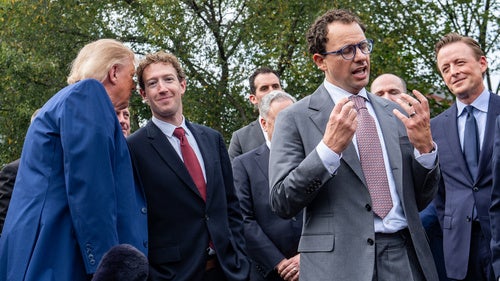
With federal regulation hanging in the balance, powerful AI companies are backing candidates on both sides of the aisle in a bid for control.
Two things have dominated national headlines this fall: the US midterm elections and artificial intelligence (AI). Cryptocurrency, AI, and online betting companies account for over half of all corporate-backed super PAC spending this election cycle. And both generative AI and false claims about electronic voting machines have been used to sow voter distrust in the process.
Overall, US President Donald Trump's second term has been a win for Big Tech. In the last two years, the Trump administration has weakened cybersecurity rules, stalled privacy legislation, and renewed pressure for encryption backdoors. The closer Big Tech has moved to the administration, the more users’ privacy has been exposed, with still unregulated AI companies collecting ever more of people’s data.
For most American voters, though, AI is less a privacy question than a community development and infrastructure concern. Public worries about electricity costs, water supplies, and the job market have made addressing the rapid development of data centers a bipartisan midterm issue. And the rise in backlash against them could result in losses by pro-data center candidates and bring more local moratoriums.
As predicted, Trump’s order preempting state regulation of AI has put political pressure on Congress and state legislatures, led to a struggle in the courts, and placed AI policy centrally in the 2026 election cycle. With federal regulation hanging in the balance, the most powerful AI companies are now spending on both sides of the aisle in a bid for control. And there is no question that who wins and who loses in the midterms will impact the outcome on this issue.
But what is behind the cryptocurrency companies’ campaign spending? The Commodity Futures Trading Commission (CFTC), which regulates “crypto” and prediction markets like Kalshi and Polymarket, has faced a slew of state lawsuits against the prediction markets in recent months. While the Trump administration has consistently backed the prediction markets (which Donald Trump Jr. notably has ties to), they appear to want to shore up support from the legislature—and are willing to pay for it.
Other tech fights have received less airtime in campaign ads but will also outlast the November 3 elections.
Section 702 of the Foreign Intelligence Surveillance Act lapsed in June, but communications have continued to be collected under court approvals, with the act authorized to run until March 2027. Whether it will be renewed or not, and whether a warrant requirement will be added to prevent domestic spying and backdoor searches, is for the next Congress to decide. Resistance to Flock automated license-plate reading cameras and other surveillance tools continue to galvanize local voter campaigns ahead of the midterms, and the campaign against their use will certainly continue regardless of the outcome in November.
Meanwhile, the United Nation’s International Telecommunication Union (ITU) will hold its quadrennial agenda-setting meeting, the Plenipotentiary Conference, in November. Attempts to extend the ITU's mandate to cover AI according to Latin American and Chinese proposals, address post-quantum cryptography to defend against cyberattacks, and confront tensions with space satellite internet are all likely. Ahead of this meeting, it is crucial to remember where global AI guardrails fail, AI standards are very likely to succeed.
Of course, international regulation and trade remain an important global front. The United States is currently using trade policy to push back on other countries’ tech regulations—an approach that can slow smaller economies but is unlikely to stop major ones from writing their own rules. Still, the midterms could change whether Congress backs or questions the actions of the State Department in this domain and how foreign governments judge the US position in negotiations.
All to say, while Americans may get a break from polling data, debate analysis, and AI-generated electioneering after November 3, questions surrounding tech governance will persist, with lawmakers deciding which of Big Tech's bets will pay off.
The Chicago Council on Global Affairs is an independent, nonpartisan organization and does not take institutional positions. The views and opinions expressed in this commentary are solely those of the author.