Leading Through Uncertainty
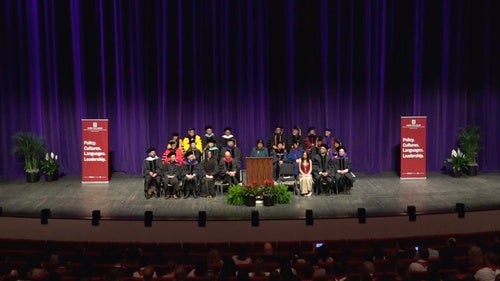
Remarks by Council President & CEO Leslie Vinjamuri for the 2026 graduates of the Hamilton Lugar School of Global and International Studies at Indiana University.
It is a sincere honor to speak to you, the graduating class of 2026, at the Hamilton Lugar School of Global and International Studies. May I first say, though, to your professors, your dean and administrators, and especially to your community of family, friends, mentors, sponsors, community leaders, all those who helped you to get to the finishing line—campus security, dining room staff, those who cleared the snow in February, and so many more—congratulations for all you did for the great class of 2026. It takes a village.
And to you, the graduates of the class of 2026, congratulations for making the bold choice to study in a school that is dedicated to nonpartisan, pragmatic engagement, following the value and commitments of the two individuals for whom this great school was named, former US Representative Lee Hamilton and former Senator Dick Lugar, two of America’s most influential foreign policy voices of their generation. A school that takes seriously deep cultural engagement and the study of languages, alongside an embrace of globalism, is more important and necessary today than ever before.
Graduates, you chose to embrace internationalism at a time of radical uncertainty, hyperpolarization, widening conflict, and disruptive technological change. This is a bold choice, and a very important one.
My generation of college graduates also faced uncertainty. I was in my penultimate year of college when the Berlin wall came down, and one by one the former Warsaw Pact countries, even the Soviet Union, saw an end to their communist regimes. But we faced this disruptive change with more agreement about our values, more clarity in our convictions, and a widely embraced assumption that disruption would bring great promise and unbounded hope. In our minds, we assumed that the future was a win.
We believed that the future would be one of liberal democratic and free market transitions, and that these would bring more freedom, more prosperity, and more hope to future generations.We also assumed, without reflection, that it would bring more stability. We believed that by extending the promise and opportunity of being part of the great institutions that had made the world safe but also prosperous for Western democracies—NATO, the European Union (then Community), the World Trade Organization—that others could also benefit, and that they would become more like us, that is, open, democratic, and prosperous.
We believed in our leaders, and we believed that change would encompass progress not regression, and that it would be morally informed. Even when the evidence suggested otherwise, whether it was ethnic conflict in the former Yugoslavia or genocide in Rwanda, we continued to believe in our leaders and in our institutions.
Our leaders, then, as today, had to navigate a world of great uncertainty. It was no longer clear whether the West should seek to expand, or whether it should declare victory and go home. Our leaders decided to extend the promise of liberalism and internationalism, to expand NATO, to embrace human rights, to promote international justice.
Looking back, we now know that in leading through that period of uncertainty, we got many things right, but we also got many things wrong. We forgot that freedom requires compromise and that prosperity at home must be shared. Our theory of change was sometimes wrong. We thought that integrating China into the World Trade Organization would make it a responsible stakeholder in the international trade order. We were wrong. The 2008 economic crisis revealed deep inequalities in our country, but we failed to address these.
We forgot that sovereign nations do not always welcome foreign interventions, and that these can go badly wrong. In our eagerness to grow and be prosperous, and to welcome new members into the international community, and in our enthusiasm for change, we forgot to look after our own, and to manage change. When the COVID-19 pandemic struck, we were wise to invest in science and create vaccinations at lightning speed. But we also looked inwards, were too slow to recognize that our health was connected to the health of those beyond our borders, and we spent a lot of time blaming China.
My generation of college graduates, like yours, were part of history at a moment of great uncertainty. The choices that our leaders made were not pre-ordained. When Russia invaded Ukraine in February 2022, the United States chose to work with its allies in Europe, and with great energy, commitment, and determination to come to the defense of Ukraine. They could have chosen differently.
The world you face is also one that is defined by radical uncertainty and considerable unpredictability. Many people believe you are graduating at a time of unprecedented disruption. It will require you to make choices.
Rapid technological change driven by artificial intelligence. Geopolitical competition occasioned in part by the rise of China but also of many emerging powers. Rising levels of international conflict and violence against ordinary people in Sudan, across the Middle East, Ukraine, and beyond. Global food and also food insecurity here at home. Trade wars. Climate change. Two decades of democratic backsliding, globally. According to V-Dem, US democracy is currently in a much faster deterioration process than any other democracy in modern times.
Today, America’s position as a global leader has come under pressure at home and abroad. The old bipartisan consensus on foreign policy has broken down. Our leaders no longer agree on the benefits of multilateralism, or alliances, or diplomacy.
America’s global influence, its ability to lead—your ability lead—has been intimately linked to its soft power, a concept defined by the late Joseph Nye, a Harvard professor of political science. But the attractiveness of the US, its soft power, has diminished. People can see that Americans and their leaders are divided, that they are no longer willing to strike compromises, and that they do not agree on the facts.
Perceptions of the US by publics outside the country have taken a sharply negative turn. When King Charles III decided to visit the United States, many people advised him to think twice. After all, recent polls showed that 68 percent of the UK public see the US as having a mostly or entirely negative impact on the world. Public attitudes towards the US are similarly poor across Europe.
But so far, no other state has emerged to replace American leadership. There is a vacuum of leadership on the global stage just when it is most needed. For our next generation of leaders, you, the graduating class of 2026, this period of radical disruption and of international dissatisfaction with US leadership presents an immense challenge. But it also creates a great need, and a great opportunity.
Today’s uncertainty demands more, not less, of you, the graduating class of 2026. When confronted with the litany of problems and challenges, it is easy to be overwhelmed. But it is vital that you do not give in to despair or complacency.
Many people have become accustomed to blaming leaders for the problems of the day. During the pandemic, many Americans blamed China. Today, Democrats blame Republicans. And Republicans blame Democrats. Our leaders blame immigrants for stealing jobs, China for the pandemic, or Europe for not being strong and capable.
But the politics of blame are self-defeating. And what happens when there is no one to blame? What happens when the pace of change and the level of technological and geopolitical disruption require solutions? Leadership that is built on blame is not leadership. It is abdication. When solutions require cooperation, blame quickly becomes a dereliction of duty. And at a time of radical uncertainty and rapid change, each of us has a duty to lead. Leadership cannot be left only to the leaders.
Where does one start? With principles and values. Leadership more now than ever will require a great deal of you, today’s graduating class. You will need to be clear about your principles, while tolerant of your differences.
Today’s problems will require you to work with those with whom you disagree, to diagnose problems but also to identify solutions, and to strike compromises and build the consensus that is necessary to deliver solutions. It will require tradeoffs. You will not be able to solve the problems that matter—peace and security, energy and food security, technology, climate change, or poverty—without taking bold steps but also pragmatic choices.
So, now, your time to lead has come. We do not choose our time; it often chooses us. As you set forth on the next stage of your journey, remember that you have been well prepared, as well as anyone can be. Be bold and principled, and in equal measure, pragmatic. And remember to look across the aisle, to find common ground and workable solutions—as Congressman Hamilton and Senator Lugar were long accustomed to do.
Congratulations.