At Trilateral Talks, Lots of Lip Service and Little Substance

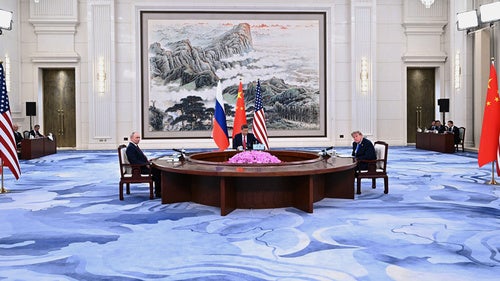
Trump appeared more focused on his friendships with Xi and Putin than on addressing profound security and economic issues.
Anyone looking for confirmation that US President Donald Trump views diplomatic ceremony as more important than diplomatic substance found it when a journalist asked him what headline he wanted to see coming out of his meeting with Russian President Vladimir Putin and Chinese President Xi Jinping. “I think I've already gotten that headline because the relationship that I have with China is a great one,” he replied, noting where he was seated at the welcome banquet (next to Xi, while Putin was seated on the other side of Xi’s wife) and how Xi greeted him at the airport (a first for the Chinese leader). “Not only that, the fanfare, the beauty, the pageantry, the thousands of people . . . the soldiers, the whole thing. It was a great respect, and I appreciate that. That’s a big win for us.”
It was not surprising then that the highly anticipated and historic trilateral meeting on the sidelines of the Asia-Pacific Economic Cooperation (APEC) summit produced very little of substance. (Early comparisons to the highly consequential 1945 Yalta Conference between then US President Franklin Roosevelt, UK Prime Minister Winston Churchill, and Soviet Union leader Joseph Stalin were destined to be deemed ridiculous.) At the end of the meeting, the three leaders issued a four-point “peace declaration” in which they vaguely agreed to reform the United Nations, increase the production of fuel products to sustain “stable energy flows,” and “conduct a dialogue” on nuclear risks and weapons. They also agreed that international courts “must not abuse their jurisdiction” in ways that infringe upon state sovereignty and the “immunities of state officials.” Presumably, this means Trump and Xi share Putin’s rejection of the International Criminal Court’s (ICC) March 2023 warrant for his arrest over alleged war crimes committed in Ukraine.
Notably, the meeting produced nothing of public record on the wars in Ukraine and Iran, even though the official Chinese readout indicates they were addressed. And both Trump’s and Putin’s public remarks before the trilateral talks indicate Ukraine was discussed at length during their bilateral meeting. Whatever was said, Putin affirmed after the summit that he has no plans to negotiate with Kyiv.
So, what is the balance sheet for US national interests from the vaunted trilateral meeting? In exchange for pomp and circumstance and being flattered by his “friends” Xi and Putin (both of whom he openly referred to as such), Trump boosted the international legitimacy and stature of the world’s two top autocrats. He essentially endorsed their position on the centrality of the UN, put no substantial pressure on them to help end the wars in Ukraine and Iran, and hinted that he would continue to resist enforcing economic sanctions on Russia. He gave lip service to nuclear nonproliferation—which he claimed was his top priority for the meeting—but he offered no plan for pursuing it, and he is unlikely to sustain any personal attention to it. He did not respond when both Xi and Putin invoked US-China-Russia collaboration during World War II, which the two almost certainly raised to implicitly criticize the current direction of security policy in Japan, a close US ally. On balance, there probably has never been a “historic” summit so haphazardly conceived and planned, marginal in substantive achievement, and lacking in strategic benefits for the United States. It may have fed Trump’s ego, but it diminished both him and the United States globally.
On balance, there probably has never been a 'historic' summit so haphazardly conceived and planned, marginal in substantive achievement, and lacking in strategic benefits for the United States.
Similarly, Trump’s separate bilateral meeting with Xi did little to advance US-China relations or address any of its underlying tensions. It did not appear to produce an extension of the “trade truce,” which expires in January, and did not include any substantial discussion of AI, which the two sides previously agreed to make the focus of a bilateral dialogue process. Trump also seemed not to raise the unfolding Nvidia scandal, which has profound implications for US-China competition in both technology and espionage. But Trump and Xi will have another opportunity to address those issues next month when they are expected to meet again in Florida for the G20 Leaders’ Summit.
According to the Chinese readout, the two sides did reaffirm the goal of “constructive strategic stability” in the bilateral relationship—as endorsed during Trump’s May 2026 visit to Beijing and Xi’s reciprocal visit to Washington in September. They even “agreed to formulate an action plan” toward that goal. But it remains unclear whether the two sides have any common understanding of what “constructive strategic stability” either means or requires, and the persistence of mutual distrust and increasingly competitive policies on both sides will probably hamper efforts to forge any such understanding.
On Taiwan, Xi reportedly stated that “the US side should keep doing the right thing,” which almost certainly refers to Trump’s continued postponement of arms sales to Taipei. The incoming Democratic-controlled Congress in Washington is likely to increase pressure on Trump to authorize those sales and will have some Republican support. To his credit, Trump reaffirmed that the United States “does not support” Taiwan independence, again deflecting pressure from Xi to declare that Washington “opposes” it. But Trump’s views and concerns on the Taiwan issue have remained inconsistent and highly unreliable.
Even before the APEC summit in China, Trump’s superficial attention to US national security interests in East Asia was on display through his fleeting presence the day before on the sidelines of the Association of Southeast Asian Nations (ASEAN) Summit and East Asia Summit in the Philippines. For the second time, Trump sent a sub-cabinet delegation to the ASEAN-led meetings (normally attended by heads of government or at least cabinet-level officials), reinforcing the regional perception that the Trump administration does not see Southeast Asia as a priority. Trump instead attended a brief Quad Leaders’ Summit with Japanese Prime Minister Sanae Takaichi, Indian Prime Minister Narendra Modi, and Australian Prime Minister Anthony Albanese, and some ceremonial gatherings with other ASEAN leaders. Although the White House touted the results of these meetings, they were mostly piecemeal or pro forma, and Trump’s personal engagement at them was more rhetoric than substance.
The impression generated by Trump’s most recent 48-hour trip to East Asia was of a leader more interested in being feted and flattered than seriously and strategically engaged with the profound security and economic issues roiling the region. Trump was more focused on his delusions of friendship with Xi and Putin than on allied priorities and appeared incapable of recognizing how Xi and Putin continue to manipulate him at the expense of US and allied interests. Such a display only further degrades the United States’ global reputation and perceived reliability.
The Chicago Council on Global Affairs is an independent, nonpartisan organization and does not take institutional positions. The views and opinions expressed in this commentary are solely those of the author.
Related Content
 US Foreign Policy