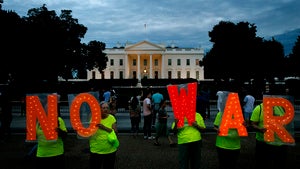
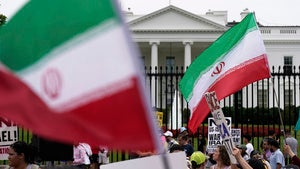
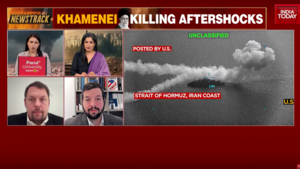
"Democrats are strongly opposed to the war, Independents tend to oppose the war, and even among Republicans a lot say they don't know," Council Director of Public Opinion and Foreign Policy Craig Kafura says, drawing on recent polling.
The congressional split over the war powers resolution signals that US President Donald Trump lacks broad support for the military intervention in Iran—and opposition on Capitol Hill is likely to grow if the war grinds on.
Recent surveys show a rise in American skepticism of the Trump administration’s approach to domestic and foreign policy. The Council explores where they stand on the economy, immigration, alliances, and more.
By barring Russian athletes from competing under the Russian flag, the International Olympic Committee demonstrated its power as a global norm-maker. Now, sporting federation leaders are seeking to distance their games from geopolitics.
Council Senior Nonresident Fellow Jordan Tama explores the unraveling bipartisan consensus on US foreign policy, drawing on a new analysis of more than 50 years of Council survey data.
"In the last decade, Democrats and Republicans have started to drift apart on the things that they consider most important," says Director of Public Opinion and Foreign Policy Craig Kafura, drawing on Council survey results.
American public opinion is increasingly at odds with US President Donald Trump’s approach to foreign policy. Fifty years of Chicago Council on Global Affairs polling reveals why the "America First" agenda has prevailed—and where it might break down.
Fifty years of Chicago Council on Global Affairs polling reveals significant reservoirs of cross-party agreement and a strong base of public support for a more cooperative approach to world affairs.
"America has had military bases in Greenland for decades,” says Council Director of Public Opinion and Foreign Policy Craig Kafura. "The idea of needing to conquer Greenland, needing Greenland to be part of the United States for U.S. national security just isn't true."
The US capture of Venezuela’s Maduro echoed intents outlined by Trump in the 2025 National Security Strategy. While the action might have appealed to his Republican base, the strategy’s principles are mostly out of step with US public opinion on America’s engagement in the world.