Will China Fill the UN Leadership Gap?

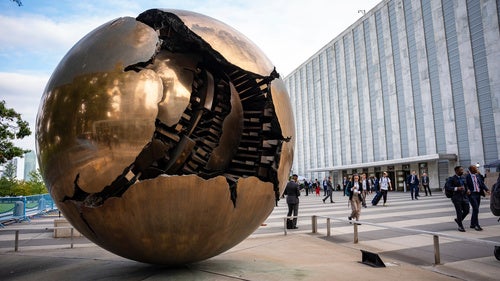
Reports that Xi will forgo addressing the United Nations General Assembly ahead of his meeting with Trump in Washington raise uncomfortable questions about the role of multilateral institutions under great power compacts.
The United Nations is in dire straits. The international organization ended 2025 short $1.6 billion in annual dues, an amount Secretary-General António Guterres called an “unacceptable volume of arrears.” Ahead of September’s General Assembly, the Trump administration—which has lambasted the organization as useless and ineffective, and withdrawn from multiple UN agencies—announced it intends to transfer $725 million, less than 20 percent of the $4 billion it reportedly owes.
This might appear to be a golden opportunity for China, which for at least 18 years has stepped into the breach left by American pullback from multilateral institutions, providing additional funding and occupying key leadership positions. But like the United States, China has also failed to pay its UN dues in full this year. While this is not uncharacteristic (since 2022, China has been waiting later in the year to make those contributions), the two countries provide 42 percent of the UN’s budget. So, while China has said it will pay its dues, they will likely arrive too late to undo the spending, workforce, and program cuts Secretary-General Guterres has been forced to make.
Adding to questions surrounding China’s UN stance, is the news that Chinese President Xi Jinping might skip this year’s meeting of the UN General Assembly, despite already being in the United States to meet with US President Donald Trump on Sept. 24. It would be an easy opportunity for Xi to directly address the world body. Instead, he appears to be prioritizing China’s relationship with the United States.
The prospect of a “G2” summit while the UN General Assembly trundles alongside raises uncomfortable questions about the role of multilateral institutions under a potential great power compact. Could Washington and Beijing relegate the United Nations and its global membership to addressing niche issues like refugees and youth, while settling the major ones themselves and to their advantage? And, if so, what does that mean for the future of the organization?
Necessary, But Not Sufficient
The world has never had a bipolar system with weak multilateral institutions. Some analysts have responded by calling for a new concert system. Between 1815 and 1870, the five great powers met regularly, but turned to ad hoc “congresses” to settle disputes among and by themselves. Peace was maintained essentially by carving up Europe and the globe into separate spheres of interest. But the lack of robust multilateralism and strong institutions made it a particularly dangerous time for small states, whose interests were frequently ignored and whose territory was taken. The meetings were also unable to resolve longstanding conflicts between the great powers, which meant intrastate wars often spilled out into interstate ones as they jockeyed for influence.
Still, the concert system at least had multinational meetings. During the subsequent Bismarckian era spanning 1871 to 1913, the same multipolar system had even fewer international fora, which were generally viewed as a “masque” for ulterior motives. Unconstrained by such bodies, historian Peter J. Beck describes the great powers as instead pursuing “national interest at the expense of others, individual action, secret bargains.” Their separation into competing, static blocs culminated in World War I.
The United Nations was established in the wake of World War II. Its creation was an acknowledgement of the necessity—though not sufficiency—of international institutions in preserving great power peace. International institutions provide information and regularize policy expectations. Multilateral ones give countries a stake in the international system, ensuring their interests are at least heard, if still sometimes ignored. The United Nations was pitched as the focal body where even adversaries could talk to each other and sometimes even reach important agreements , and the past 70 years have been a remarkably safe time for smaller states.
The creation of the United Nations was an acknowledgement of the necessity—though not sufficiency—of international institutions in preserving great power peace.
Throughout the Cold War and after the fall of the Soviet Union, the United Nations managed to retain enough respect and authority to expand its work on humanitarian assistance, human rights, and peacekeeping. But in recent years, a gridlocked Security Council, recurring scandals, and hostility from major states have weakened the body’s legitimacy and crippled its ability to accomplish delegated missions. An emergent G2 and an isolated United Nations is historically uncharted territory, and there are strong reasons to suspect this will produce a more uncertain and unstable international system.
Bilateral Gains?
Washington and Beijing may find it easier to work outside the UN system, cutting bilateral deals and more easily avoiding concessions to smaller states able to vote in multilateral settings. But depending on what issues they relegate or delegate, the two capitals could sacrifice the stability generated by UN management of transnational challenges, coordination of policies and responses, and peacekeeping of intractable conflicts.
China can more easily jettison multilateral commitments for bilateral gains from Washington. In recent years, it has established an alternative network of international institutions mirroring US and UN bodies, such as the Asian Infrastructure Investment Bank. Its four global initiatives—development, security, civilization, and governance—broadly enshrine positive-sum multilateralism and strict state sovereignty as guiding principles. Beijing can strategically choose among competing international bodies, diverting policy challenges from the United Nations towards its own organizations, for example.
In the United States, Republicans and Republican presidents have long been skeptical of international institutions. But Washington will still sacrifice far more in a shift to a G2 than Beijing. China’s four initiatives focus on positive-sum situations, such as countering terrorism and drug and human trafficking. It is comparatively easier to garner international support against transnational challenges, particularly ones that impinge on the sovereignty and authority of member states. This task is made even easier when it is unclear if China’s initiatives actually ask states to make policy changes or bear some costs.
By contrast, the US alliance network directly confronts the more difficult zero-sum challenges of deterring adversary aggression. Unlike China’s initiatives, these are clear, costly commitments. Partners and allies sacrifice policy autonomy, align strategies, and spend on collective defense. But with that deeper commitment comes significant gains: Even US competitors recognize that this network constitutes a unique strategic advantage. In shifting to a G2, Washington would be giving up that very advantage as countries worry Trump will cut deals with China inimical to shared alliance interests.
A Shift Away
What happens to the United Nations in this possible future? Even if American and Chinese financial and policy neglect kill of many of its programs, the body will nevertheless perform some important functions. As mentioned, it remains the physical locus for global dialogue even among member adversaries. Barring perhaps the pope, the UN secretary-general is unique in having politically independent, ambitious, and flexible “good offices” that opponents can turn to for mediation of political and military disputes. And it’s nice to have one central repository for official international treaties.
But those functions alone will not sustain nor justify the current panoply of UN programs, including peacekeeping, providing humanitarian assistance, and coordinating responses to climate change. Many UN agencies and committees might become “zombie organizations,” continuing to operate but with only limited operational capacity with which to pursue and achieve their mandates.
Meanwhile, the continuing gridlock at the Security Council coupled with American and Chinese-induced financial distress will only accelerate a shift of resources, personnel, and diplomatic time and attention away from the UN system and toward seemingly more “effective” bodies. This puts Beijing in a strong position to strategically forum shop, undermining both UN and US global leadership.
The Chicago Council on Global Affairs is an independent, nonpartisan organization and does not take institutional positions. The views and opinions expressed in this commentary are solely those of the author.
Related Content
 Global Politics