US Foreign Policy Leaders Say America Should Take an Active Role in World Affairs
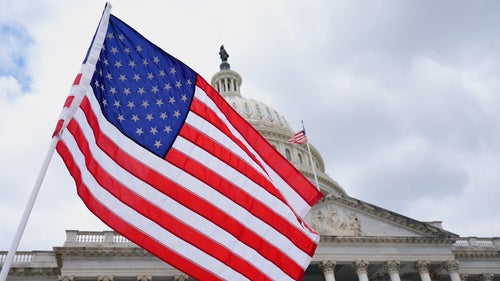
But recent polling finds little consensus on whether the Trump administration's policies are working.
This article is republished from The Conversation under a Creative Commons license. Read the original article.
In the wake of the US midterms, Vice President JD Vance blamed the Iran war for the election result. Affordability, Vance pointed out, appeared to be central to voters’ choices, with foreign policy decisions such as the Iran war generating higher fuel prices and rates of inflation. Polling before the election confirmed voters’ concerns—nearly two-thirds of Americans disapproved of President Donald Trump’s foreign policy.
But do foreign policy experts share Americans’ concerns?
To answer that question, the University of Texas at Austin, in partnership with the the Chicago Council on Global Affairs, recently surveyed 449 US foreign policy leaders from the executive branch, Congress, think tanks, interest groups, media, and academia.
Their responses matter because as the United States struggles to end the Iran war and navigate the fallout of tariff policies, these experts will be tasked with finding solutions to those pressing problems. These foreign policy experts are also likely to be advising presidential candidates in the run-up to the 2028 elections.
Areas of consensus and disagreement
On some issues, there is a consensus.
We found strong bipartisan agreement on the need for the US to take an active role in the world, the importance of supporting NATO, and the use of force to support European allies if they are attacked.
Ninety-three percent of experts want the United States to take an active part in the world. That includes 83 percent of Republican experts, 98 percent of Democrats and 90 percent of Independents. More than 70 percent of Democrats and more than 80 percent of Republicans and Independents among foreign policy experts we surveyed agree that military power has been very important to American influence in the world. And more than 90 percent of experts of all partisan stripes agree that economic power has been very important.
However, these points of agreement mask key differences.
On the Iran war, 98 percent of Democrats and 73 percent of Independent experts say war was the wrong decision, while 58 percent of Republican leaders say it was correct. While experts of all stripes recognized that tariffs would raise costs for Americans, there were stronger splits on whether tariffs were good for the US economy. One hundred percent of Democrats and 81 percent of Independents say they were bad, while 53 percent of Republicans say they were good.
America First
These answers largely rally around partisan identities, but responses to philosophical questions about how the US should pursue its interests proved more varied.
The Trump administration has challenged the foundations of US foreign policy through its America First agenda, which favors US domestic and economic interests over international agreements and global alliances.
On tariffs, efforts to expand US territory and the use of force, the Trump administration used coercion to achieve its ends, including with close allies.
The Biden administration used tariffs to counter China’s dominance in areas such as critical minerals and batteries. The Trump administration has applied tariffs to rivals such as China and traditional allies alike, including in Europe and Asia.
The Trump administration also expressed interest in territorial expansion through the acquisition of Greenland and even Canada as a possible 51st state.
Besides military operations to depose and capture the Venezuelan president and war with Iran, the Trump administration has struck boats in the Caribbean suspected of running drugs.
The downsides of coercion
We asked foreign policy leaders to assess the sources of US power and whether there are downsides to a coercive strategy of American dominance. Specifically, we asked them: “In order to achieve US foreign policy goals internationally, do you think it is more important for the US to be feared or admired around the world?”
Sixty-two percent of Republican leaders suggested it is more important to be feared, while 97 percent of Democrats said it’s more important to be admired. Independents were closer to Democrats, with 81 percent saying it’s better to be admired.
We also asked whether countries have options to oppose US coercion: “The Trump administration has used coercion, tariffs, punitive sanctions, and threats against many other countries, including traditional allies,” we said. Then we asked, “Which of these best captures your view?”
The respondents had three options to choose from. Thirty-nine percent of Republican experts agreed that “Other countries largely have to accept what the US dictates.” No Democrats and 11 percent of Independents agreed with that sentiment.
Fifty-five percent of Democrats and 54 percent of Independents chose the second option: “Other countries will accept what the U.S. dictates in the short run but will distance themselves from United States order in the longer run.” A large percentage of Republicans—48 percent—agreed with that sentiment. This suggests a recognition by Republicans that coercive power alone may have its limits.
A further 44 percent of Democrats and 35 percent of Independents chose option three, “Other countries have viable options in the short and long run to resist US coercion,” compared to only 13 percent of Republicans.
These partisan gaps suggest some strong cleavages about the foundations of US power in the world. They also raise questions about how best the US can achieve its interests on the world stage.
A subsequent US president may have to engage in more vigorous dialogue with the American public about the sources of US influence and power. The Trump administration’s coercive turn has some adherents, but many leaders see major costs to that approach and may be open to a new approach to US foreign policy.
Enough damage to the existing world order has been done by the Trump administration, we believe, that a return to establishment internationalism of old is not an option.
Our survey suggests a ripe moment for new ideas and wide-ranging conversation about the US role in the world.