Trump and Xi Agree on "Constructive Strategic Stability," But Differ on What It Means

Prospects for positive breakthroughs and stabilization of the US-China relationship will remain limited as long as the two sides are focused more on maneuvering for advantage than on working to define the concept.
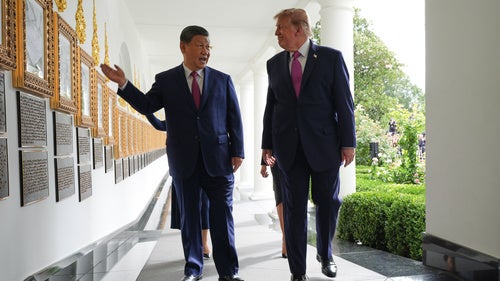
US President Donald Trump pulled out all the stops last week to give Chinese President Xi Jinping a lavish reception in Washington. Although substantive discussions were limited, the two leaders agreed to extend the US-China “trade truce” for two months, established a dialogue process on artificial intelligence (AI), and confirmed they will meet in November when China hosts the Asia-Pacific Economic Cooperation (APEC) Economic Leaders’ Meeting and again in December for the US-led Group of 20 summit in Florida. Throughout, Trump’s primary goal appeared to be to sustain and deepen what he claims is a “great friendship” with Xi.
Still, Trump’s almost sycophantic treatment of Xi raised eyebrows among some observers, who thought he showed Xi more hospitality than a communist dictator deserved. Many also complained that Trump’s behavior may have validated Xi’s supposed view that he holds the upper hand in the strategic competition between China and the United States.
That strategic competition has become the inescapable prism through which all US-China interactions are now viewed and made it difficult to see a path forward to the “constructive relationship of strategic stability” Trump and Xi rhetorically embraced in Beijing in May and reaffirmed in Washington. But it is the competition itself that prevents the two sides from making any progress on how to define and pursue that goal.
Since the phrase “constructive strategic stability” emerged this spring, Beijing has tried to capitalize on Trump’s endorsement and lock it in as a framework for stabilizing US-China relations. Xi invoked it repeatedly during his meetings in Washington, stressing that the countries should turn the “vision into action” and “strive to take their relationship where cooperation is the mainstay.” He added that the word “competition” need not be avoided but that such “competition should be a healthy one and should be kept within bounds.”
Yet many US commentators have described the approach as a Chinese trap, speculating that Beijing will subsequently hold Washington accountable for abiding by China’s own interpretation of the framework. Perhaps in response to that, the Trump administration has invoked the phrase only occasionally and given few indications that much thought has been given on how to operationalize it. According to official Chinese media, it was only during a breakfast tea meeting on the last morning of the summit that Xi secured Trump’s reiteration of the phrase.
The divergence is emblematic of the underlying competitiveness that belies the rosy characterization of Xi’s visit. Beneath the surface—and even above the surface—both Washington and Beijing are still approaching the relationship as a zero-sum contest for global influence, with both sides insisting that the other side has made it so. Moreover, both sides appear to believe that they have the leverage in the relationship. And both believe that time is on their side.
This is clearly not a sturdy foundation on which to pursue “constructive strategic stability” in US-China relations.
Rather than continue to argue over the proper mix of competition and cooperation in the relationship, both Washington and Beijing need to recognize the constraints imposed by interdependence and dispense with the notion that either side could ever sustainably “win.” They should engage in working out the terms of peaceful coexistence—for their benefit and that of the rest of the world, which wants Washington and Beijing to do so.
Two issues in the bilateral relationship will be key indicators going forward. The first is Taiwan. As most experts anticipated, there was no substantial movement on the issue of Taiwan during Xi’s Washington visit. Xi again urged Trump not to resume arms sales to Taiwan, with the focus of attention now on whether Trump will authorize the sale he suspended after the Beijing summit. But arms sales—and a focus on military deterrence in the Taiwan Strait—ultimately diverts attention from the real core dilemma that Washington faces with regard to Taiwan: the continuing erosion of the United States’ “one China policy.” The bigger question now is what Trump’s bottom line is on “one China” and Taiwan’s strategic importance.
The second key indicator to watch is artificial intelligence, which is probably the issue on which strategic cooperation between China and the United States is most imperative. Unfortunately, AI has now also become central to the strategic competition, with the Trump administration explicitly stating that the United States needs to “win” over China. Whether the dialogue process that was announced in Washington can redirect the two sides away from zero-sum confrontation and toward collaboration on the rapidly advancing technology will be a key bellwether for the future of the bilateral relationship—and for global security.
Trump and Xi have the opportunity in their November and December meetings to get more into the substance of these and other key bilateral issues. But the prospects for positive breakthroughs and stabilization of the relationship will remain limited as long as the two sides are focused more on maneuvering for advantage than on working together to define “constructive strategic stability.” And as long as Trump remains an impulsive, rather than strategic, decisionmaker.
The Chicago Council on Global Affairs is an independent, nonpartisan organization and does not take institutional positions. The views and opinions expressed in this commentary are solely those of the author.