Can the World's Most Dangerous Weapons Be Contained?
Sergey Radchenko, Deborah Rosenblum, and Ariane Tabatabai explore how the world can manage biological and nuclear risks amid deepening geopolitical divisions.
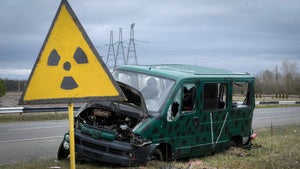
A radiation sign in front of a Russian military vehicle near the Chernobyl nuclear power plant, April 16, 2022.
Nov
12
Efrem Lukatsky / AP
Speakers
Sergey Radchenko
Deborah Rosenblum
Ariane Tabatabai
Date and Time
Doors Open: 5:15 pm
Location
Chicago Council Conference Center, 130 E Randolph Street; or via YouTube
Who Can Attend

REGISTRATION

This event is open to the public.

Register Now
Register Now

About This Event

For decades, even the fiercest geopolitical rivals recognized the need to cooperate on the world's most dangerous weapons. Today, that cooperation is fraying. Advances in biotechnology are raising important questions about laboratory safety and biological security, while longstanding nuclear arms control agreements face an uncertain future. How can countries build on past successes to address today's evolving threats? Are existing safeguards keeping pace with scientific advances and shifting geopolitical realities? And can countries find common ground on biological and nuclear security even as competition between them intensifies? Join Sergey Radchenko, Deborah Rosenblum, and Ariane Tabatabai for a conversation on managing biological and nuclear threats in an increasingly divided world. 

About the Speakers
Rupert Murdoch Distinguished Professor, Henry A. Kissinger Center for Global Affairs, Johns Hopkins School of Advanced International Studies
Sergey Radchenko
Sergey Radchenko is the Rupert Murdoch Distinguished Professor at the Henry A. Kissinger Center for Global Affairs at the Johns Hopkins School of Advanced International Studies. He has written extensively on the Cold War, nuclear history, and Russian and Chinese foreign and security policies.
Sergey Radchenko
Distinguished Nonresident Fellow, Nuclear and Biological Defense, Chicago Council on Global Affairs
Deborah Rosenblum headshot
Deborah Rosenblum has spent over 35 years working in the national security and defense field. Most recently, she served as the Senate-confirmed Assistant Secretary of Defense for Nuclear, Chemical and Biological Defense Programs as well as the Acting Deputy Under Secretary of Defense for Acquisition and Sustainment.
Deborah Rosenblum headshot
Vice President of Research, Security and Defense; Senior Fellow, Middle East, Chicago Council on Global Affairs
Headshot of Ariane Tabatabai
Dr. Ariane Tabatabai joined the Council in 2026 as the vice president of research, security and defense. She also serves as senior fellow for the Middle East, focusing on nuclear security and regional security dynamics in the Middle East.
Headshot of Ariane Tabatabai