What the US-Saudi Nuclear Deal Means for Global Nonproliferation

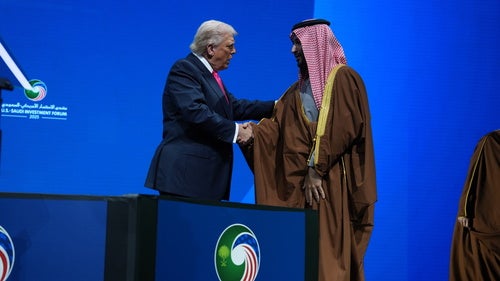
Rachel Bronson explains how the deal's uranium enrichment terms and apparent bypass of IAEA oversight break from past US nuclear agreements—and what precedent that sets.
The United States and Saudi Arabia signed a landmark nuclear agreement on July 22, potentially giving the kingdom the ability to enrich uranium in the future.
US officials have described the deal as a “peaceful nuclear cooperation agreement” that will grant the Saudis access to US nuclear technology, “benefiting American industry, workers, and supply chains while helping to meet Saudi energy needs.” But reports of its contents have prompted concern among experts.
“The Trump administration does not seem to have demanded that Saudi Arabia’s nuclear program, including potential enrichment, is tethered to international safeguards,” Council Lester Crown Senior Nonresident Fellow Rachel Bronson said. “This agreement, if we understand it correctly, disempowers the International Atomic Energy Agency—something the US has historically avoided for good reason.”
Bronson spoke with the Council’s Christina Colón about how the deal differs from past frameworks, what it means for the broader nonproliferation picture, and whether it sets Saudi Arabia on the path to developing a nuclear bomb.
The interview has been edited for length and clarity.
What does the agreement entail, and how does it differ from past frameworks?
Although we don’t yet know all the details, we do know that it’s an important deal, that it will take 30 years to implement, and that the administration and the Saudis have been working on it for some time. The first Trump administration explored a nuclear deal with Saudi Arabia, as did the Biden administration. We got early glimpses of the second Trump administration’s commitment to advancing Saudi Arabia’s nuclear program during President Trump’s trip to the Gulf in May 2025 and then again at the US-Saudi investment summit in November of last year.
Still, there are several ways that this deal differs from past discussions. First, it gives Saudi Arabia the right to enrich uranium. This is new. Many countries that rely on nuclear power get their enriched uranium from international suppliers. If this deal comes to fruition, it will add a new country to the list of those who are able to enrich uranium. Today, only about 14 countries can do this.
Second, the deal does not advance the Abraham Accords. Past US administrations intended to grant Saudi Arabia enrichment and other benefits in exchange for normalizing relations with Israel. That does not seem to be the case with this deal. After it was signed, President Trump shared on social media that normalization is a condition of the deal. But a Saudi source responded that “Tweets don’t reverse signed agreements.” So, we will need to watch what happens there.
Third, the deal seems to explicitly connect US reactor technology to the future of Saudi’s program. This likely means that the Saudis are committing to investing in the Westinghouse AP1000 nuclear reactor now operating near Waynesboro, Georgia. This is a reactor with a troubled history of getting to completion, so a Saudi decision to incorporate it into their plans would give the US a significant boost in the intense global competition to advance nuclear power.
Two aspects of this agreement stand out as problematic, if what we are hearing about it is true. The first concerns enrichment. Saudi Arabia is reputed to have one of the largest global stores of uranium and has long been keen not only to mine it, but to process, enrich, and use it to power their economy. In other words, they have long sought to control their full fuel cycle. Advancing nuclear power aligns with their economic development plans of energy diversification specified in Saudi Vision 2030, their longstanding economic development plan. But enrichment is a new and important change to past agreements.
The second and more problematic aspect of the agreement, is that the Trump administration does not seem to have demanded that Saudi Arabia’s nuclear program, including potential enrichment, is tethered to international safeguards. This agreement, if we understand it correctly, disempowers the International Atomic Energy Agency (IAEA)—something the US has historically avoided, for good reason. That is breathtaking. The IAEA is a respected body that has developed a considerable inventory of safeguards to ensure that nuclear power plants and enrichment facilities remain safe. But from what we are learning, the IAEA is not part of this agreement.
The Trump administration is instead committing the United States to monitoring Saudi Arabia’s nuclear power program outside of recognized international agreements. This removes considerable international expertise and makes it more likely that Russia, China, or any other global power can create similar carve outs when striking agreements with new nuclear states. It will also make Saudi Arabia’s neighbors nervous about its intentions.
Does this deal put Saudi Arabia on the path to developing a nuclear bomb?
It could, but it doesn’t have to. One of the most important things to understand is that nuclear power plants require uranium to be enriched at about 3 to 5 percent. Nuclear power plants operating in Illinois and elsewhere operate with what is called low-enriched uranium. This is not bomb-grade material. It is not weapons-grade material. For uranium to be weapons grade, it needs to be enriched up to the 90 percent level. There’s a stark difference between the two.
Enriching uranium is a step in the chain to creating weapons-grade fuel, but nuclear power is relatively safe because of this difference in fuel type. The IAEA, when it undertakes its inspections, verifies this difference. But when the IAEA is kept out of the equation or when weapons programs are hidden from it, it can’t do its job.
To be clear, if Saudi Arabia wanted a bomb, it has a much easier path to get one. Saudi Arabia has been long understood to have worked with Pakistan to ensure it has access to Islamabad’s nuclear weapons should it need them. And it wasn’t lost on most Middle East observers that Saudi Arabia and Pakistan formalized their defense arrangements in September 2025 after Israel targeted Qatar in its effort to kill Hamas leaders there.
Why are Washington and Riyadh pursuing a nuclear power agreement now?
There is a nuclear renaissance underway. Almost every country in Europe is reconsidering nuclear power and many in Asia are as well. Japan, Vietnam, and Myanmar are pursuing nuclear power, and even Rwanda in Africa is committing to nuclear power. Russia is building nuclear power plants in Turkey that will come online in the next few months and working to advance Egypt’s nuclear power program.
This is all happening for a number of reasons. Tumultuous geopolitics is demanding that every country reconsider where their energy comes from and how best to ensure indigenous sources of energy. And nuclear power can be more attractive in this context. Energy-poor states are looking for ways to provide large amounts of energy for industrialization, which nuclear power can provide. And advanced countries are investing heavily in AI, which is energy intensive. The global race for new sources of energy is thus making nuclear power more attractive, as are advances in small module reactors—an area where the US has a potential competitive advantage. The World Bank has also reconsidered how it is financing nuclear power.
Tumultuous geopolitics is demanding that every country reconsider where their energy comes from and how best to ensure indigenous sources of energy.
Acknowledging this reality, the second Trump administration—and the Biden administration before it—has been betting on nuclear power as a very important industry of the future, both for the United States and for our allies. The Trump administration came into power accelerating the nuclear transition, both domestically and abroad. It has been looking for new nuclear power agreements and asking allies like Japan and the Gulf states to invest in the US nuclear future as well. Saudi Arabia offers a massive market that will be advantageous for the US to be a part of.
This agreement has enormous commercial and geopolitical upside for the United States. Saudi Arabia is a huge energy market and the United States stands to gain considerably, both strategically and economically. Nuclear relationships embed suppliers and clients in each other’s scientific, technical, and governance ecosystems for 40 to 80 years and sometimes longer. They have, as such, been referred to as “a 100-year hug.” And that’s not too far off. The US will have significant influence over Saudi Arabia’s nuclear program if the Saudi’s choose the United States’ Westinghouse AP1000 reactors. And it will make them more attractive to other states as well.
Saudi Arabia also has considerable interest in this agreement. The nation’s growing economy is becoming increasingly energy dependent. Further, their population is expanding rapidly, which means demand is increasing for air conditioning, water desalination, and other energy-dependent technology and services. At the same time, Saudi leaders are fully aware that their oil and gas is more valuable to sell than to use for domestic consumption. If they can power their economy with renewables and nuclear power, they can export more and attract energy-intensive industries. Thus, they would rather sell their oil and gas—and develop and sell its upstream byproducts—while consuming other forms of generated energy.
The Saudis are also making huge multi-billion-dollar investments into data centers. And they are going to need energy at a massive scale to power them. Nuclear power makes sense for the Saudis given their deposits, their strategy, and the fact that they have both time and money to invest in it. But if one wants to move in that direction, it’s incumbent to move safely. And that's where it becomes so important to have these issues of enrichment and the IAEA’s “Additional Protocol” embedded in a respected, highly-regarded international institution. The protocol allows for snap inspections, and undeclared inspections and activities that increase transparency and confidence that an enrichment program is being used purely for civilian power. But it does not seem to be part of this agreement.
What do you think this deal means for the broader nonproliferation picture, regionally and globally?
It's a terrible precedent. We had been moving in a direction of greater transparency and safety around nuclear power. If you want a nuclear future, like the administration has been touting along with many others, then you should insist upon transparency and built-in safety mechanisms. The Saudis should want this too. The fact that such safeguards have been swept aside increases risk and misperceptions. And it could easily set off a cascade of neighboring countries demanding enrichment outside of international safeguards.
The United Arab Emirates (UAE) provides a great example here. The UAE is rightly viewed as a model nonproliferation state. They have four nuclear reactors and are looking to expand to serve as a major center of AI compute, which would allow them to maintain a competitive advantage in energy-intensive industries. They signed what's called a ‘123 Agreement’ with the United States that's viewed as the gold standard agreement. What makes it the gold standard is that Abu Dhabi has foresworn uranium enrichment and has opened its country to the full spectrum of inspections. It is fully embedded in the US and international safeguard systems.
When the UAE adopted this approach, they were looking to diversify their energy portfolio, much as the Saudis are doing today. But there was also a political aspect to it. Part of their decision hinged on demonstrating to the Iranians that a country could have a nuclear program that did not alarm the international community.
But importantly, their deal with the US states that if any country in the region signs a deal that makes their deal “less favorable,” they have a right to renegotiate their agreement. With news of this deal, the UAE has every right, should it choose, to seek to lessen the restrictions they originally agreed to. They could renegotiate their agreement with the United States and seek uranium enrichment.
The Russians and the Chinese are also very active in the nuclear space. The Russians are building nuclear reactors all around the world, including Egypt and Turkey, whose reactors are months away from coming online. The Russians offer a model whereby they provide the enriched uranium and, in principle, remove the spent fuel. It is both a financing and a nonproliferation model. But now that the United States is agreeing to allow one of its closest allies to work outside of the IAEA framework, why should Russia be demanding it of their clients? And why should the Chinese demand it?
Thus, this agreement would seriously chip away at a nonproliferation architecture that's been built up over the last 75 years to ensure that nuclear power can be safe—and not used as a bolt from the blue to create a nuclear weapon.
Why do you think the United States and Saudi Arabia took this approach?
This administration has repeatedly balked at international constraints imposed by international institutions. I think we are seeing the same thing here. The Trump administration has also regularly agreed to the talking points of those it is negotiating with, as evidenced by the memorandum of understanding with Iran. It seems that this is the case here as well.
For the Saudis, I think they’ve given up believing that the US will eliminate Iran’s nuclear weapons program, and they feel like they need to do something to signal to the Iranians that if they continue pursuing their program, the Saudis can build one too. I do think this is largely about signaling. As I said earlier, they have a much simpler path to the bomb. But it’s all very dangerous, and the deal will tie the US deeply into their program, which will have important geopolitical benefits for Saudi Arabia over the long-term.
What do you expect to happen next?
The next step will be for the United States and Saudi Arabia to conduct a two-year study considering enrichment. Nothing will happen before that. And a lot can change over that period.
Beyond the logistics, we can expect Middle Eastern states to be more edgy about the Saudi program, including but in no ways limited to Israel. The Emirates may seek to renegotiate their 123 Agreement with the United States. And the US and Saudi will continue to develop stronger commercial ties, a strategy that has worked by and large well for both countries. Turkey and Egypt could consider asking more from the Russians in terms of their own programs.
Finally, I think there's going to be a fight in Congress about whether they're willing to sign up to this agreement. It seems that the Trump administration probably does have the votes that it needs to put it into force. But I expect Congress to ask some hard questions. At least they should ask them.
The Chicago Council on Global Affairs is an independent, nonpartisan organization and does not take institutional positions. The views and opinions expressed in this commentary are solely those of the author.

Related Content
 Global Politics