Trump's Meeting with Xi Reveals Limits of Personalistic Foreign Policy

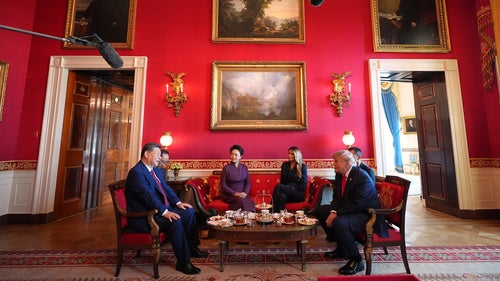
The two leaders left the US-China summit without any agreement on technology competition, trade, or Taiwan.
Expectations were low heading into US President Donald Trump and Chinese President Xi Jinping’s meeting in Washington on Thursday. Analysts expected at least some agreement on technology competition, trade, and Taiwan to come out of the leaders’ second 2026 summit. It appears to have failed to produce anything of substance on these issues.
Instead, Trump showered praise on Xi, calling the Chinese leader “strong, fit, and vibrant” (despite concerns about Xi’s health) and touting their “truly great friendship.” The display was consistent with his approach to US foreign policy, which entails collapsing complex society-to-society interactions into personal exchanges between two leaders. But in attempting to “personalize” US-China ties, Trump has produced an incoherent diplomatic process that will fail to stabilize the world’s most important bilateral relationship.
By contrast, Xi was much more disciplined in both his delegate selection and words. He reemphasized the need for “strategic stability,” once again attempting to impose guardrails on the relationship and convince the United States to avoid confrontation on Beijing’s supposed red lines, including human rights and Taiwan. Xi’s performance may have bought China some time to manage its growing list of domestic challenges, particularly the country’s ongoing economic malaise.
The outcome of the summit reveals the limits of Trump’s personalistic foreign policy. While filled with pomp, ceremony, an exchange of official gifts, and an air force flyover, substantive discussions between the two leaders only lasted about 90 minutes. This may be because American preparations for the visit—which included ironing out the critical talking points negotiating positions, and tradeoffs critical to any policy discussions—were handled chaotically and at the last minute.
As a result, this week’s summit is most notable for what didn’t happen. Trump did not lift his pause on a $14 billion arms sale to Taiwan, cementing a win for Beijing. And the two sides did not reach any agreement on protections against AI misuse, despite several reports (and confessions) of tech companies failing to impose basic safeguards on their rapidly advancing models.
During the May summit, both leaders agreed to a pause in trade hostilities and export controls, albeit with mixed adherence. China had communicated a desire to extend this pause, potentially until the end of Trump’s term. But shortly after Xi’s arrival on Wednesday, Treasury Secretary Scott Bessent announced that Washington would only extend it by two additional months, saying that a regular renewal would provide more opportunities to apply pressure in the future.
Such ephemeral bargains are typical of a personalized and transactional diplomacy. Countries more responsive to the public and with strong checks and balances (i.e., democracies) tend to have more consistent and stable foreign policies. But Trump has shown himself to be transactional in his policy preferences, with his personalist approach forcing even cabinet secretaries to vie for his approval of their pet projects. It is unstable ground for any durable international agreement, not least because Trump has a demonstrated willingness to renege on deals he himself made.
In the past, federal departments would coordinate, make tradeoffs, and reach compromises—moderating and increasing the durability of major policy decisions by giving each actor a stake in the outcome. The lack of an interagency process today means federal departments are not reaching durable policy compromises. Instead, secretaries have strong incentives to pursue their department’s individual interests. US foreign policy therefore swings depending on who is in Trump’s favor at the given time and shifts again as conditions change.
Such short time horizons are generally bad for private companies, which need greater stability to secure supply chains, garner or make investments, and gain greater market access. This is especially true when it comes to the US-China relationship and explains the presence of many American business leaders at Thursday’s state dinner. One way to stabilize individual business operations is by cutting side deals with both the US and Chinese governments. But this can mean going against broader American interests.
Ultimately, the visit is unlikely to steady bilateral relations for long. The relationship is complex, multifaceted, and grounded in highly interdependent society-to-society exchanges. To be clear, these exchanges are not always positive. For example, the “China shock” decimated American manufacturing, generating lasting political consequences. But it is unrealistic to think that these challenges can be managed purely through short, sporadic conversations grounded in the inter-personal relationship of two leaders. While such relationships are important, they must be backed by disciplined intra-governmental coordination that is fashioned into clear negotiation objectives.
The Chicago Council on Global Affairs is an independent, nonpartisan organization and does not take institutional positions. The views and opinions expressed in this commentary are solely those of the author.
Related Content
 Global Politics