The Gulf's New NATO?

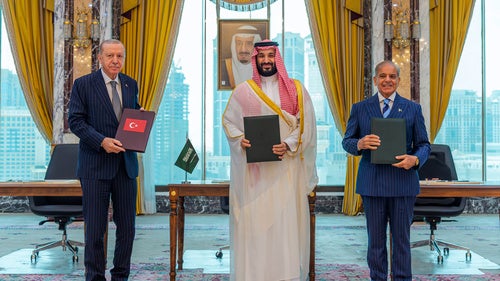
The Mecca Joint Defense Agreement is not just a response to Iran but the divergence between states over theories of power.
When Saudi Arabia, Turkey, and Pakistan signed the Mecca Joint Defense Agreement on August 7, the reaction in Washington was one of muted surprise. Here is a NATO-style agreement stipulating that an attack on one signatory is an attack on all, involving a NATO ally, and assembled outside the NATO framework. And from its cautious response, it appears Washington was not the key architect of this new arrangement.
The landmark mutual defense pact unites three regional heavyweights: Saudi Arabia, a top global oil producer and holder of financial reserves; Turkey, which boasts the second-largest military in the NATO alliance and a burgeoning arms industry; and Pakistan, which stands as the only nuclear-armed Muslim state and maintains one of the world’s largest active militaries. In theory, Turkey’s arms industry will now have a treaty-level pathway into Saudi procurement, as well as a prospective co-producer in Pakistan. Meanwhile, Pakistan’s trained personnel will gain a Gulf partner with capital to scale them, with Saudi wealth flowing into Turkish and Pakistani defense manufacturing under a formal framework instead of through ad hoc deals. It is, on its face, a breathtaking development.
Understandably, analysts are quickly trying to assess the driving impulse behind the announcement. Is it a regional reaction to Iran? A targeted response to Turkey and Israel’s deteriorating relations? Or is the agreement better understood as a message to the United States about its failure to ensure the safety and security of its regional allies? While all of these impulses play an important role, the signing in Mecca is reflective of something even more consequential—an underappreciated, fast-moving set of political realignments taking place across a huge swath of territory to counter regional threats and build the powerful economies required to survive and thrive in the 21st century.
Two Theories of Power
Over the past year, the Arabian Peninsula and surrounding region have been cleaving into two loose but distinct coalitions led by the United Arab Emirates on one side and Saudi Arabia on the other. Each regional bloc holds very different ideas about how to respond to Iran in particular but also interpretations of future geopolitical and geoeconomic trends. Their increasingly strained relationship has radiated well beyond the Arabian Peninsula, mapping onto existing rivalries in South Asia, the Horn of Africa, and even the Eastern Mediterranean. With caveats and cautions, the sides include Israel, the UAE, Greece, and India on one, and Saudi Arabia, Turkey, and Pakistan on the other, with Egypt and Qatar tentatively drawing closer to the latter. While the two sides are not internally coherent in terms of threat perception, military strategy, or economic outlook, their interests increasingly overlap in those realms, and their pattern of geopolitical alignment is increasingly unmistakable.
The UAE, Israel, Greece, and India are betting that this century will reward agility: small, networked states competing on technology, energy conduits, data infrastructure, and capital, rather than territory or population. Ian Bremmer and Firas Maksad call this side the Abrahamic coalition, anchored in the 2020 Abraham Accords. Melinda Haring and Daniel Kimmage, writing more broadly about the changing character of state power, describe Israel and, more ambiguously, the UAE as “new Spartas,” states that compensate for size with “wile and guile.”
For the UAE, Israel, and their partners, Iran is more than a military threat. By targeting the region’s infrastructure, Iran endangers an economic model built on energy, technology, and tourism. Everything this side does stems from this belief, from the deployment of Israeli Iron Dome batteries to the UAE and the UAE’s investment in India’s civilian nuclear program to the accelerating build-out of the technology, data, and energy infrastructure tying these states together.
Saudi Arabia, Turkey, and Pakistan, meanwhile, are betting on an older theory: that mass and depth still matter, and that territory, population, standing militaries, energy reserves, and religious legitimacy are still the name of the game—even as these states modernize alongside their smaller rivals. Iran is dangerous, but not the only threat. Bremmer and Maksad call this bloc the Islamic coalition.
For the Saudi-led or mass-and-depth group, brazen direct military confrontation is not the path forward. Operation Epic Fury, the closure of the Strait of Hormuz, and renewed threats to Red Sea shipping have affirmed it does not work. Riyadh, therefore, has run its own direct channel with Tehran, even as it condemns Iranian aggression, because it views a hobbled Iran as a more manageable adversary. This hedging strategy has infuriated the UAE, which bore the brunt of Iran’s drone attacks, among others. But for Riyadh, Islamabad, and Ankara, a failed Iran will only leave a dangerous vacuum for adversaries to fill, just as a failed Iraq did following American intervention there.
A hobbled Iran could also serve as a counterweight to what Riyadh currently sees as an equally destabilizing force: Israeli maximalist goals, which were put on display in September 2025, when Israel struck a Hamas negotiating team inside Qatar. Within days of that strike—the first by Israel on a Gulf Cooperation Council member state—Saudi Arabia signed a strategic mutual defense agreement with Pakistan. The act formalized a bilateral security relationship that had existed informally for decades. Turkey’s recent addition in Mecca can be seen as a next building block in a widening security arrangement.
What is forming in the region is new enough that even close observers haven’t settled on what to call it. But strip away the labels and the dynamic remains: One side is betting that small and fast can beat large and measured. The other is betting that size and pace, modernized, will still win. The Gulf has become the arena where that argument will be settled, not in a seminar room, but in rail lines, defense pacts, and the supporting infrastructure that will carry the region’s energy and trade for a generation.
A Pattern Across the Region
While the claim that the Gulf and broader region is cleaving into two competing coalitions is far from a consensus view, the evidence bears it out. In Sudan, Saudi Arabia has backed the Sudanese Armed Forces and the UAE has backed the Rapid Support Forces in what observers have increasingly called a Gulf proxy war. In Somalia, Saudi Arabia has joined dozens of Muslim and Arab states in condemning Israel’s recognition of Somaliland. The UAE has been conspicuously quiet in this matter, which tracks with Abu Dhabi’s own basing ambitions there. In Yemen, the two countries’ proxies came into direct armed confrontation in January 2026—the starkest evidence yet that two nominal American allies are, in places, effectively at war with each other by other means.
This pattern extends into energy diplomacy, where Greece, Israel, India, and the UAE have backed the Biden and first Trump administration’s India-Middle East-Europe Economic Corridor (IMEC) unveiled in 2023 at the G20 in New Delhi. Meanwhile, Saudi Arabia has spent the past year courting Damascus as its preferred Mediterranean node and rerouted infrastructure, including fiber-optic networks, through Syria rather than Israel. Turkey and Saudi Arabia signed a rail agreement via Syria and Jordan in June, a route Ankara has described as designed to diminish Israel’s regional role. Turkey’s trade minister called it a blow to the Israel-India-UAE axis—one that includes its age-old rival Greece, a key architect of the corridor. The UAE is a major investor in India’s civilian nuclear program; Saudi Arabia backs Pakistan’s. The recent Saudi nuclear deal seemed an effort to draw the United States to one side over the other.
Earlier, in May, the UAE pulled out of the Organization of the Petroleum Exporting Countries (OPEC), a Saudi-led oil cartel that manages a considerable portion of global oil supply. It did so to free itself from Saudi-driven production constraints that Abu Dhabi believes limited its economic and political aspirations. Shortly after, in July, Saudi Arabia announced that 13 countries had joined them in the creation of a maritime defense alliance to secure freedom of navigation through the Red Sea, Gulf of Aden, and Bab el-Mandeb Strait. The UAE was not among them. Neither were Greece, Israel, nor India, despite all having significant maritime interests in the waters the alliance is organized around protecting.
These deepening divisions have been particularly challenging for India, whose foreign policy has long rested on multi-alignment. On August 6, the day before the Mecca signing, Indian Prime Minister Narendra Modi received a call from Israeli Prime Minister Benjamin Netanyahu. The official readouts were anodyne, citing the India-Israel Special Strategic Partnership and “developments in West Asia.” What happened the next day was more telling: Turkish and Pakistani media reported that India had urgently approached Israel about a reciprocal defense arrangement to counter the new axis. India’s Ministry of External Affairs denied any new pact was being negotiated, calling the reports “fake news.” But it did not deny the underlying premise, saying instead that New Delhi was “closely following” the Mecca agreement. Governments do not typically issue formal responses to rumors they consider immaterial.
Pakistan sits inside the mass-and-depth coalition. Thus India, however hedged, leans more heavily toward the network-and-agility coalition. As the two loose groups formalize into institutions, the room for multi-alignment will narrow. It is a dynamic that deserves its own fuller treatment elsewhere, but one that New Delhi’s own rushed denial-and-confirmation suggests it already senses.
What Comes Next
The United States has spent the three decades since Operation Desert Storm building a de facto Middle East security architecture. US military presence, interoperability training, and shared intelligence has knit Gulf partners and Israel into something like a coordinated defense posture loosely referred to as a “Middle East NATO.” The Mecca Joint Defense Agreement forces an uncomfortable question: Is that architecture being fulfilled, or superseded?
Read one way, it is Washington’s project finally bearing real fruit. The agreement is a next step in region-wide interoperability and a genuine mutual-defense commitment. Read another, however, it is that project’s quiet supersession. The aspirational interoperability is real, but built around Riyadh, Ankara, and Islamabad, with Washington informed after the fact rather than consulted beforehand. It is too soon to know which reading holds. But the assumption underlying three decades of American Gulf policy that Washington would sit at the center of whatever architecture emerged can no longer be taken for granted.
The interoperability that Washington has long championed requires trust among the participants building it. That trust is harder to sustain when two of the architecture’s most essential nodes—Saudi Arabia and the UAE—are simultaneously blocking each other’s bank payments, arming opposite sides in Yemen, and building rival coalitions that pointedly exclude one another. Washington is not facing a choice between two coalitions. It is discovering that its closest partners have already started choosing for themselves.
In the weeks ahead, the Mecca Joint Defense Agreement will be analyzed mostly as a story about Iran, Israel, deterrence, and a NATO member stepping beyond its bounds. But something larger is also at play. The Mecca agreement is the clearest evidence yet of a chasm forming in the heart of the Arabian Peninsula that is deepening and morphing, infiltrating banking systems, underwriting proxy militias, and cleaving along deep-seeded geopolitical antipathies. Two coalitions are competing for corridors, capital, and now, formally committed on paper, to mutual defense pacts. It is a fight for a leadership stake in the 21st century.
The mass-and-depth coalition is building the harder, more binding commitment; the network-and-agility coalition, for now, has not. Whether that reflects strength (a signal that agile states don’t need formal treaties to move together) or exposure will become clear only as the rivalry unfolds. But the states involved are done waiting to find out which theory of power wins in the abstract. They have started building the answer into the language of a treaty.
The Chicago Council on Global Affairs is an independent, nonpartisan organization and does not take institutional positions. The views and opinions expressed in this commentary are solely those of the author.
Related Content
 Global Politics