The Case for Talking to China Is Not a Case for Détente

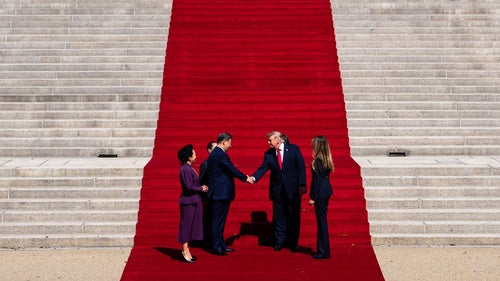
Summits, like this week’s between Trump and Xi, are never cost-free.
This article was originally published by the Financial Times.
This week’s US-China summit was long on symbolism and short on substance. No big deals or grand bargains were reached, let alone discrete deliverables. That reflects both Donald Trump’s aversion to preparation and the economic stalemate following the 2025 trade war.
Yet this summit should not be dismissed as mere spectacle. Trump hosting Xi Jinping at the White House matters. And regular leader meetings, possibly two more at multilateral gatherings this year, keep the trade truce alive and the lines of communication open.
That is needed today. Global politics is in a strategic interregnum, moving on from the era of US dominance and a rules-based order. But to what? With two regional wars raging, the range of possible geopolitical outcomes is wider today than perhaps in any period since the 1920s. What is not uncertain is the centrality of the US-China relationship.
Washington and Beijing are in the early days of a long-term competition whose terms and boundaries are still being set. As such, more communication is better than less. Summit diplomacy, properly handled, can reduce misperception, encourage restraint, narrow differences and foster co-operation. This is desperately needed in a relationship whose list of problems, from AI to Taiwan, is expanding.
This week’s summit addressed few of these issues, but it at least bought both sides more time and stability. But the case for talking is not a case for détente: a stable arrangement based on shared strategic interests. Summits are not cost-free; they allow China to play for time and project an image of comity, if not accommodation. Time and stability are only valuable if used well.
With summits like this, Washington risks sending signals that embolden Beijing rather than deter it. This is especially true on issues like Taiwan and Japan, where Trump appears receptive to Xi’s calls for restraint. US-China relations work best with clear, consistent and credible communication about American interests, backed by leverage. But Trump has his own view of US interests: criticising allies while embracing China.
Advocates of détente misunderstand both the state of US-China relations today and Xi’s global aspirations. Ties between the two countries today rest on a fragile truce, agreed in autumn 2025 to pause the trade war. It is underpinned by mutual economic vulnerability: both can inflict serious damage on the other. Washington and Beijing both value the stability of a truce, but both are racing to reduce their vulnerability and increase their leverage. For China that means reducing exposure to US tariffs and technology controls; for the US, reducing dependence on rare earths and magnets.
Some now argue that this mutual economic vulnerability can do for Washington and Beijing what nuclear deterrence did in the cold war. That would be a dangerous mistake.
The inherent instability of the cold war’s mutually assured destruction (MAD) is often forgotten. Washington and Moscow constantly tried to escape MAD, often with risky military operations. Nuclear vulnerability was hard to escape. Economic vulnerability is far less so. Today’s stalemate—built on narrow economic vulnerabilities—is not an equilibrium. It is a race, and summits set its pace, but aren’t a finish line.
Today’s bilateral bargaining is also lopsided. China’s actions, such as pauses on export controls and soyabean purchases, can be reversed overnight. American concessions on technology cannot. China’s economic challenges explain why Xi wants calm now, but that is a reason to buy time, not to settle.
Meanwhile, strategic competition persists. Both sides are putting each other’s companies on control lists and denying access to critical technologies. China’s military coercion in Asia is intensifying, as is its support for Russia’s war in Ukraine and for Iran. No one knows where the boundaries are, until they are crossed. The summit clarified none of this and, worryingly, projected the image of a US-China “G2” condominium.
That image matters all over the world but especially in Asia. Coexistence in the cold war rested not on summits and restraint alone, but on alliances and military capabilities. Détente without credible deterrence is not the basis for coexistence; instead, it invites miscalculation and instability.
Trump’s affinity for Xi and dealmaking with China are also at odds with hawks in his own administration and Congress, undermining its political sustainability at home and credibility abroad.
Xi believes the US is accelerating its own decline but remains dangerous because it could lash out on the way down. His plan is not to confront Washington but to accumulate power and influence until a transition becomes inevitable. Xi needs time to make China less reliant on others and others more reliant on it, beginning with the US.
So, the real question arising from the summit is who will make better use of the breathing room it has created. Washington should use it to build alternative supply chains, align export controls with partners, rebuild its force posture, reassure Taipei, Tokyo and Manila, and insist on crisis communications that work. If Washington treats the summit as an achievement in and of itself rather than an opportunity to do more, then it has already lost the competition.
The Chicago Council on Global Affairs is an independent, nonpartisan organization and does not take institutional positions. The views and opinions expressed in this commentary are solely those of the author.