Can Trump End the War in Ukraine?

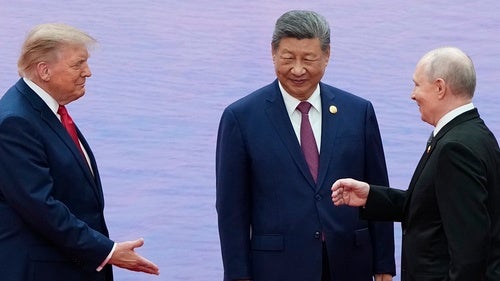
Xi, Putin, and Trump will discuss Russia’s ongoing campaign on the sidelines of the APEC summit.
US President Donald Trump repeatedly promised during his 2024 presidential campaign to bring the war in Ukraine to an end. Two years into his second administration, he appears eager to deliver on a breakthrough. Delegations gathered in Abu Dhabi earlier this month for the first US-mediated talks in nine months. Now, Trump is in China, where he will meet with Chinese President Xi Jinping and Russian President Vladimir Putin on the sidelines of the APEC summit and discuss his “favorite subject, Ukraine."
Could this be a turning point in negotiations? Senior Nonresident Fellow Alexander Cooley spoke with the Council’s Christina Colón about the trilateral talks, Russia’s renewed push for a new European security framework, and what a Democratic-controlled Congress could mean for Ukraine.
This interview has been edited for length and clarity.
Let’s start with the meeting in Abu Dhabi. These were the first trilateral talks on the war in Ukraine since February. What happened? And what did we learn about each country’s priorities?
Abu Dhabi demonstrated that although the parties are willing to resume diplomatic engagement under this format, they really haven’t budged on their kind of central positions over territory, security, and Ukraine's position in the world order. Each country tried to showcase their priorities. So, for Russia, locking in territorial gains, but even more importantly, the European security order and the need to change that.
Ukraine's priorities have always been about preserving its sovereignty, but also not leaving itself vulnerable to external control of its foreign policy decisions. As Ukraine has realized that it is no longer supported to the same degree that it used to be by the United States, it has really cultivated this belief that it has to develop its own capacity and it has to act autonomously. It is not going to give in to a settlement that it perceives leaves it vulnerable to renewed Russian aggression.
When it comes to Washington, clearly this is an administration that talked about ending the war on its way in. And they believed that if they brought the sides to the table, if they pulled aid from Ukraine, if they threatened to pull things like intelligence sharing or targeting information, that that somehow would bring leverage over Kyiv. The problem with the US stance though is there's still this view of the conflict as a territorial conflict, as a real estate deal. But the political complications surrounding proposals for a new European security architecture and Ukraine's own desire for foreign policy autonomy don't have solutions on a map.
US President Donald Trump has said on multiple occasions that he wants to end the war but has appeared to ease up on Russia in the last few months—inviting Putin to join the G20 Summit in Miami, lifting sanctions to import Russian diesel, and even saying Russia has “been fine on Ukraine.” To be clear, many of these actions have been met with bipartisan outrage. Why has Trump taken this approach to Russia and the war?
Trump usually views foreign policy through personal relationships and US power. He believes that high-level bargaining by powerful countries can solve global issues and problems. So, he's held on to this idea of a dramatic agreement with Putin, and US diplomats have focused on providing incentives for Putin that could bring a deal.
There's a desire to try and close the Ukraine issue for political reasons but also to remain focused on Iran. And I think that Trump believed that he had adequate instruments, both on the carrots side—dropping sanctions on Russian diesel, for instance—but also on the sticks side on Ukraine, that their dependence on Western military and intelligence support would make them vulnerable. As it turns out, these instruments might be important, but they're not determinative. There's a limit to what Washington can do. But I think it's clear that Trump is quite eager for a deal and is willing to try and create whatever incentive structure—positive and negative—to get that through.
The Trump administration’s seeming eagerness to appease Russia has also put the United States at odds with its European allies, who have been largely sidelined in negotiations. While there is now a seeming push to include Europe in the next rounds of diplomacy, the United States has raised the possibility of adding a new European security framework to the discussions. Why is this being floated? And what impact could it have?
This is something that's always been on the Russian wish list. But European countries aren't really interested in changing their security architecture. They view NATO as the main anchoring alliance and security block, and they're not particularly interested in getting away from the European Union as a political bloc.
European countries also do not trust Moscow's intentions. For years, they have been on the receiving end of hybrid operations targeting their infrastructure and airports without clear Russian attribution but with suspected Russian involvement. So, there's very little trust there. And some of the frontline countries, especially the Baltic states, view any attempt at giving into Moscow as potential appeasement but also a signal that Russia could potentially attack these countries and that the response by NATO and the West would not be as decisive and as swift as the alliance demands. I think for all these reasons, European countries are very reticent to change the security architecture. And it's not clear what they would even get in return for it given that Russia has proven itself perfectly willing to violate norms of territorial sovereignty with or without an agreement.
I do find the European security architecture reintroduction quite interesting because the way the war has evolved over the last nearly five years, it's been Russia that has actually globalized it by bringing in non-European partners. Russia is the one who started using Iranian drones to attack Ukraine, then created production plants, and now reexports them to Iran. They're the ones who signed a security agreement in North Korea allowing North Korean troops to fight Ukraine on Russian territory. And they're the ones who have been cooperating with China over the reexport of dual-use technologies. So, Russia has globalized its part of the war, and now it's going back to this talking point about a new sort of European security architect.
And Europe is about to be sidelined once again this week, with Trump set to meet with Putin and Xi in China, where he has said they will talk about his “favorite subject, Ukraine,” among other things. What is so significant about this trilateral summit, and what do you expect to come out of it?
One reason I think it's really important is it really marks the changing global order under Trump. We’re moving from a system of great-power competition—which was the national security doctrine under Trump 1.0 in 2018—to this world of great-power accommodation, where the three great powers are getting together to talk about global affairs. This makes Europe nervous. This makes a number of other countries nervous—I would add Canada to that list.
But if we look sort of below the surface, I think each of the three “great powers” gets something and wants something very different from this. For Putin, the meeting on the side of APEC is very symbolic. It sort of legitimizes his own claim to great-power status for domestic audiences. It also demonstrates that Moscow is somehow indispensable in global diplomatic negotiations. For Putin, that kind of revered status is very important. And for Xi, it’s the optics of it. It’s being held in China. China is being courted by both Russia, which wants Chinese backing of its sort of peace plan, and also by the United States, which is courting China to put pressure on Iran, among a number of things. So, China finds itself the focal point, both geographically and politically.
For Trump, this is consistent with his view that the only countries that really matter in global politics are the important countries. One of the reasons Trump seems to dislike multilateralism is it involves the juridical equality of smaller nations. He thinks and acts as if the great-power counterparts are the consequential actors in the international system, so those are the ones that we should engage with.
Beyond the sort of symbolism and the status of the three meeting, it’s not clear what there's going to be progress on, whether that's Ukraine, arms control, or even Iran.
Just ahead of the summit, Ukraine destroyed a section of the bridge that links Russia and Crimea. What does this attack tell us about how Ukraine is thinking about the war?
It gets back to Ukraine feeling it is self-reliant and that it cannot rely on anyone else to change the dynamics of this conflict except its own capabilities. The Kerch Bridge has both operational significance and symbolic significance. It is the major connector between Russia and its occupied territory of Crimea, and disrupting it creates all sort of sorts of logistics complications. It also creates a widespread sense of insecurity that perhaps it is more vulnerable than Russian authorities have admitted.
And then the symbolic significance is enormous. It is a very controversial piece of infrastructure completed after the 2014 annexation of Crimea, meant to physically connect Russia to the peninsula. Attacking it challenges this notion that somehow there's a permanency there—that the territorial acquisition is secure and irreversible. I think that part is really important.
It is also a kind of operational lesson in that the Ukrainians do have the capabilities because this is a heavily defended target. The fact that it can be struck down and that they're willing to do it, and signaling that ahead of the summit is also, I think, quite important. So, it's doing multiple things, but certainly it's reminding the world that Ukraine does have a significant capability to disrupt Russian planning and Russian views of how the conflict should be settled.
Meanwhile, Ukraine is becoming a bigger bargaining chip in Congress, with House Republicans now reportedly trying to force Democrats to choose between sending aid to Ukraine and expanding congressional oversight. Will we see the US approach to the war shift under a Democratic majority?
I personally don't think so precisely because Congress is now serving as a check on all parts of the domestic agenda that Trump feels it is even more important to preserve his autonomy over the foreign policy and security space, where, let's face it, he's had few checks to begin with. I actually think this is going to lead Trump and his inner circle to focus even more on foreign policy than before. And I can't see a world in which congressional Democrats give away the expansion of oversight or the ability to conduct investigations or hearings for Ukrainian aid.
It all points to the fact that we're in a different domestic institutional environment, and it adds yet another layer of complexity. Going back to this week’s trilateral, I would say both Xi and Putin have noticed what happened in the midterms, and they consider Trump’s weakening position domestically to be something that they can try and use to their advantage. Maybe in the Russian case it's trying to really emphasize the urgency of getting a deal done. And maybe on the Chinese side, it is emphasizing that the United States needs to stick to its commitments that it made over things like tariffs and critical minerals and keep these agreements stable.
So, I think it informs some of the foreign policy but frankly, for this administration, foreign policy has always been something that they feel they have unchecked authority over.
The Chicago Council on Global Affairs is an independent, nonpartisan organization and does not take institutional positions. The views and opinions expressed in this commentary are solely those of the author.