When Agricultural Research Is Abandoned
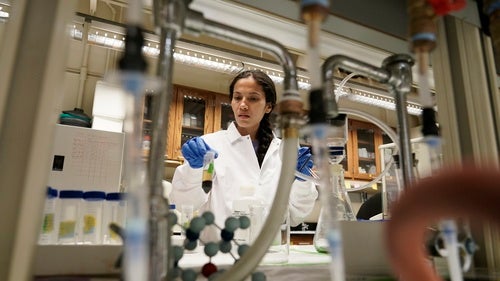
To address global hunger, Congress must reinvest in public research and development.
America’s most visible role in fighting hunger abroad is in emergencies. But American agricultural research has, in the long run, saved many more lives.
It was US public research funding that powered the Green Revolution, a Cambrian explosion of agricultural technology in the 1960s that would retire the era of natural-cause famines. And US-sponsored efforts at the United States Agency for International Development (USAID), private companies, land grant universities, and international institutions produced advances in agricultural biotechnology, seed genetics, machinery, chemistry, and agronomic practices that have helped to lift billions out of poverty and risk of starvation. But as chronic hunger and artificial famine resurged in the past decade, Congress let its investment in agricultural research slip back to 1970s-levels.
The early 1970s was the last time our world faced a hunger crisis of today’s magnitude. Congress then understood that agricultural research was a uniquely effective instrument against extreme poverty because of its twin virtues: simultaneously increasing the local supply of food and total household purchasing power. The research successes of the late 20th century served as a repeat lesson that, for most countries, agricultural improvement is a required stop on the way to better lives for its citizens. And the peace and welfare of these countries in turn benefit the economy and security of the United States.
In the face of today’s crises, Congress must learn again.
From Innovation to Impact
Grants of money or productive assets, while sometimes valuable, are often insufficient by themselves to generate sustained productivity growth among poor farmers. Smallholders also need innovations suited to their circumstances. Such technologies range from resilient crop varieties to affordable soil-fertility and pest-management methods, and machinery or conservation practices appropriate to local farm sizes, soils, and topography.
The decades following the Green Revolution demonstrated how innovations developed from publicly supported research can be adopted into widespread commercial use. In 1985, the International Rice Research Institute released IR64, a rice variety combining high yields and early maturity with disease resistance and the cooking qualities consumers preferred. By 2005, farmers in some of the hungriest developing nations were cultivating 10 million hectares. A second example began in India in 1991, when researchers developed a locally suitable zero-till seed drill for rice-wheat systems, dramatically reducing costs and improving yields. Approximately 620,000 farmers were using zero or reduced tillage on 1.76 million hectares by 2008. In each case, modest USAID research investments reached millions more farmers than was possible with costly grant funding.
These are a small sample of USAID’s research investments benefiting Asia, the adoption of which coincided with a drastic reduction in chronic hunger in the region. Without them, the emerging economies of Vietnam, Malaysia, Thailand, and the Philippines may be unrecognizable today. On paper, these investments would appear to have been a definitive political and policy win for their backers in Congress. But these research developments didn’t produce material results until decades after the work began.
Then-Representative Glickman’s first budget vote in Congress in 1977 would have funded IR64. But the rice variety was not widely adopted until after his departure from the House of Representatives in 1995. By then, few elected officials remained to take credit for, or even remember, the appropriations behind this enormous success.
The Decline in Public Funding
The delayed gratification of public agricultural research is connected to its decline. The United States was by far the largest national donor, performer, and sponsor of public agricultural research until the mid-2000s. Indexed to 2020 US dollars, public research and development (R&D) spending peaked in 2002 at $6.9 billion and declined to $4.7 billion in 2023—a 32 percent fall. Today, US public agricultural research spending, in real terms, is at 1970s levels or even less, factoring in research costs.
Since 2002, Congress has appropriated discretionary spending in an increasingly debt-constricted environment. It’s politically intuitive why investments in agricultural research, with distant and uncertain benefits, have struggled against more immediate and urgent priorities. And while farm groups have always listed research as a policy priority, each farm bill and appropriations cycle has trained their efforts on visible core priorities like the farm safety net and crop insurance.
While private R&D has grown at the same time, such investment may be less productive against the backdrop of a decline in public spending. Private research is a complement, rather than a substitute, to public research. Publicly funded research includes basic research with no immediately obvious application—discoveries that are often later essential to breakthroughs. Public research also leads to discoveries that may not be commercializable today but serve humanitarian or foreign policy goals. Private R&D builds on public research to bring discoveries to commercial markets.
Delayed Symptoms and the Risks Ahead
Just as investment in agricultural research can take decades to bear fruit, the costs of disinvestment are plain only over time. The research decline commenced right when the world most needed American leadership. Had Washington sustained 2002 funding levels, the initial benefits of that research would have debuted in the mid-2010s—just when chronic hunger rates were beginning to rise again.
Since then, climate change has materialized in global farming, especially in places closest to the equator in Sub-Saharan Africa and Central America, where chronic hunger and farm productivity are closely related by the prevalence of subsistence agriculture. Warming has already slowed the growth of global agricultural productivity by roughly a fifth since 1961 and in Africa and Latin America by as much as a third. The research burden is now even heavier than in the 1970s; breakthroughs are needed just to keep yields where they are, and more still to raise them.
The symptoms are appearing at home, too, where farm productivity growth is projected to stall as the gains of past research slow. Abroad, the dismantling of USAID in 2025 destroyed the finely tuned machinery that carried American research investments to the world’s poorest farmers. Without congressional action, the expertise and experience that has led to more recent research advances will remain idle until a new administration.
If the historical pattern holds, the full costs of these decisions will stay hidden for a decade or more. Leaders’ choices today will help determine the rate of hunger in the 2030s and 2040s.
What Can Be Done?
The best time to plant a tree was 20 years ago. The second-best time, as they say, is today. Congress must commit to long-term investments in public agricultural research, and this or a future US president should build a US-led international coalition setting a minimum contribution to research consortiums like the Consultative Group on International Agricultural Research (CGIAR).
Besides the moral, economic, and security consequences of the growing hunger crisis, there is a domestic political case for research investment. As elected officials grasp for solutions to Americans’ frustration with food price inflation, research investment is likely to produce the desired results. Agricultural producers have faced continuously difficult market conditions for nearly 15 years as profits from productivity gains have been erased by the rising cost of inputs. Public agricultural R&D is necessary to relieve the poor equilibrium in which American producers are stuck. Our security competition—namely China—has overtaken the United States as the world’s leading sponsor of public agricultural research, and our agri-food competition—Brazil—is closing in fast. Taken individually, any of these factors would justify congressional action.
A US-led international coalition would also address Americans’ growing wariness of spending taxpayer funds solving the world’s problems. Nations who share our horror at chronic hunger could match our renewed financial commitment to agricultural research—to their own benefit, and the world’s.
According to an analysis in Nature, research funding should be doubled across the board to account for the growth in research costs, to reestablish the culture and infrastructure that made the Green Revolution possible, and to make up for lost time. We concur, and it will make a difference if the United States acts alone. But if we hope to finally answer humankind’s oldest challenge—how to produce enough food—congressional action must be met with American leadership and a global reply.
The Chicago Council on Global Affairs is an independent, nonpartisan organization and does not take institutional positions. The views and opinions expressed in this commentary are solely those of the author.