What Trump's Greenland Deal Means for Arctic Security
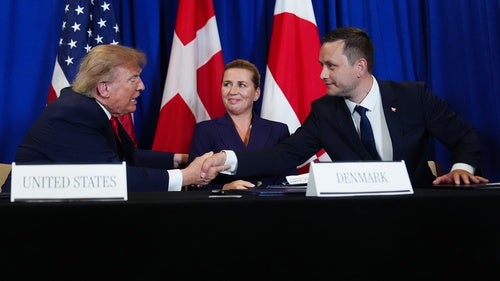
Julianne Smith, Deborah Rosenblum, and Ariane Tabatabai discuss how the US-Denmark-Greenland agreement will impact US force posture, intra-NATO tensions, and Trump’s push to acquire Greenland.
After months of escalating tensions between the United States and Denmark over Greenland, the two countries appeared to come to a resolution on the sidelines of the United Nations General Assembly.
US President Donald Trump joined the leaders of Denmark and Greenland in signing a landmark security agreement, which will amend the 1951 US-Danish defense agreement and enable the United States to increase its military presence in Greenland. The deal also permits the establishment of a Golden Dome and prohibits non-NATO states from building military installations on the island. Perhaps most notably given Trump’s repeated threats to forcibly take Greenland, the agreement maintains Danish sovereignty over the semiautonomous territory.
“I think there is, frankly, some relief in Europe that, hopefully, Europe and the United States can put this issue behind them,” Ambassador Julianne Smith, Council distinguished nonresident fellow and former US permanent representative to NATO, said. “Although I will assure you that the allies will not forget about it entirely for quite some time."
She joined Council Vice President of Research for Security and Defense Ariane Tabatabai and Council Distinguished Nonresident Fellow Deborah Rosenblum to discuss what the agreement means for NATO, Arctic security, and US force posture—and whether Trump has really given up his fight for Greenland.
This interview has been edited for length and clarity.
Ariane Tabatabai: Julie, can you talk to us about the role that Greenland has played in the tensions between the United States and Europe and the intra-NATO tensions that we've seen unfold over the past few months?
Julianne Smith: The last year and a half has been a difficult period, to say the least, for the transatlantic partners. The relationship between Europe and the United States has been extraordinarily rocky, and the roots of that are multifold. We've had arguments over tariffs. We've gone back and forth on whether or not the United States is upholding its commitment to Article Five—depending when you catch the president. But no issue has been as damaging to the transatlantic relationship as the Greenland issue. To have the largest and most powerful member of the alliance, the United States, talk about “getting" the sovereign territory of another NATO ally—Denmark/Greenland—really shook NATO allies to their core. And as a result, this has sent the alliance into a tailspin, or it did as it was unfolding late last year into early this year.
The issues seem to have been resolved through Davos when NATO Secretary General Mark Rutte was able to sit down with Trump and kind of iron out some sort of a deal to do more in the Arctic and then send Denmark, Greenland, and the United States off to the negotiating table. But the issue surfaced again at the NATO summit this past summer.
Europeans have been on edge. And what I'm sensing right now is irrespective of whether or not there are some different versions of what we're looking at here. I think there is frankly some relief in Europe that, hopefully, Europe and the United States can put this issue behind them—although I will assure you that allies will not forget about it entirely for quite some time.
Tabatabai: Deborah, the most significant reason why the president has been pushing for the acquisition of Greenland [is that] Russia and China are growing their presence in the Arctic, and we need to have an increased presence there to be able to counter that. How do you assess the threat posed by Russian and Chinese activities in the region? And the follow-up question is; we already have a presence in Greenland—we have an installation there. Was that not sufficient to address that threat?
Deborah Rosenblum: I think the Chinese and Russian presence in the Arctic is significant. We have seen, particularly in the case of Russia, a continued pattern of submarines going through the straits, and there are real issues around the ability to have adequate early warning were there to be any kind of land or submarine-based ballistic missiles launched toward North America.
We have abilities in Canada, certainly in Alaska, that give us early warning for missile launches that have occurred. But this was a gap that the United States has wanted to close for a while. And particularly as we're seeing, as a result of climate change, geographic changes within the Arctic itself—the melting of some of the ice caps—it's allowed for much greater freedom of movement of shipping vessels and submarines through that gap area. The one base where we have a presence has been largely focused on space and space-based assets without the ability to have fighter aircrafts, tankers, as well as, specific to Russia, some of our special operations forces being able to operate out of that.
What this agreement does is, in many ways, codify rights that were already there from the 1951 agreement that was set. But it kind of resolidifies this and also very artfully brings NATO into this in ensuring that any activity that would occur at subsequent defense areas that the United States would build out would be for the sake of NATO as well as the North Atlantic area.
Tabatabai: So, in your assessment, the agreement does actually contribute something toward addressing the Russian and Chinese threat?
Rosenblum: Absolutely. And it's not just about the Golden Dome. I think because the president has spoken so much about the Golden Dome, that's what people immediately think of. But it also provides greater optionality for the United States and NATO to know what's happening with a lot of Russian military aggressive action in the High North and in the Arctic.
Tabatabai: Julie, could we have gotten here without the tensions of the past few months? Was there a way for the United States and Denmark and Greenland to have these discussions and close the gaps that Deborah has been talking about without threats of acquisition of Greenland?
Smith: It ultimately depends on what the goals for the United States were. If US negotiators were determined to acquire Greenland one way or another, then the negotiations would still be ongoing, and this would still be a key point of contention.
The agreement, in essence, did three or four things. One of the most significant aspects is this expansion of the US military presence on Greenland. If that was the objective, that could have been worked out well before we got into all of these tense negotiations and public bickering over Greenland and worries about US forces landing there and somehow undergoing some sort of intervention. It would not have been difficult for Denmark, Greenland, and the United States to sit down and to use the 1951 agreement to broker the deal that we see today.
I think even if you look beyond the agreement to expand US posture in Greenland and you look at some of the other aspects of it, for example, now the United States will be able to ensure that it's submarines have access to Greenland—this isn't just going to be something that the United States can access through the air—that's an important new development. But I'm quite confident that that could have been resolved and finalized through some quiet, diplomatic efforts behind the scenes, using again the 1951 treaty as the foundation for those discussions. So, one does have to ask whether or not everything that we see here now on paper as part of this new agreement, could all of that have been settled without the tension and the public blowup that we've witnessed over the last couple of months? And think the answer to that, in my book, is yes.
Tabatabai: Deborah, let's talk about these two additional installations. I know we don't have a ton of detail on this yet, but if you had to offer some assessment of what gaps they might close and how they might complement what the existing installation is doing, where do you guess this is going to go?
Rosenblum: Building on what Julie said a few minutes ago in terms of US ships and submarines, one of the locations is specifically a deepwater port, and that's going to give a lot more optionality to the United States having a naval presence up and in that area. That really was not possible with just the existing base that was there. We've also heard the commander of Northern Command talking about what needs to be done to protect the US homeland in addition to the United States' NATO responsibilities, and he has pointed to the need for airfields that can host a range of US aircraft—whether that be fighters or tankers refueling—because there really has been heightened concern, from a military perspective, about what's happening in what they call the High North. That's where we've seen very aggressive behavior on the part of the Russians toward a lot of the NATO allies up in that region.
By having greater optionality on Greenland, not restricted strictly to what was happening with space-based assets and early warning, but the ability to do some training and exercising together with other potential NATO allies as well aimed at the High North, I think it provides a lot more optionality than was the case with just the existing base that they had.
Tabatabai: The other concern we talked a little bit about is critical minerals. Part of what the administration has been trying to achieve here is to get access to critical minerals. Does this agreement do anything to advance that particular objective?
Rosenblum: It does. There are two really important sections in there that explicitly bar any kind of foreign investment by a non-NATO, non-European Union member state in Greenland. And I think the concern was, if in the future Greenland were to exercise its right of independence from Denmark, would they enter into financial arrangements that could help to facilitate foreign investment by Russia, China, or others. This agreement explicitly bars that and the ability to do that.
Tabatabai: Julie, the clause about non-NATO countries’ presence in Greenland—does this mean that the president is not going to withdraw from NATO because then we would not be able to have a presence in Greenland?
Smith: Well, I'm not exactly sure that was the frame of mind for the US negotiators. I mean, I think there is an assumption that we will remain a member of the NATO alliance. It's actually an interesting construction; it's members of the NATO alliance, members of—when it comes to investment—the European Union, which I think is an important angle. And then it lists NATO partners as well, which is interesting. The alliance actually has over 30 partnerships with countries around the world. It would, I think, surprise most people to hear that Colombia is a NATO partner, Japan, Jordan—there's a whole collection of countries around the world that work closely with the NATO alliance, and they are lumped into this grouping as well.
In 1951, this was an agreement between Denmark and the United States. Now, Greenland has been inserted. The requirement of NATO membership is mandated throughout, which would be interesting if the United States or any other party considered leaving the NATO alliance, but the way in which that investment clause is constructed I find interesting—and actually useful—to list the European Union there side by side with NATO and NATO partners.
Tabatabai: The president was asked about whether, with this agreement, he would essentially forego any potential future threats to try to acquire Greenland by force, and he was fairly noncommittal. I am asking you to read tea leaves here, but is the acute phase, if you will, of this crisis over and behind us? Are we all moving on? Or can we look back in a few months and see this as just one episode on the way to another crisis pertaining to Greenland?
Julie Smith: Certainly from a Danish perspective, from the folks in Greenland, they are eager to move on. And I think that sentiment kind of exists across the European continent. Again, this has been an incredibly turbulent year for the transatlantic partners and the Greenland kind of scenario, incident, crisis—however you want to describe it—has really sat front and center of that tension.
It's hard to get in the head of anyone serving in the administration, including the president, and so I can't predict with certainty that this is now all behind us. I think the proof will be in the pudding. We'll have to see how future transatlantic engagements go. We'll have to see what the mood music looks like at future NATO ministerials and, most importantly, at NATO summits. We'll have to watch closely to see if Greenland comes up in any of the president's engagements, even with singular individual allies of the alliance. But I really would hope that the United States recognizes that now, through these negotiations, some significant improvements to US access to Greenland have been made. I think Denmark and Greenland are also very comfortable where we've landed. This speaks to the very serious diplomatic process that all three actors put into this. And it would be a shame if that didn't allow us now to move on and focus on, as Deborah noted, the very serious concerns all of us have about some of the rogue actors in the Arctic region.
It would be better for all of us to turn our attention to that, to lock arms and cope with that challenge collectively, rather than to get into yet another up-and –down, tense back-and-forth between Europe and the United States on Greenland itself.
Watch the Conversation
Julianne Smith, Deborah Rosenblum, and Ariane Tabatabai discuss how the US-Denmark-Greenland agreement will impact US force posture, intra-NATO tensions, and Trump’s push to acquire Greenland.

The Chicago Council on Global Affairs is an independent, nonpartisan organization and does not take institutional positions. The views and opinions expressed in this commentary are solely those of the author.