Ignoring the BRICS Summit Is a Mistake

Though internally divided, the grouping normalizes an international landscape where the United States is not at the table.
The 18th BRICS summit came and went in New Delhi last weekend with little notice in the United States. American news feeds are full of upcoming elections, deepening conflict in the Middle East, and fears of an AI apocalypse. Moreover, the meeting yielded no grand bargain, institutional breakthrough, nor even a unified response to the Iran war. Despite bringing together governments representing nearly half the world’s population and 40 percent of the global economy, from the perspective of Washington and Western capitals, BRICS remains for now a relatively lowkey gathering of nations that have as much that divides as unites them. But the grouping’s ability to survive, evolve, and even innovate in a volatile world are reasons not to count out what has quietly become a durable if still weak counterweight to Western institutions.
Twenty-five years ago, Goldman Sachs economist Jim O’Neill coined “BRIC” to describe four large emerging economies whose growth was thought to have the potential to reshape the global economy. By 2009, Brazil, Russia, India, and China had converted an acronym coined for investors into a diplomatic grouping; South Africa joined two years later. Their ambitions rose as their economies expanded. BRICS pressed slowly but with some steadiness for a greater voice for developing countries in the International Monetary Fund (IMF) and World Bank, to reform global governance, to loosen the grip of the dollar, and, ultimately, furnish an institutional counterweight to a Western-led order.
Today, BRICS has 11 members, including Egypt, Ethiopia, Indonesia, Iran, Saudi Arabia, and the United Arab Emirates. Its expansion has increased its weight while multiplying its internal contradictions. India and China remain strategic competitors. Iran and the UAE are effectively on opposing sides of the current war in the Middle East. Egypt and Ethiopia have refused to support a BRICS endorsement of South Africa’s candidacy for a permanent seat on the United Nations Security Council, among other frictions. Brazil and India resist efforts to cast the grouping as an anti-Western alliance, while Russia and China are more comfortable presenting it as an alternative pole of global power.
Those divisions are not papered over. BRICS foreign ministers failed to agree on joint statements in their September 2024, April 2025, and May 2026 meetings. The UN Security Council reform language adopted in New Delhi supported a larger role for developing countries but recorded explicit Russian and Chinese backing only for Brazil and India, with South Africa left off despite having been previously endorsed. The new declaration offered cautious language on the Middle East and made no specific mention of Ukraine. The group has also made little headway toward the common currency periodically invoked by its more exuberant boosters. On cross-border payments, BRICS claims to be studying interoperability and expanded use of local currencies but has not agreed on a common approach.
As an alliance or an embryonic replacement for the Western-led Group of Seven (G7), BRICS remains weak. That standard, however, misses an important part of what the grouping has become.
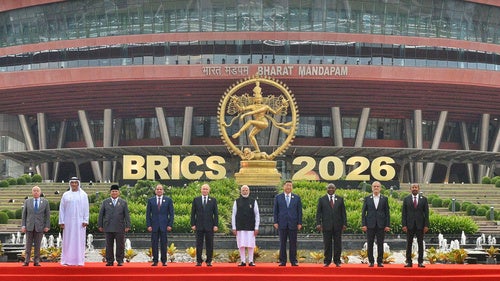
Look at the photograph from the 2026 summit in New Delhi. Indian Prime Minister Narendra Modi hosted Chinese President Xi Jinping, Russian President Vladimir Putin, Iranian President Masoud Pezeshkian, South African President Cyril Ramaphosa, and senior representatives from across Asia, Africa, and the Middle East. Pezeshkian appeared beside major powers while his country is at war and under heavy Western sanctions. Putin spent two days conducting bilateral diplomacy despite years of Western efforts to isolate him.
The image is part of the product.
For much of the postwar era, Western-led institutions did more than coordinate policy. They established hierarchies of prestige and belonging. A G7 family photograph conveyed that a small collection of advanced democracies constituted a steering committee for the world economy. NATO summits displayed the depth and reach of transatlantic alliance power. Annual meetings at Davos reinforced a similar geography of influence.
BRICS offers another table in a split image. Its members need not agree on much to value a venue that showcases an antidote to Western leadership. For Iran and Russia, it punctures diplomatic isolation. For China, it demonstrates the ability to convene a broad swath of the Global South and, at least for the duration of a conference, cast them as all within Beijing’s orbit. Warm images splashed in the Indian press of Modi holding hands with Putin and Xi raise the specter of an alternative alliance that could box out the United States, even if no such concord exists today. For nations that sustain strong bonds to Washington, including India, Brazil, Indonesia, Saudi Arabia, and the UAE, BRICS is a manifestation of strategic optionality that is both symbolic and real, reminding Washington it is not the only game in town and nurturing a broader web of ties that help make that more true. They can retain close ties with the United States or Europe while asserting that no Western capital can dictate the circles in which they participate.
Notably, the gathering was harder to miss in many of the countries represented. In China, Xinhua built a dedicated BRICS summit site carrying a steady stream of news stories, commentary, interviews, photographs, and video. Indian newspapers covered the summit intensively, following the Modi-Xi and Modi-Putin encounters, the negotiations over the declaration, and the choreography of the leaders’ appearances. Russian state media offered similarly extensive coverage, while major outlets in Brazil and the UAE followed the gathering and its internal disputes closely.
This image-making function helps explain why expansion and division have not collapsed the organization. A more demanding institution might buckle under the contradictions among its members. BRICS asks comparatively little. Countries with incompatible interests can share a platform and, in doing so, project the common proposition that the West no longer has a monopoly on the institutions, relationships, or symbols that confer international status.
Countries with incompatible interests can share a platform and, in doing so, project the common proposition that the West no longer has a monopoly on the institutions, relationships, or symbols that confer international status.
Modi voiced a version of that proposition in New Delhi, arguing the Global South should move from “rule-taker to rule-shaper.” The summit declaration called for reform of the United Nations and international financial institutions, greater representation for developing countries, and opposition to unilateral sanctions. It also advanced a dense menu of cooperation on development finance, digital infrastructure, artificial intelligence, trade, health, and local-currency transactions. Over time, some of BRICS’ contributions have been concrete. In 2014, the body created a $100 billion Contingent Reserve Arrangement to give members access to emergency liquidity during financial stress, a still-untested but tangible alternative source of support outside the traditional Western-led system. It also helped press for IMF reforms that gave emerging economies greater voting power and representation. In addition, BRICS has accumulated working groups, ministerial meetings, and technical networks that have thickened institutional ties. Most significantly, the BRICS’ New Development Bank is now an established lender, having approved projects totaling $44 billion and distributed an estimated $25 billion thus far to support them.
The combination of symbolism and substance gains force through repetition. Each summit normalizes an international landscape with multiple centers of convening power. Each new member gives the project a measure of vitality and growth. Each bilateral meeting held on the margins thickens relationships that circumnavigate Washington.
In the early years of BRICS, some American analysts voiced alarm over a bloc of rising powers that was thought to represent a threat to US power and influence. In the ensuing period, stagnating economies, domestic turmoil, geopolitical fissures, and divergent economic and security interests blunted fears of a potentially tight knit bloc operating in concert to take on the United States. What evolved instead was less organized, slower, and more ambiguous: China has emerged as a peer competitor to the United States, while India has become a fast-growing balancer between the two; the fortunes of both the Western alliance and groupings of rising or middle powers have waxed and waned. For many Western observers, BRICS faded to the background, just one in an alphabet soup of international groupings that operate mostly outside the limelight.
But while the bloc failed to rise together in a coherent challenge to the Western order, it is not useless nor permanently irrelevant. BRICS has become an institution suited to a world in which hedging is paramount and governments prize maneuvering room over alignment. Its members can disagree, duck out of commitments and communiqués, and cultivate the West while still assembling and quietly building to demonstrate that they have somewhere else to go.
Perhaps that is why last weekend’s summit was so easy to overlook from Washington. The meeting did not resemble the kind of geopolitical challenge Americans are accustomed to recognizing. There was no rival alliance, common army, or dramatic declaration. There was simply another crowded table, filled with important countries, at which the United States had no seat.
The Chicago Council on Global Affairs is an independent, nonpartisan organization and does not take institutional positions. The views and opinions expressed in this commentary are solely those of the author.
Related Content
 Global Economy
British economist Lord Jim O'Neill joins Leslie Vinjamuri on Deep Dish to discuss the global relevance of the BRICS.
 Global Politics
Distinguished Nonresident Fellow Lord Jim O'Neill (coiner of the "BRICS" acronym) weighs the possibility of a shared currency among the BRICS club.
 Geopolitics
“India’s aspiration is to set it up as being not about the West but not opposed to the West," Council President and CEO Leslie Vinjamuri tells BBC Weekend.